Originally published in General Guan Linzheng by the National and Shaanxi Huxian CPPCC Cultural and Historical Data Committees.
Reflections & Reminiscences
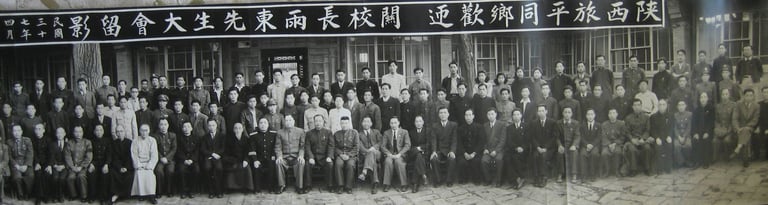
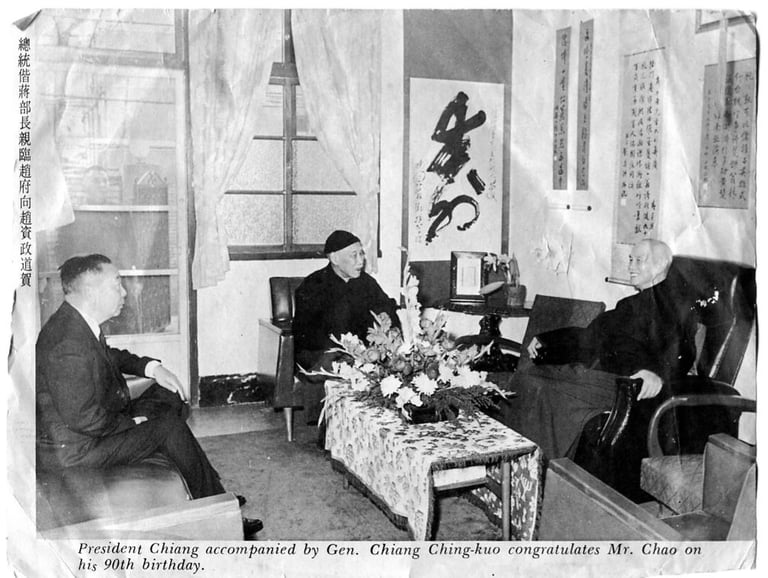
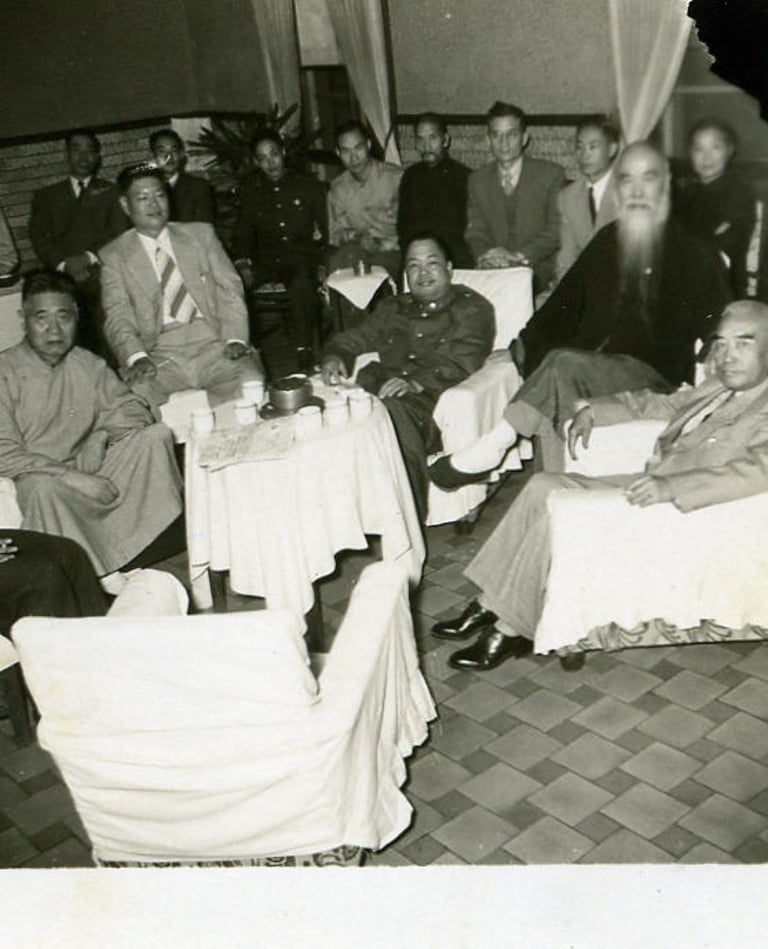
Memories of Reuniting with My Brother in Hong Kong
By Guan Wuzhi
My eldest brother and I had been separated for over thirty years. Living worlds apart, I feared we would never meet again in this lifetime.
However, through the care of the state and the assistance of relevant departments, I finally traveled to Hong Kong on May 23, 1979, to reunite with my brother, his wife, and my nieces and nephews.
I will never forget that afternoon at 5:00 PM. I had traveled from Guangzhou to Hong Kong, and my family was waiting at the train station.
As I stepped off the carriage and searched the crowd, my eldest niece, Bokun, was the first to recognize me. My nephews and nieces rushed toward me, calling out affectionately, "Aunt! Second Aunt!"
Looking at the faces before me—each bearing the striking resemblance, mannerisms, and voices of my brother and his wife—I was overwhelmed by a flood of emotions. But the moment that moved me most was seeing my brother and sister-in-law walking toward me.
As siblings reunited, we held each other and wept. We had a thousand things to say, yet in that moment, we didn't know where to begin.
After a long while, my brother said sorrowfully, "My dear sister, if we had met anywhere else, I wouldn't have even recognized you!"
My sister-in-law held my hand tightly, her eyes welling with tears as she comforted us: "Reuniting with Wuzhi is a joyous occasion. Let us not be sad anymore."
Truly, this reunion after such a long separation felt like a dream. Reflecting on the past while facing the present, my mind was filled with a myriad of thoughts...
When we parted, my brother was in his prime;
Now, his hair is as white as frost.
In those days, I was but a child;
Now, the passing years have brought me to middle age.
After leaving the station, we drove to the hospital to visit my second brother, Linzhao, who was ill.
Seeing him and my second sister-in-law brought another wave of tears; that mixture of grief and joy is truly beyond the power of words to describe.
Days of Family Joy
We spent three months together, day and night. We spoke at length about the great progress of our motherland and the new face of our hometown.
We shared family stories, caught up on our long years of separation, visited relatives, and went sightseeing.
My brother and his wife looked after me with the utmost care, and my nieces and nephews treated me with great affection. The warmth of these blood ties remains fresh in my memory to this day.
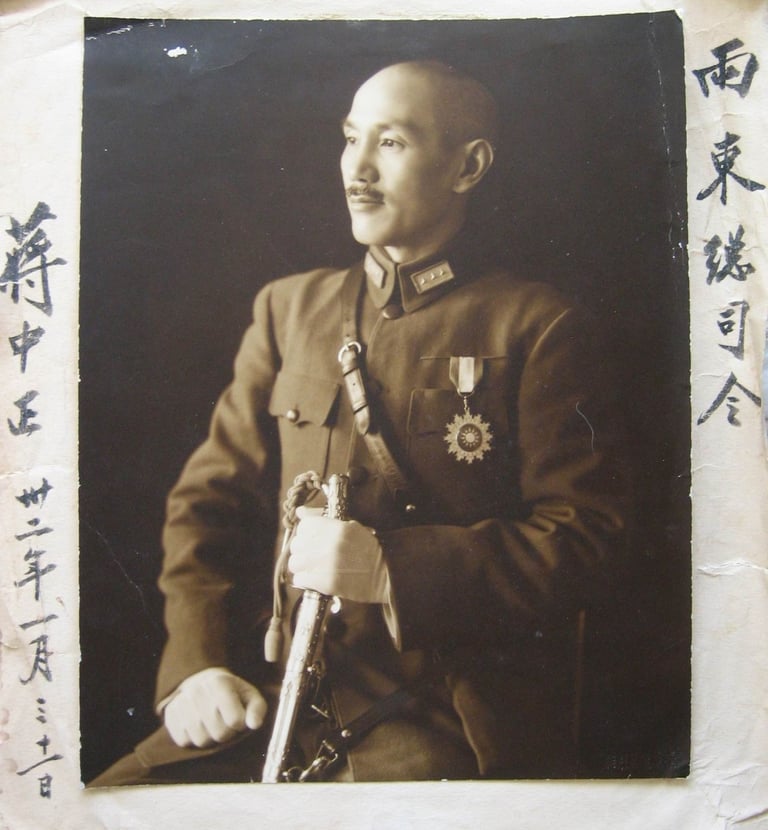
Though my brother was over seventy at the time, his image remained much like my childhood memories: a tall, imposing frame with the commanding presence of a General, yet a warm and hearty personality.
He had a resonant voice and was a brilliant conversationalist. Most notably, he deeply loved the Chinese nation and remained profoundly concerned for its prosperity.
He held filial piety in high regard, cherished his siblings, and never forgot his old friends or his roots. None of these qualities seemed to have faded with time.
A Life of Integrity
On the eve of the national liberation, I heard my brother had gone to Taiwan. It was only after this reunion that I learned the truth: after resigning as Commander-in-Chief of the Army of the Nationalist Government, he chose not to go to Taiwan.
Instead, he lived a quiet, reclusive life in Hong Kong, keeping to himself and maintaining his personal integrity. For a General who was only in his forties at the time, this was a truly remarkable and noble choice.
This decision reflected his upright character and his disdain for fame and wealth. In 1975, following the passing of Mr. Chiang Kai-shek, Mr. Chiang Ching-kuo invited him to the funeral and urged him to take a position in Taiwan.
Many old classmates and former subordinates also hoped he would stay. Yet, he politely declined and returned to Hong Kong.
One day, while chatting in the living room, I teased him: "Big brother, living here all this time, do you no longer love our country?"
"No," he replied. "I love our country deeply. If I didn't, would I have fought the Japanese invaders with such ferocity?"
He then went into his bedroom and brought out a book titled The Famous Anti-Japanese General Guan Linzheng. He told me, "You were too small during the war. Read this, and you will understand your brother."
The Glory of the Battlefield
Over the following days, I read the book and talked with him. I saw a photo of him in a hospital bed at Peking Union Medical College; he looked so young. I asked him about his injuries.
My brother grew pensive as he recounted the battles. In March 1933, Japanese forces invaded the vital Great Wall passes in Rehe and Chahar.
As Commander of the 25th Division, he led his troops north to reinforce the defenses alongside Huang Jie’s 2nd Division.
Upon reaching Shixia, he was ordered to "wait for further instructions." Seeing the urgency of the situation, he knew that if they didn't reach the pass first, they would lose the initiative.
Driven by patriotic fervor, he decisively led over 10,000 men north. They clashed with the Japanese 8th Division at Gubeikou.
After three days of bloody combat, they broke the enemy's momentum, marking one of the first major victories for Chinese forces against the Japanese since the September 18th Incident.
The battle was so intense that even the Japanese had to admit it was the "fiercest among the fierce." My brother commanded from the front lines of the 149th Regiment.
He was wounded in five places by grenades and covered in blood, yet he refused to leave his post until the victory was secured.
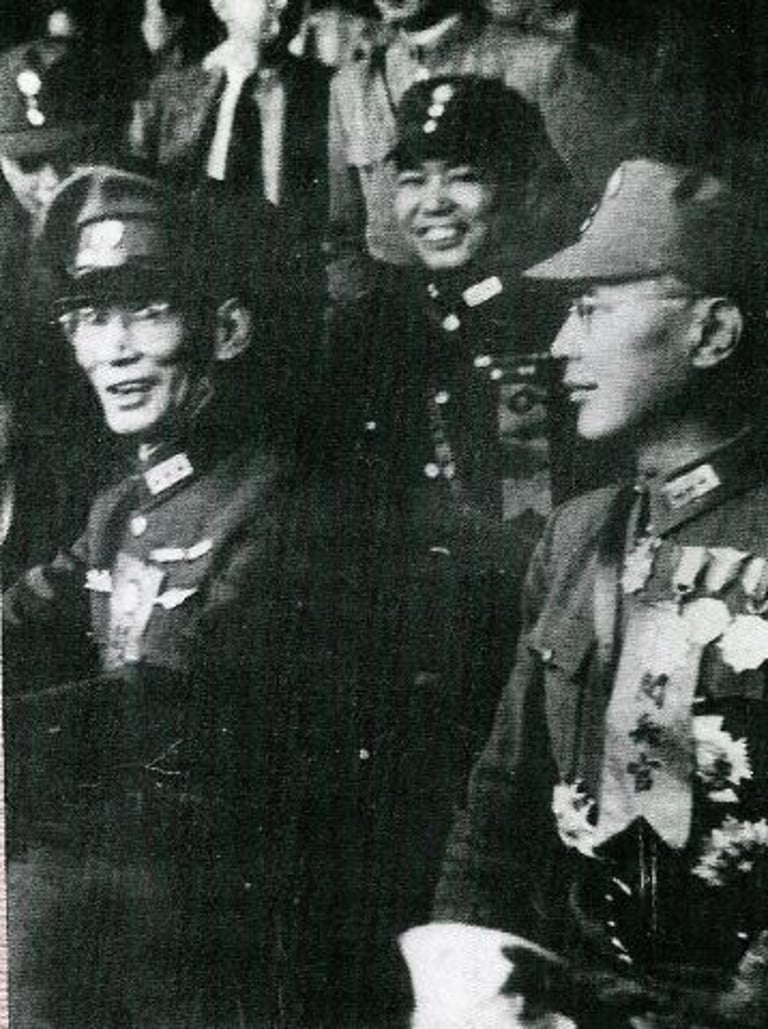
Only then did he go to Beijing for treatment. Because of his bravery, students and citizens flocked to the hospital with flowers.
The Ta Kung Pao newspaper even published an editorial titled "A Patriotic Son Sheds Blood on the Battlefield" to honor his feat. He was only twenty-six years old.
He also spoke of the Battle of Taierzhuang and the Great Victory of Northern Hunan.
In March 1938, as Commander of the 52nd Army, his troops led the main assault at Taierzhuang. It was a brutal struggle. Coordinating closely with other forces, they eventually annihilated over 30,000 of the 50,000 elite Japanese troops.
This victory shocked the world. General Itagaki Seishiro, the enemy commander who faced the 52nd Army, later remarked: "One army under Guan Linzheng should be viewed as the equivalent of ten ordinary Chinese armies."
Later, in 1939, as Commander-in-Chief of the 15th Group Army, he thwarted a 100,000-strong Japanese force attempting to take Changsha.
Using tactics like "luring the enemy deep" and "ambushing from all sides," he crushed the invaders in the famous Great Victory of Northern Hunan.
For his leadership, he received over 100,000 letters and telegrams of gratitude from across the country. He was thirty-three years old.
Listening to these stories, I was moved by his patriotic spirit. From his graduation in the first class of Whampoa to his service in the Eastern and Northern Expeditions and the War of Resistance, he fought with unwavering courage. He fulfilled his duty as a son of China and a soldier.
A Heart Longing for Home
I told him, "The people of our homeland understand you, and their evaluation of your contribution to the war is very high." He stood up and paced the room, looking deeply moved by this sense of being understood and trusted.
"I am a descendant of Yan and Huang," he told me. "I long for the early reunification of our motherland."
His nostalgia for Shaanxi was palpable. He missed the family home in Xi'an and his birthplace in Zhenhuawi Village, Huxian.
He asked about everything: the Bell Tower, the Drum Tower, the Qinqiang opera at Yisu Theater, and the local snacks like mutton paomo.
He remembered the pomegranate trees in our courtyard, the village schools he founded, and even his childhood friends by their nicknames—Wenjie and Huzhu.
During the Dragon Boat Festival in Hong Kong, he insisted on following every Shaanxi custom to the letter.
A Final Farewell
One thing I can never forget was his devotion to our father. Shortly after I arrived, he asked in detail about our father's grave in our hometown.
The next day, he took us all to visit our father’s grave in Hong Kong. He offered incense and performed the traditional rites.
He told me that every year, he brought his children and grandchildren here. He even burned incense for the neighboring graves, hoping they would keep our father company in the afterlife.
On the way back, he spoke of the promise he made to our father on his deathbed: that he would one day return our father’s remains to their ancestral soil.
He said with great unease, "To this day, that wish remains unfulfilled." I comforted him, saying that with travel becoming easier, he would surely be able to fulfill his filial duty.
Tragically, my brother passed away in Hong Kong on August 1, 1980. I never imagined that our reunion would be our final farewell.
I lost a beloved brother, and my sorrow was beyond words. Two generations, father and son, passed away overseas—when will their remains return home?
After his passing, Marshal Xu Xiangqian and many of his old friends and brothers-in-arms from Whampoa sent heartfelt telegrams of condolence.
On the day of the funeral, hundreds of people came to pay their respects. It was a dignified end, a testament to the fact that those who serve their nation are never forgotten by history.
Legacy
My sister-in-law, Xu Xiaoren, was a dignified and virtuous woman, the perfect partner to my brother through decades of joy and hardship.
My brother left behind two sons, four daughters, and over ten grandchildren, now living in Hong Kong and the United States.
They are well-educated professionals, mostly in science and technology. They carry on my brother's legacy, contributing in their own ways to the revitalization and reunification of China.
I have spent my life serving the people, and I know how hard-won our progress has been.
When my brother learned I had been appointed to the Shaanxi Provincial CPPCC, he wrote to a friend: "I hope Wuzhi will seek guidance so she does not fail the trust of the people."
This was his final teaching to me, and I carry it in my heart. Our motherland has a bright future, and as a descendant of the Yan and Huang Emperors, I will do my utmost for its unity and prosperity.
In Memory of My Late Father-in-Law, General Guan Linzheng
By Ke Dashu
Forty years have passed since the Chinese people achieved our historic unity and secured the final victory in the War of Resistance against Japanese Aggression.
Amidst the nationwide and overseas commemorations, I find myself deeply missing my late father-in-law, General Guan Linzheng.
His life was defined by his struggle against Japanese imperialism—or, as he put it, "a life spent fighting the Japanese invaders."
A First Impression of Command
I first met General Guan in the late spring of 1937 at Dayingpan, on the western outskirts of Xi’an, where Shaanxi middle school students were gathered for collective training. He had been invited to deliver a special lecture.
As the military band played, he ascended the podium accompanied by General Song Xilian. Dressed in grass-green fatigues, his towering frame and dignified bearing left everyone with an impression of heroic majesty.
Just as the students stood in hushed silence, a stray dog suddenly darted onto the scene. Before the officer on duty could intervene, the General barked a single word—"Dog!"—and sent the wondering animal scurrying away with a swift kick.
What could have been an embarrassing moment turned into a lighthearted interlude. The students were delighted; they saw that this famous General was a man of bold character who did not stand on ceremony.
Indeed, that small incident captured his essence: he was straightforward, decisive, and detested bureaucracy and empty pageantry.
Lessons in Warfare
The topic of his lecture that day was "Japanese Combat Tactics." Beyond explaining their habitual techniques in attack and defense, he specifically praised the discipline of the Japanese soldiers, their fundamental training, and their superior marksmanship.
He urged the students to take these strengths seriously so that they might one day devise the strategies necessary to achieve victory on the battlefield.
At that time, the full-scale war had not yet begun. He was one of the few commanders in the country who had already clashed with the Japanese, drawing primarily on his experience leading the 25th Division at the Great Wall’s Gubeikou Pass. His words were filled with a patriotic fervor that moved us all.
From Student to Soldier
In April 1938, news of the Great Victory at Taierzhuang electrified the nation. General Guan’s 52nd Army had been a primary assault force in that campaign.
As part of a student comfort mission, I met the General for a second time in a small farmhouse in Southern Shandong.
After offering our respects, another student and I requested to join the army immediately.
General Guan considered this for a moment and said: "You are still young and haven't finished high school. Without proper training, it will be hard to find a suitable role. "
"Go back, finish your studies, and if you wish to join the Whampoa Military Academy later, I will recommend you. If you choose university instead and face financial hardship, I will support you."
After our repeated pleas, he finally relented. He appointed us as "Political Training Officers" at the Army Headquarters. Soon after, I was transferred to the telegraph office to translate confidential telegrams.
General Guan spent his life nurturing the younger generation. Even amidst the chaos of war, he never forgot to cultivate his subordinates.
In the autumn of 1939, he recommended me and four other young colleagues for training at the Whampoa Second Branch School.
Another colleague, a telegraph operator named Mr. Yin, was able to finish university with the General's help.
Mr. Yin, who now resides in the United States, recently wrote to me expressing his eternal gratitude for the "cultivation by Yu-gong" (General Guan’s courtesy name).
Calm Under Fire: The Breakout from Xuzhou
The morning after I received my orders, I was shaken awake by the General's adjutant and hurried onto an open-top car.
In the morning mist, the General and his Chief of Staff, Yao Guojun, sat in the front, while four students, several journalists, and five guards with Mauser pistols squeezed into the back.
We were "breaking out" toward Hubei to regroup. The higher command had decided to abandon Xuzhou, and the enemy was closing in to cut off the Longhai Railway.
As we drove through Xuzhou, the city was a hellscape of flames, ruins, and tides of refugees.
As we sped west on a deserted highway, the sound of artillery grew louder. Passing a small village, the residents fled in terror; we discovered that Japanese tanks had just passed through, leaving fresh tread marks in the dirt.
We found a villager to guide us through the backroads and, near dusk, finally slipped through the enemy lines to reach the 25th Division headquarters.
Upon our arrival, the Division Commander, Zhang Yaoming, reported incredible news: that morning, a battery of Solothurn cannons from the 73rd Brigade had destroyed 12 Japanese tanks near Lizhuang Station.
Despite having not eaten all day, we forgot our hunger and rushed to the battlefield. In the golden light of the setting sun, I counted seven crippled tanks scattered across the wheat fields.
We turned over the body of a young Japanese soldier near a tank—the first time many of us had seen the face of the invader.
On the return trip, emboldened and excited, we sang "The Sword March" at the top of our lungs.
Throughout that perilous breakout, the General remained perfectly composed.
With fewer than ten handguns between us, we would have stood no chance in a direct fight.
Whenever enemy planes appeared overhead, we sought cover while the General stepped out to calmly study military maps and survey the terrain. His "courage without fear" was a stabilizing force for us all.
Leadership and Tactical Wisdom
General Guan’s talent for commanding large formations was widely recognized. He believed a commander’s place was at the front.
Whether in attack or defense, he positioned his headquarters as close to the front line as possible to observe the enemy and boost morale.
He was famously wounded in five places by grenades while leading from the front at Gubeikou in 1933.
Years later, in July 1980, when he was rushed to the hospital in Hong Kong, doctors saw the extensive scarring on his chest and asked what major surgery he had undergone.
They were moved to learn these were the marks of a patriotic general who gave no thought to his own safety.
But he was as clever as he was brave. At the Battle of Ruichang, facing a superior enemy force, he realized his veteran officers were depleted and his new recruits were inexperienced.
He discarded traditional defense methods and instead rotated units by battalion every 24 hours.
This "relay" of fresh troops held the line for 19 days, annihilating countless enemies without losing an inch of ground.
At the Battle of Jinniu, he fulfilled his mission to "hold for one week to cover the evacuation of Wuhan" not by following rigid orders to retreat to a fixed line, but by dispersing his forces to harass the enemy at every step.
This flexibility and independent judgment were hallmarks of his genius.
The Vigil in Yunnan
After the victory in Northern Hunan, General Guan was tasked with defending the border in Southern Yunnan.
For nearly five years, he oversaw rigorous training and devised ingenious defensive plans.
He even built a large sand table in his quarters and encouraged officers of all ranks to debate tactics with him.
He was a strict commander but possessed the humility to listen to his subordinates' ideas.
By the time 1945 arrived, the Japanese had never dared to invade through that border.
Years later in Hong Kong, he would joke with friends: "Back then, I almost wanted to send the Japanese a formal invitation just so we could finally settle scores."
The Quiet Years in Hong Kong
In the winter of 1949, General Guan declined the appointment of Commander-in-Chief of the Army and moved his family to Hong Kong.
He lived a reclusive life, finding joy in reading, calligraphy, and educating his children.
He was a man of deep intellect. During the early days of the Korean War, he accurately predicted the Inchon Landing, much to the amazement of his friends.
Though he held no office, he remained profoundly concerned with the progress of the nation, rejoicing at every report of China’s development.
His main hobby was calligraphy, and his bold, unique style earned high praise in exhibitions. For leisure, he enjoyed movies, particularly traditional operas.
I remember once when the family watched a performance of June Snow; the Shaanxi melodies touched his heart, and he moved to tears by the memories of home.
During holidays, we would have family "operas" where his brother, Linzhao, played the Huqin, the General sang, and I would join in. Those moments feel like only yesterday.
Filial Piety and Legacy
General Guan was a man of profound filial respect. He visited Taiwan in 1975 to attend the funeral of Mr. Chiang Kai-shek, moved by their long history as teacher and subordinate.
While there, he was greeted by hundreds of former students and comrades, a testament to the respect he commanded.
In Hong Kong, he never missed a year visiting the grave of his father, Tree-ming Gong, rain or shine.
He taught his children that "honoring the ancestors" was a fundamental duty.
Today, as I look back on these fragments of the past, I am certain that his contributions to the Chinese nation will be enshrined in history. His was a life of glory, lived without regrets.
Cherishing the Memory of General Guan Linzheng
By Song Xilian
Roots and Early Ambition
General Guan Linzheng, originally named Zhidao and styled Yudong, was born in Zhenhuawai Village, Huxian County, Shaanxi.
His father was a farmer. Despite frequent natural disasters and social upheaval that left the family in poverty and debt, these hardships sparked a fierce ambition in the young Guan Linzheng to strengthen himself and serve his country.
Educated in private schools from a young age, he was deeply influenced by the traditional belief that "great generals and ministers are not born to their rank; a man must forge his own path."
Before reaching adulthood, he was recommended by the renowned calligrapher Yu Youren to join the Whampoa Military Academy. It was there that we became classmates and lifelong friends, closer than brothers.
A Career Defined by Sacrifice
From his entry into Whampoa in 1924 until his retirement to Hong Kong in 1949, General Guan spent 25 years on the battlefield. He commanded hundreds of thousands of troops through the Eastern Expedition, the Northern Expedition, and the War of Resistance.
Throughout his career, he fought in nearly a hundred battles and was wounded six times. He possessed both great courage and strategic brilliance.
He was virtually invincible, building a record of illustrious military service. Two campaigns, in particular, stand as monuments to his career: the defense of Gubeikou at the Great Wall and the Battle of Taierzhuang.
The Defense of Gubeikou (1933)
In the spring of 1933, the Japanese invasion of Northern China created a dire crisis. If the Great Wall fell, Beijing and Tianjin would be lost. In this hour of peril, Guan Linzheng was ordered to lead the 25th Division to hold Gubeikou.
During the march from Beijing, the discipline of his troops was impeccable. They did not press-gang a single civilian or requisition a single cart. The soldiers carried their own cooking gear and supplies on their shoulders, earning them the heartfelt support of the local people.
Upon reaching Gubeikou, before fortifications could even be completed, the Japanese launched a fierce assault with air support and tanks.
General Guan led from the front, exposing himself to extreme danger. Seeing their commander lead by example, the troops were inspired to fight with tragic bravery. Despite heavy casualties, they held their ground and blunted the momentum of the Japanese invasion.
"The Invincible General"
General Guan was wounded during this battle and treated at the Peking Union Medical College Hospital. When news spread, student representatives from across Beijing flocked to the hospital to pay their respects.
The famous journalist Zhang Jiluan published an editorial titled "A Patriotic Son Sheds Blood on the Battlefield," praising Guan’s sacrifice. Even General Huang Jie wrote a poem in tribute, stating: "Everyone says you are invincible; even I could not match your prowess."
Even the Japanese forces at Gubeikou were awed by the prestige of Guan’s troops. Before his wounds had even healed, Guan returned to the front leaning on a cane. From then on, the enemy feared him like a tiger, and his name became a household word alongside Zhang Zizhong as a hero of the resistance.
The Triumph at Taierzhuang (1938)
In the world-renowned Battle of Taierzhuang, a Japanese force of over 50,000 was decimated, with two-thirds of their troops killed or captured.
It was universally acknowledged that the 52nd Army, led by General Guan, fought the most fiercely and eliminated the most enemies. For this, Guan was promoted to Army Corps Commander.
Two aspects of his leadership at Taierzhuang were remarkable:
1. Coordination and Composure: He worked seamlessly with allied forces, maintaining a steady, methodical pace that secured victory step by step.
2. Tactical Ingenuity: He used flanking maneuvers and large-scale encirclements to systematically destroy the enemy. During the pursuit, he gave the Japanese no room to breathe, striking with lightning speed.
The "Fanning the Flames" Tactic
Taierzhuang was a strategic town on the Tianjin-Pukit Railway. The Japanese elite Itagaki and Isogai Divisions attacked with dozens of planes, 40 tanks, and over 100 artillery pieces. They never expected to be met with such a crushing counterattack by the 52nd Army.
Because the enemy was better equipped, General Guan ordered his troops to defend by day and strike by night, surrounding and eliminating the enemy village by village.
When the Japanese retreated into buildings to resist, Guan ordered "fire attacks." Soldiers used ladders to climb onto roofs and set them ablaze, forcing the enemy into the open to be eliminated.
The troops nicknamed this the "Fanning the Flames Tactic"—a testament to General Guan’s creative military mind. This victory revitalized the nation's spirit and forced Western powers to view China with newfound respect.
The Master of Northern Hunan (1939)
General Guan’s military genius reached its peak during the Battle of Northern Hunan. In 1939, acting as Commander-in-Chief of the 15th Group Army, he dealt a head-on blow to 100,000 Japanese land, sea, and air forces.
Under his command, six armies worked as one. Despite the enemy's fierce integrated assaults, Guan remained calm.
His strict discipline and superior fortifications kept the invaders pinned north of the Xinqiang River. The enemy did not dare to cross. It was only due to a strategic order to reposition that the Northern Hunan positions were eventually yielded.
A Legacy of Integrity
General Guan Linzheng was a truly eminent strategist. His unwavering composure and heroic stature remain a model for all soldiers.
In his 20-plus years of command, he was fiercely loyal to the nation and never engaged in factionalism or the pursuit of personal gain for power.
Sadly, after the war, General Guan fell out of favor with those in power. He faced slander and political coldness. Because of his unyielding integrity and refusal to flatter his superiors or drift with the tide, he eventually chose to resign and live in seclusion.
A Final Farewell
In 1980, while traveling to the United States via Hong Kong, I visited my brother Yudong at his home. We embraced and wept, reflecting on the failures of the past. We discussed how the downfall of the Nationalist party was rooted in the selfishness of those in power, who favored cronyism over merit and ignored the "Public Spirit" preached by Sun Yat-sen.
Though we were as close as brothers, I did not know that our meeting would be our last. In August of that year, while in New York, I received the news of his passing with profound sadness.
I write this today to commemorate him, hoping to bring comfort to his soul in heaven.
May 1988, Beijing
Note: Song Xilian (1907–1993) was a high-ranking Nationalist general and a classmate of Guan Linzheng in the first class of the Whampoa Military Academy
Remembering My Dear Friend, General Guan Linzheng
By Li Mo’an
A Bond Beyond the Ordinary
In the autumn of 1928, following the completion of the Northern Expedition, the government reorganized the military. It was then, within the newly formed 11th Division, that Guan Linzheng and I began working together. Our friendship transcended the ordinary.
Guan Linzheng, styled Yudong, was a native of Huxian, Shaanxi. We were classmates in the first graduating class of the Whampoa Military Academy. He possessed the bold, rugged spirit of a northern hero. He detested intrigue, was scrupulously honest in public and private matters, and was a loyal friend who valued honor far above material gain.
Our careers shared many striking parallels:
· We both spent our lives leading troops in combat.
· We both rose quickly through the ranks based solely on battlefield achievements.
· Neither of us ever spent a single day away from our units.
· We both rose step-by-step through every level of command.
· We both shed blood on the battlefields of the War of Resistance.
The "Brotherhood" of the 11th Division
In 1928, I was promoted to Commander of the 31st Brigade, and Guan Linzheng served under me as Commander of the 61st Regiment. Along with our colleague Xiao Gan, the three of us spent a week inspecting our troops together.
We were all young men in our twenties, fired up by the revolution. Our subordinate officers were mostly younger graduates from Whampoa classes 2, 3, and 4. We formed a tight-knit, idealistic group, determined to build a disciplined and effective fighting force.
During this time, a charming anecdote emerged. Guan Linzheng deeply admired the historical hero Guan Yu (Guan Yunchang) from the Romance of the Three Kingdoms. Since there were three of us, he suggested we model ourselves after the famous brotherhood of Liu Bei, Guan Yu, and Zhang Fei.
He called me the eldest (Liu Bei), referred to himself as the second brother (Guan Yu), and called Xiao Gan the third (Zhang Fei). While we had no formal ceremony, this spirit of "Brotherhood" created a legendary culture of unity within our division.
The Conflict with Chen Cheng
General Guan’s later friction with General Chen Cheng is well-known, but it began as a misunderstanding. In 1928, Chen Cheng was the Guard Commander of the General Headquarters, and Guan was a regimental commander under him.
During a meeting, Chen made a negative comment about Guan to Chiang Kai-shek. Rather than accepting it, Chiang scolded Chen for failing to recognize talent. A fellow officer overheard this and told Guan, sparking a lifelong resentment between the two.
Guan was never shy about his dislike for Chen, often expressing it openly. Despite our efforts to mediate, the rift only grew deeper over the years.
A Rare Moment with the Generalissimo
Guan Linzheng once recounted a moving story about Chiang Kai-shek. In August 1927, when Chiang was forced to temporarily step down and return to his hometown in Xikou, Guan rushed there to pay his respects.
Chiang was deeply moved that a student would come to visit him during such a low point. Visibly angry about the political betrayal he faced, Chiang allegedly told his students: "Tell your classmates... I was betrayed. If you go and become bandits, I will be your bandit chief!"
Guan noted that this was the only time in decades he ever heard Chiang use such coarse language, reflecting the Generalissimo’s extreme frustration at the time.
Career Setbacks and Perceived Injustice
General Guan felt there were two major injustices in his military career, both of which he attributed to Chen Cheng’s influence:
1. The Four Front Armies:
Toward the end of the War of Resistance, the government formed four major Front Armies to receive American equipment. Guan was only appointed as a Deputy Commander under Lu Han. Meanwhile, Wang Yaowu—who was a junior graduate from Whampoa Class 3 and had less seniority—was made a full Commander. Feeling insulted and targeted by Chen Cheng, Guan refused to take the post in protest.
2. The Northeast Command:
After the war, Guan was originally told he would be the Commander of the Northeast Security Command. However, at the last minute, the position was given to Du Yuming instead.
Chiang Kai-shek had told Guan that Du Yuming had "mishandled" an incident in Kunming and needed to be punished, and that Guan should take over. Yet, the official orders showed Du being promoted to the prestigious Northeast post while Guan was sent to a secondary position in Yunnan. Guan was furious at this lack of clarity between reward and punishment. He only accepted the post out of personal loyalty to Chiang.
Reflections on History
General Guan believed that sending Du Yuming to command the Northeast was a strategic disaster. He felt Du lacked the necessary battlefield experience to lead hundreds of thousands of men against the Red Army. Guan predicted Du’s defeat, noting that while the final collapse happened after Du left, the foundation for failure was laid under his watch.
General Guan was a man of immense talent and fierce pride. His life reminds us that in the theater of war and politics, personal integrity and professional brilliance are often met with complex challenges.
August 20, 1987, Washington D.C.
Mourning General Guan Yudong
By Huang Jie
Originally published in "Biographical Literature," Taiwan, Vol. 37, No. 3
A Poem for a Comrade
In 1933, when the defense of the Great Wall was at its peak, I wrote a poem for General Guan Linzheng, who was then the Commander of the 25th Division.
At the time, I was the Commander of the 2nd Division, and I had been ordered to lead my troops north to repel the superior Japanese forces near Gubeikou. It was on that battlefield that General Guan and I began fighting side-by-side. The poem read:
To the Great Wall to slay the invaders,
Together we rode into the grand plan.
Flesh and blood fly across the natural moats,
As beacon smoke blends into the vast void.
The East has just lost its defenses,
And Gubeikou has become a ruin.
Everyone says you are invincible;
In facing such hardships, I cannot match you.
The Whampoa Bond
We both entered the Whampoa Military Academy in May 1924 as members of the 1st Class, 3rd Company. We were very close, though after graduation, our duties often sent us to different battlefields across the north and south.
General Guan, a native of Shaanxi, embodied the rugged and bold character of the Qin and Long people. He was warm and bright toward his classmates, yet deeply loyal and respectful toward our teachers and superiors.
In those days, we were young students filled with a sincere desire to save the nation. Our shared goal was "to be wrapped in a horse’s hide" (to die for one's country). Guan’s bravery in battle showed he was always ready to make that ultimate sacrifice.
The Fish Bone Incident
I remember a lighthearted detail from our days at Whampoa. Every meal usually included fish. Since General Guan grew up in inland Shaanxi, he likely hadn't eaten much fish and was terrified of getting a bone stuck in his throat.
Whenever fish was served, he became incredibly serious. He strictly forbade any of us from speaking while he ate. Years later, we often teased him about this at reunions, and he always took it with a good-natured smile. These small details revealed his careful, disciplined personality.
Innovation at the Front: "Reverse Slope Defense"
In March 1933, the 25th Division engaged the Japanese at Gubeikou. Facing heavy bombardment from planes and artillery, our troops—with their inferior equipment—suffered severe casualties. General Guan was slightly wounded, and his division withdrew to defend Nantianmen.
I led the 2nd Division to take over his defense on March 13. During our meetings at the front, we studied the enemy and devised a new defensive method.
We decided to dig our foxholes and trenches behind the ridgelines so that the Japanese artillery and planes couldn't hit us directly. This gave birth to the tactical term "Reverse Slope Operation." We also used our high morale to launch unexpected counter-attacks. I still keep a photo of us sitting on the floor of a small temple in the middle of that battlefield.
A Friendly Rivalry
After the fighting ceased, our divisions were stationed near Beijing for training. Being in the same area, we spent much time together, attending gatherings and going on outings.
General Guan once visited my 2nd Division to watch our training. When he saw that our cavalry horses could "lie down" on command, he didn't say a word.
About two months later, he invited me to see the 25th Division training. He showed off his cavalry and said proudly, "Look! My horses can lie down, too!" Only then did I realize he had visited me specifically to see what he needed to improve. That was his competitive spirit—he always wanted his unit to be the best.
The Student Training Crisis
In the spring of 1935, we were both tasked with training high school students for military service. This was part of Chiang Kai-shek’s secret preparation for the coming war.
The Japanese realized what we were doing and forced the government to disband the training after only two months. I remember the day of the dismissal; the students were filled with grief and rage, many weeping as they swore to avenge the national humiliation. Many of those students later joined the resistance.
The "Guan 40 Cents" Joke
During the Xi'an Incident in 1936, we were both stationed in Xi'an. General Guan hosted a banquet for our classmates at the West Beijing Guesthouse.
He asked the waiter how much a bottle of Shaoxing wine cost. The waiter replied, "Si Mao" (0.40 yuan). Guan thought this was a great bargain and mentioned it so often that we playfully nicknamed him "Guan Si Mao" (Guan 40 Cents).
From Glory to Seclusion
During the War of Resistance, Guan’s finest hour was the Battle of Changsha, where he scored two major victories as Commander of the 52nd Army.
By 1944, we met again in Yunnan. He was a Group Army Commander defending the southern border, while I defended the west. By then, the Japanese were at the end of their strength, a far cry from the desperate days we faced in Northern China.
Our final meeting in mainland China was in Guangzhou in 1949. The spirit of our youth was gone, replaced by the heavy sorrow and anxiety of the changing times. We lost contact when I led my troops into Vietnam, and I only learned in 1952 that he was living in Hong Kong.
Final Farewell
In 1975, when Generalissimo Chiang Kai-shek passed away, General Guan flew to Taiwan to pay his respects. I met him at the airport. When we saw each other, we embraced and wept—a moment that feels like it happened only yesterday.
General Guan passed away in Hong Kong on August 1, 1980. Looking back on 50 years of friendship, I feel both the joy of our shared youth and the sadness of our final parting. He was a pillar of our nation and a model of loyalty among our classmates.
(Originally published in "Biographical Literature," Taiwan, Vol. 37, No. 3)
Key Achievements in the War of Resistance
By Tan Yizhi and Yao Guojun
Introduction
General Guan Linzheng was a graduate of the first class of the Whampoa Military Academy. We were his fellow students and his colleagues over many years, and we know well that he gave his strength and shed his blood for the nation — in the Eastern Expedition, the Northern Expedition, and throughout the War of Resistance Against Japan. The courage, patriotism, and outstanding battlefield record he displayed in engagement after engagement during the war against Japan won the admiration of all who witnessed it. We wish to set down here, based on our own firsthand experience, a concise account of his contributions in these years.
His Patriotic Record as a Division Commander
In 1932, Guan Linzheng was promoted from brigade commander of an independent brigade in the 4th Army to commander of the 25th Division. By this time, the Japanese invaders had already seized the three provinces of northeast China and were actively preparing to advance on north China.
In January 1933, they seized Shanhaiguan. In late February they attacked Rehe, and by early March had occupied the entire province, launching assaults along the Great Wall against the forces of Song Zheyuan at Xifengkou, Shang Zhen at Lengkou, and the Northeast Army at Gubeikou.
Public feeling in Beijing, Tianjin, and Hebei was running high, with widespread calls for resistance. Faced with demands from civic organizations in north China and from Zhang Xueliang for troops to be sent north to reinforce the fighting, the Nationalist Central Government decided first to dispatch Guan Linzheng's 25th Division by rail from Xuzhou to concentrate near Tongzhou outside Beijing, followed by Huang Jie's 2nd Division near Baoding, both under the command of He Yingqin.
When the 25th Division reached Tongzhou in early March 1933, it received an urgent message from Zhang Xueliang — then acting chairman of the Beijing branch of the Military Affairs Commission — reporting that the situation at Gubeikou was critical and requesting that Guan Linzheng bring the entire 25th Division forward to reinforce.
Guan Linzheng kept the broader picture firmly in mind. He immediately assembled his officers and men, spoke to raise their morale and steady their resolve, then set the division moving toward Gubeikou through the night while wiring reports to Chiang Kai-shek and He Yingqin.
En route, he received a telegraphed order from He Yingqin, conveyed also through a senior staff officer sent in person, ordering the division to halt and await orders near Shixia, north of Miyun County.
The March North — Defying Orders to Save the Line
Guan Linzheng considered this carefully. If the division stopped mid-march, the enemy might seize Gubeikou and the vital defensive line at Nantianmen to its south — a development that would endanger not only the allied units fighting along the Great Wall but Beijing itself, with grave consequences for the entire situation in north China. He resolved to press on toward Gubeikou.
When brigade commander Du Yuming led the advance elements into Gubeikou, the Northeast Army division under Zhang Tingzhu had already suffered heavy casualties and could barely hold on, urgently requesting that the 25th Division relieve its positions. As Guan Linzheng himself arrived, Zhang Xueliang sent Northeast Army commander Wang Yizhe to meet him and formally request an immediate relief of Zhang Tingzhu's defensive line.
To hold the enemy, Guan Linzheng decided to commit the main body of the 25th Division to taking over the Gubeikou line, with a portion occupying key positions on both sides near Nantianmen as a reserve line. After conducting personal reconnaissance and assigning tasks to each unit, he executed the relief of the entire Gubeikou line in a single move at dusk, and through the night his men worked to strengthen their fortifications.
Three Days and Nights at Gubeikou
The Chinese forces held the Great Wall ridgelines on both sides of Gubeikou, with the main effort on the high ground to the right. These heights were steep and easily defended; not surprisingly, the Japanese made them the focus of their attack. Heavy fighting broke out the very morning after the 25th Division took over. Our forces were equipped only with rifles, light and heavy machine guns, mortars, and grenades.
Facing them across the Gubeikou front was the Japanese 8th Division, with a marked advantage in weapons and equipment. Our troops had high morale and the edge in close-quarters fighting. The Japanese method was to open with mountain and field artillery bombardments while aircraft flew continuous reconnaissance and bombing sorties to cover the infantry's advance. Wherever the Japanese artillery concentrated its fire, that was where their infantry would attack. Under artillery cover, Japanese infantry launched multiple assaults on our positions — all were repulsed, at heavy cost to both sides.
Guan Linzheng wired reports to Chiang Kai-shek, He Yingqin, and other commanders. What moved everyone deeply was that civic organizations in Beijing sent trucks continuously to the front carrying flatbreads and padded clothing for the troops, a gesture that greatly encouraged the officers and men. The division commander and every brigade and regimental commander was personally present directing the fighting.
After nightfall, our forces took advantage of the lull in enemy artillery to press on with strengthening their positions. On the second day, Japanese guns pounded our lines front and rear without pause, covering infantry in repeated attacks — all repulsed. By the third morning, the enemy had reinforced its artillery and turned it with great ferocity on our right flank positions held by the 149th and 145th Regiments, covering wave after wave of infantry assaults. Fierce close-quarters fighting broke out repeatedly.
The 149th Regiment's commander, Wang Runbo, was wounded and killed in action. The 145th Regiment, its casualties mounting beyond endurance, also called for reinforcement. Guan Linzheng personally directed a reserve battalion forward to assist. As it neared the 149th Regiment's position, the enemy infantry crested the line — Guan Linzheng at once ordered the reserve to counterattack. The fighting was desperate, casualties heavy on both sides.
Wounded but Unbowed
Guan Linzheng himself was wounded in five places by Japanese grenade fragments. But the enemy assault was broken and the line held. Carried by stretcher to division headquarters — situated in the Guandi Temple near Gubeikou — while still being treated for his wounds, he ordered brigade commander Du Yuming to assume the role of deputy division commander and continue directing the battle in his place, and wired reports to Chiang Kai-shek and He Yingqin.
By this point the division had suffered over one thousand killed. Guan Linzheng instructed his deputy that if circumstances required it, the line could be withdrawn to the reserve positions near Nantianmen. Deputy Commander Du Yuming acted on this guidance that night, shortening the front line, strengthening fortifications, and sending a regimental commander to reinforce the reserve positions.
On the fourth morning, Japanese artillery continued its bombardment, but the enemy infantry — its losses severe — could no longer mount the furious assaults of the previous three days. Our forces seized the opportunity and that afternoon began a phased withdrawal from the first line to the Nantianmen reserve positions. During the withdrawal, the Japanese, apart from artillery fire and air reconnaissance, made no attempt to advance.
After three days and nights of fierce combat with the Japanese 8th Division at Gubeikou, the 25th Division withdrew to Nantianmen. Only at dawn of the following day did the advance elements of Huang Jie's 2nd Division arrive near the 25th Division headquarters and make contact with Deputy Commander Du Yuming. Orders were received for the 2nd Division to relieve the Nantianmen line while the 25th Division moved to the rear to rest and be replenished.
The Battle of Gubeikou had a decisive bearing on the entire campaign along the Great Wall. After Guan Linzheng was wounded, civic organizations and newspapers in Beijing sent warm expressions of sympathy and praise. The Nationalist Central Government awarded him the Order of Blue Sky and White Sun.
After a brief period of rest and replenishment, the 25th Division moved back to the front to fight alongside the 2nd Division. Guan Linzheng, his wounds not yet healed, returned to command his troops in the field. Not until the end of April did he receive orders to withdraw north of Miyun County and take up positions for further operations — but the Japanese, having seized the area from Nantianmen to Shixia, made no further advance.
Withdrawal, Commendation, and a Soldier's Grief
At the end of May 1933, the 25th Division was ordered to concentrate near the northern outskirts of Beijing for rest. As Guan Linzheng departed Miyun County and saw the fear in the faces of the local people — terrified that the Japanese army would come — he could not hold back his grief and wept: "The government has ordered a withdrawal without regard for the safety of the people. We have truly let them down." Only later did they learn that China had signed the Tanggu Truce, requiring Chinese forces to withdraw from the area.
After the Tanggu Truce, Huang Jie's 2nd Division was garrisoned between Beijing's Nanyuan and Baoding for training. Guan Linzheng's division concentrated in Beiyuan in the northern suburbs of Beijing for training and reorganization.
Ordered South — The He-Umezu Agreement
In early June 1935, the Beijing branch of the Military Affairs Commission was compelled to sign what became known as the He-Umezu Agreement with the commander of Japanese forces in north China, General Umezu. Among its terms was a provision requiring Nationalist central forces, the military gendarmerie, and the Northeast Army's 51st Corps to withdraw from Beijing and Hebei Province.
Guan Linzheng made a heartfelt appeal to He Yingqin: "If we withdraw from Beijing and Hebei without a fight, we will lose the hearts of the people and damage the authority of the central government." He strongly urged that preparations be made to fight. He also wired Chiang Kai-shek directly, stating in effect: "A withdrawal from Beijing and Hebei without resistance would greatly damage your authority." At the same time, he ordered all units of the 25th Division to immediately begin constructing defensive positions in the outskirts of Beijing in preparation for battle with the Japanese.
These appeals were not approved. The 25th Division was ordered to concentrate near Changxindian and entrain for training at Luoyang in Henan. Huang Jie's 2nd Division was ordered to Xuzhou in Jiangsu.
While concentrating near Changxindian before departing south, Guan Linzheng was visited by teachers from Beijing schools who had come especially to see him off. He expressed his deep pain at being ordered south against his will, at having failed to fulfill his duty to resist the Japanese invaders, and at having fallen short of the expectations of Beijing's people. He said he believed that the patience of the government and the nation had its limits — that the time would come when everyone would unite to resist Japan together. He bade farewell with great reluctance.
In June 1935, as Guan Linzheng was leading the 25th Division to Luoyang and passing through Zhengzhou, he received a telegram from Chiang Kai-shek, then in Sichuan, summoning him immediately to a meeting. This was during the period when Chiang was in the Emei Mountain area directing Nationalist forces against the northward-marching Red Army. After meeting with Chiang Kai-shek, Guan Linzheng returned to Luoyang. He said privately to us afterward: "The Generalissimo is still holding to the policy of pacifying internal affairs before resisting external threats — the idea of eliminating the Communist Party first. But there is no way to do it. The Communist Party has a foundation among the people and international connections. It cannot be eliminated."
Not long after the 25th Division arrived at Luoyang from Beijing, Chiang Kai-shek sent Kang Ze to Luoyang to visit Guan Linzheng and address the troops of the 25th Division. He offered a few words of praise for the 25th Division's resistance at Gubeikou, but his main theme remained the familiar line: pacify internal affairs before resisting external threats.
The Battle of Baoding
In July 1937, Japanese forces launched the Marco Polo Bridge Incident and began attacking the Chinese garrison in Beijing and Tianjin under Song Zheyuan. On July 30th, Beijing and Tianjin fell in succession.
The full-scale War of Resistance had begun. By this time Guan Linzheng had been promoted to commander of the 52nd Corps, comprising the 25th and 2nd Divisions. In August he received orders to move via the Longhai and Jinpu railways to concentrate near Cangzhou in Hebei Province in preparation for battle. On arrival at Cangzhou, he was redirected to concentrate near Baoding and await orders. Japanese forces were then engaged with the troops of Tang Enbo and Fu Zuoyi near Nankou, and had already begun crossing the Yongding River in preparation for a southward advance.
Guan Linzheng arrived at Baoding with the 52nd Corps in early September, coming under the command of Second Army Group commander Liu Zhi. He was ordered to occupy positions along the south bank of the Cao River between Baoding and Mancheng, construct fortifications, and prepare for battle. North of the Baoding line, the area around Liangxiang and Fangshan was defended by Sun Liangzhong's 1st Corps.
In mid-September, three divisions of the Japanese 1st Army advanced along the Beiping-Hankou railway and attacked Sun Liangzhong's positions at Liangxiang and Fangshan. When Liangxiang and Fangshan fell, Sun Liangzhong's forces withdrew southward through Zhuoxian, Xushui, and Baoding. Throughout this period, Japanese bomber formations conducted continuous raids on the outskirts of Baoding and on Mancheng.
Liu Zhi's headquarters, initially in the South Garden inside Baoding, moved to a village south of the city after being bombed. Many buildings in the city and the railway station outside were destroyed by Japanese aircraft. The building housing the 52nd Corps headquarters was also bombed flat — its staff had been dispersed and suffered no casualties.
On September 20th, Japanese forces began attacking the Chinese positions along the south bank of the Cao River between Baoding and Mancheng, concentrating their assault on the left-flank positions of the 25th Division near Mancheng. The 149th Regiment of the 25th Division, defending near Mancheng, fought for two days and two nights under encircling attack by superior enemy forces, losing more than half its officers and men.
As the Japanese launched a full assault along the entire Cao River line to the outskirts of Baoding, Guan Linzheng requested reinforcements from Liu Zhi for the 25th Division's exposed left flank near Mancheng. Liu Zhi said the 3rd Army was on its way. The 3rd Army never came. Liu Zhi's headquarters had already left the Baoding area without notifying anyone, and contact with the 52nd Corps was completely lost.
After three days of fierce fighting against the Japanese 1st Army along the Cao River line between Baoding and Mancheng, with heavy casualties, and with the 47th and 17th Divisions that had been temporarily placed under Guan Linzheng's command already withdrawing southward toward Baiyangdian, and Japanese forces that had broken through the Cao River front pushing along the railway in an attempt to encircle Baoding, Guan Linzheng — unable to reach higher command for guidance and determined to avoid encirclement — ordered the 2nd and 25th Divisions to abandon their positions and withdraw to the south bank of the Tang River south of Baoding. The Japanese occupied Baoding on September 24th.
After the 52nd Corps withdrew from the Baoding-Mancheng line to the south bank of the Tang River, it was ordered to Shenzhe County for rest and reorganization. Japanese forces continued their southward advance along the Beiping-Hankou railway, successively taking Dingxian, Zhengding, and other points, leaving Shijiazhuang threatened on three sides. The 52nd Corps received orders from 1st War Zone commander Cheng Qian to move gradually south along the east side of the railway to the area south of the Zhang River for reorganization and replenishment in preparation for further operations.
The Battle of the Zhang River
On October 13, 1937, Japanese forces occupied Handan and Cixian north of the Zhang River. Guan Linzheng's 52nd Corps was ordered to move via Linxian around to the vicinity of Shexian, using Shexian as its base for operations toward Pengcheng, Wu'an, and other areas, conducting continuous day and night raids against Japanese forces near Handan and Cixian.
Operating under cover provided by local farmers, the corps moved with great secrecy and effectiveness. The enemy, shut up inside Handan and Cixian, was entirely on the defensive. Outside the city, the Japanese airfield held over a dozen aircraft and fuel depots, with perimeter defenses consisting only of an infantry company and no wire entanglements.
Burning the Airfield at Handan
Guan Linzheng selected from the 25th Division a resourceful and courageous battalion commander named Liang Zhiwei, who first took a small party of men in civilian clothes to reconnoiter the villages near the airfield, organizing the local farmers to cooperate in the operation and arranging for all dogs in the surrounding villages to be controlled so as not to betray nighttime movements. The entire battalion was then divided into an assault team and a fire-setting team, which concealed themselves in the darkness before the attack.
After midnight, catching the enemy off guard, the assault team broke through the perimeter defenses of the airfield and surrounded the enemy garrison barracks. The fire-setting team rushed into the airfield and set the Japanese aircraft and fuel depots ablaze. The enemy garrison, surrounded by the assault team and unable to fight the fire, could only watch as flames leapt skyward and explosions thundered like rolling thunder. Japanese forces inside Handan could only fire blindly from the city walls, too afraid to come out. Liang Zhiwei's battalion destroyed the enemy aircraft and withdrew without loss.
1st War Zone Commander Cheng Qian immediately issued a commendation, promoting Battalion Commander Liang Zhiwei to the rank of major and regimental commander within the 25th Division, and awarding bonuses to every man in the battalion.
The Japanese garrison at Handan had suffered heavy losses under our continuous raiding. After October 20th, the Doihara detachment of the 14th Division arrived to reinforce the Handan-Cixian area and attempted a counterattack. Guan Linzheng received orders to bring the main body of the 52nd Corps back to the south bank of the Zhang River, to assist the allied forces under Shang Zhen in defending the Zhang River line, while leaving one infantry regiment north of the river to continue guerrilla operations.
Around the end of October, the Doihara Division began attacking the Zhang River line. A portion of its forces crossed the river at night near Dongxi Baozhang. Guan Linzheng immediately ordered a brigade of the 2nd Division to move through the night and surround the Japanese forces on the south bank, while ordering an infantry regiment of the 25th Division on the north bank to strike the enemy's rear hard in coordination. Caught between hammer and anvil, the Japanese suffered severe losses and fell back to the north bank in disorder. In the fighting, Regimental Commander Zeng Qian was killed in action, thirteen field-grade officers were killed or wounded, and total casualties approached one thousand. Both sides then settled into a confrontation across the Zhang River.
Having suffered significant casualties, the 52nd Corps was ordered to Xinxiang, Qixian, and nearby areas on the north bank of the Yellow River for rest and replenishment. The Zhang River south bank positions were handed to allied units. Guan Linzheng subsequently received orders to rest the 52nd Corps for a week near Zhengzhou before moving to the Luohe area for reorganization and replenishment.
Three Months of Rebuilding
In the three months of rest and reorganization following the Zhang River battle, the corps reviewed the lessons of its fighting from Gubeikou onward, intensified combat training and patriotic education, and built a rock-solid conviction that the War of Resistance would ultimately be won. Officers at every level also deepened their study of command. Guan Linzheng himself, during this period of overseeing the training and education of his troops, found time to read army college textbooks, military history, combat doctrine, tactical exercises, and the ancient works on the art of war. Three months of training, reorganization, and replenishment produced a substantial improvement in both the political quality and the fighting power of the corps.
The Battle of Tai'erzhuang and the Beipi Operations
The Battle of Tai'erzhuang and the northern Pei operations demonstrated Guan Linzheng's gifts as a commander — his courage, his decisiveness, his cool judgment under pressure, and his ability to turn a passive position into an active one by reversing an attempted encirclement against the enemy. His actions played a significant role in reversing the difficult position our forces had found themselves in near Tai'erzhuang and contributed to the ultimate victory in that battle.
In the northern Pei operations, Guan Linzheng directed the 52nd Corps in nearly a month of continuous fighting against the Japanese 5th Division, inflicting casualties exceeding half its strength, dealing it a serious setback, and demonstrating the 52nd Corps' fighting power and Guan Linzheng's own — and his commanders' — unflagging spirit of perseverance.
The Battle of Tai'erzhuang and the Beipi operations played a decisive role in the victory of the Xuzhou campaign as a whole.
The Road to Tai'erzhuan
When the battle opened, the Japanese 10th Division had sent only the Seya Detachment — a reinforced brigade — south along the Jinpu Railway. On March 16, 1938, it attacked Tengxian and fought for three days against Wang Mingzhang's division of Sun Zhen's Sichuan Army; Wang Mingzhang died heroically in the fighting. The Seya Detachment seized Tengxian on March 18th, continued south, and by March 23rd had taken Lincheng and Zaozhuang.
The Nationalist 52nd and 85th Corps, under Tang Enbo's command, concentrated near Xiangcheng northeast of Tai'erzhuang on March 21st to intercept the Seya Detachment. At the same time, three divisions of Sun Liangzhong's Army Group were constructing defensive positions near Tai'erzhuang in preparation for defense.
The 52nd Corps arrived at Xiangcheng on the evening of March 22nd and received orders to advance toward Zaozhuang on March 24th. That evening it reached the area of Guoli concentration north of Yixian County, where it encountered and destroyed an enemy advance guard — a reinforced company of the Seya Detachment.
Interrogation of a captured Japanese sergeant revealed that the main body of the Seya Detachment's 63rd Regiment had concentrated south of Yixian on March 22nd in preparation for an attack on Tai'erzhuang, with remaining forces near Lincheng preparing to advance on Yixian, and one battalion in Zaozhuang.
Guan Linzheng proposed to Tang Enbo that the 52nd and 85th Corps combine their full strength in an immediate attack on the main body of the Seya Detachment. Tang Enbo instead decided to conceal both corps in the hill country north of Yixian, wait for the Seya Detachment to move south from Yixian toward Tai'erzhuang, and then strike it by surprise. This overrode Guan Linzheng's recommendation.
The Seya Detachment's 63rd Regiment attacked Tai'erzhuang from March 24th to 27th, and the detachment's main body moved south from Yixian toward Tai'erzhuang on March 30th.
Flanking the Enemy — The Attack Begins
Guan Linzheng led the 52nd Corps south on March 27th and from March 28th began attacking the flank and rear of the Japanese forces advancing on Tai'erzhuang. By March 29th, his forces had seized Nanbei Luo and Beidajiao north of Tai'erzhuang in fierce fighting. The Japanese launched several counterattacks to retake these positions — all were repulsed.
On the afternoon of March 31st, Tang Enbo arrived with the 85th Corps at Henanhou and Yangjia Temple northeast of Tai'erzhuang. From April 1st, the 85th Corps took over the 52nd Corps' left flank and pressed its attack on Japanese forces northeast of Tai'erzhuang. The two corps together launched a fierce assault on the flank and rear of the Seya Detachment's main body attacking Tai'erzhuang, cutting rail communications north of the town, creating an encirclement, and sending a portion of the force westward toward Nigou beyond the rail line.
Japanese forces attacking Tai'erzhuang pulled out units from their assault force to counterattack our flanking forces — all counterattacks were repulsed. Then, on the afternoon of April 1st, as the 52nd and 85th Corps were in the midst of encircling and attacking the Seya Detachment's main body, reports came in that the Sakamoto Detachment of the Japanese 5th Division — infantry, cavalry, and artillery, some four thousand men — was moving south from Linyi, with its advance elements already near Xiangcheng.
Turning the Tables — The Sakamoto Detachment Destroyed
Guan Linzheng judged that this force intended to encircle and attack our flank and rear while reinforcing the Seya Detachment. Acting quickly, he immediately sent an infantry battalion and a cavalry company from the corps command area running at full speed toward Lianling Town to deploy and engage this enemy head-on, forcing it to deploy prematurely and buying time for the 52nd Corps to disengage forces from the front to meet the threat.
He then shifted the 25th Division to face this new enemy, while the 2nd Division continued to cooperate with the 85th Corps in encircling and attacking the Seya Detachment. Guan Linzheng personally directed the 25th Division in a fierce assault on the Sakamoto Detachment, encircling it completely. Under cover of darkness the enemy fled toward Yanglou and Dijiao, while the cavalry unit was surrounded and destroyed in its entirety at Fuzhuang northwest of Lianling.
On April 3rd, the 25th and 2nd Divisions encircled the main body of the Sakamoto Detachment near Yanglou and Dijiao and attacked. That day they seized both positions, inflicting heavy casualties. Under cover of darkness the remnants fled southwest to the area of Xiaowang.
Our forces pursued and encircled the Sakamoto Detachment again near Xiaowang, attacking it continuously from April 4th through April 5th. On the evening of April 5th, the Sakamoto Detachment wired the Seya Detachment: "Our detachment is surrounded by two enemy divisions near Xiaowang and is fighting hard" — requesting reinforcement. But the Seya Detachment, under counterattack by the 85th Corps and Sun Liangzhong's forces, could not respond.
After continuous encirclement and assault, the Sakamoto Detachment's casualties were severe. Under cover of darkness on the night of April 7th it broke out northward. The 52nd Corps pursued it to the vicinity of Yixian, seizing Jiushan and nearby villages east of the county town. The Seya Detachment, hit from front and rear near Tai'erzhuang, suffered devastating losses and fled west of Yixian in disorder. Our forces achieved the stunning victory of Tai'erzhuang.
On April 21st, while our forces were engaged near Yixian with Japanese 10th Division reinforcements, the main body of the Japanese 5th Division began moving south from Linyi in an attempt to link up with the 10th Division and encircle our forces.
The 52nd Corps received orders to withdraw from the Yixian area on the evening of the 21st and move to the area north of Pixian County, occupying positions between Aishan and Yanzihe by the morning of April 22nd — the 25th Division at Aishan, the 2nd Division at Daliu and Xiaoliu villages between Aishan and Yanzihe.
The Beipi Defensive — Holding Against the 5th Division
Under Guan Linzheng's command, the 52nd Corps' fighting north of Pixian against the Japanese 5th Division proved to be the longest in duration since joining the Tai'erzhuang battle — from late April to mid-May — the most intense in combat, and the costliest in casualties on both sides. Our forces occupied favorable terrain, improved their fortifications, maintained close coordination between infantry and artillery to create dense fields of fire, and set the flat open ground in front of the positions so that the enemy, attacking from any direction, came under our combined infantry and artillery fire.
From April 23rd through the end of April, the Japanese launched continuous attacks on the 25th Division's positions — all were thrown back with heavy losses, the enemy leaving behind large numbers of dead and weapons in front of our lines.
After these failures against the 25th Division, the enemy waited several days before reinforcing and attacking the 2nd Division's positions at Daliu and Xiaoliu villages. The first assault came at dawn under air and artillery cover — in the open wheat fields before our positions, the attackers were struck by dense fire from our infantry and artillery and flanked by the 25th Division, suffering heavy losses and retreating in disorder.
Two days later, the enemy again crept up to our positions at night and launched a fierce dawn assault with air and artillery support. Again our defenders counterattacked, and again the enemy withdrew in disorder after suffering severe casualties.
Three days after that, the Japanese reinforced and launched an all-out assault on the 2nd Division's positions at Daliu and Xiaoliu. The fighting was the most intense yet seen. The 25th Division brought all its weapons to bear from the Aishan heights, striking the enemy in the flank and cooperating with the 2nd Division's defense. Guan Linzheng and his division and brigade commanders went to the front lines in person to direct the counterattack. The enemy again suffered severe losses and withdrew in disorder. In front of the 2nd Division's positions, the wheat fields were strewn with enemy dead and weapons — over two hundred enemy rifles and more than ten light machine guns were collected afterward, along with countless swords, pistols, Rising Sun flags, and soldier's notebooks.
After these repeated failures, the Japanese confined themselves to air bombardment and artillery fire against our positions; their infantry launched no further assaults.
Documents captured from both divisions confirmed that the principal Japanese forces attacking the 52nd Corps were Itagaki's 5th Division, with elements of Isogai's 10th Division also involved.
From the Battle of Tai'erzhuang through the Beipi operations, the 52nd Corps suffered total casualties exceeding half its strength — one regimental commander killed in action, two wounded, and numerous field and company-grade officers killed or wounded. Japanese casualties were higher still. According to documents compiled by Section 3 of the Japanese North China Area Army headquarters staff in June 1938, the Japanese 5th Division suffered 1,281 killed and 5,478 wounded; the 10th Division suffered 1,088 killed and 4,137 wounded.
5th War Zone commander Li Zongren, recognizing that the 52nd Corps had fought long and hard with severe casualties, ordered Li Yannian's 2nd Corps to relieve the positions north of Pixian. The 52nd Corps concentrated near Xuzhou on May 13th and was subsequently ordered to the Suixian and Zaoyang area in Henan Province for reorganization and replenishment.
The Verdict on Tai'erzhuang
For his distinguished service in the Xuzhou campaign, Guan Linzheng was promoted to commander of the 32nd Army Group. In the summer of 1938 in Wuhan, Wang Pengsheng — the Nationalist government's senior Japan intelligence expert — told Chiang Kai-shek: "The Japanese military's assessment of Chinese forces singles out the 52nd Corps for demonstrating exceptional fighting power at Tai'erzhuang." Chiang Kai-shek accordingly said at an address to the officers' corps at Luojia Mountain in Wuhan: "If all Chinese armies fought as well as the 52nd Corps, defeating Japan would be no problem." Guan Linzheng's standing among Nationalist military officers was at this time extremely high.
Chiang Kai-shek decided to form a 32nd Army Group comprising the 52nd and 5th Corps under Guan Linzheng's command. Guan Linzheng requested that the 5th Corps' mechanized units, motorized artillery, and other assets be incorporated into the 52nd Corps' order of battle. This was opposed by Xu Tingyao and Du Yuming, and Guan Linzheng accordingly asked He Yingqin not to include the 5th Corps in the 32nd Army Group's order of battle. He Yingqin instead formed a new corps from a Guizhou division — the 82nd Division — and a Hubei provincial security division, assigning this to the 32nd Army Group.
Striking the Japanese in the Area West of Ruichang, South of the Yangtze
After the fall of Nanjing, and especially after the Xuzhou campaign ended in late May 1938, Wuhan had become the political and military center of China and the principal target of the Japanese invasion. The Nationalists concentrated substantial forces north and south of the Yangtze to prepare its defense. North of the river, left-flank forces drawn from the 5th War Zone defended against the enemy advance. South of the river, 9th War Zone commander Chen Cheng directed right-flank forces defending the area south of the Yangtze.
In August 1938, Guan Linzheng's 32nd Army Group crossed from the north to the south bank of the Yangtze and concentrated near Xianning, coming under the command of 9th War Zone commander Chen Cheng. The Japanese 11th Army — comprising five divisions and occupying the Jiujiang area — had advanced with its 9th and 27th Divisions toward Ruichang.
Chen Cheng's orders to Guan Linzheng were essentially: the enemy that has seized Jiujiang has advanced to near Ruichang and is in fierce combat with the 92nd Corps under Li Xianzhu; the army group commander is to lead his forces forward to Ruichang and support the 92nd Corps. Guan Linzheng immediately led the 52nd Corps toward Ruichang via Yangxin and ordered the 82nd Division and the Hubei security division under Zhang Gang — then still near Wuchang — to move to the Yangxin area on the south bank of the Yangtze to defend that section of the river.
When the 52nd Corps reached the vicinity of Yangxin, Ruichang had already fallen. Guan Linzheng immediately ordered 52nd Corps commander Zhang Yaoming to lead his troops quickly to occupy positions on the high ground between Huangqiaopao and Paishazhou west of Ruichang, to block the enemy's westward advance. This terrain — a series of ridgelines running north to south — was well suited to defense, placing attacking forces from the Ruichang direction at a disadvantage.
On August 14th, the Japanese 9th Division launched repeated attacks on the 52nd Corps' positions under air and artillery cover — all were repulsed with heavy losses. By early September the 9th Division had temporarily halted its attacks after repeated failures, and both sides settled into a standoff.
At this point Tang Enbo's 20th Army Group also moved up. Its 13th Corps relieved the 52nd Corps on the right flank, coming under Guan Linzheng's command, and the 195th Division, arriving from the rear, was assigned to the 52nd Corps to hold positions on the left flank.
The Japanese then shifted to the 27th Division for their attacks, pressing forward day and night without pause. Fighting was extremely intense and casualties were heavy on both sides. It was high summer turning to autumn, and the area around the battlefield was dotted with lakes and marshes — mosquitoes and flies swarmed, malaria ran through the ranks, and medical supplies were insufficient. Many officers and men continued to hold their positions day and night while suffering from illness. Guan Linzheng himself contracted malaria — the common shaking fever — yet continued to direct operations.
It was during this period that the comfort mission led by Shen Junru arrived to present a banner of commendation to the army group. Guan Linzheng was running a high fever and bedridden, unable to be present personally — an absence he expressed great regret over. Many other commanders were also directing their men day and night while ill.
Despite the ferocity of the Japanese attacks, our front line held throughout. Five Japanese warships had penetrated to the Yangtze reach between Matouzhen and Wukong, shelling our positions from the river flank in an attempt to cover amphibious landings. Under heavy artillery from Tang Enbo's 20th Army Group and Soviet air force bombing, the Japanese were unable to land.
Forty Days on the Line — Sick but Still Commanding
Guan Linzheng directed the 52nd Corps in the defense of these positions through illness, fighting more than forty days of grueling combat from mid-August to late September. Casualties from battle and illness combined exceeded half the corps' strength.
In late September, all but the 195th Division — which remained in the line — withdrew: corps headquarters and the 2nd and 25th Divisions pulled back to Liling and Changyang in Hunan for replenishment and reorganization. Guan Linzheng continued to direct the 195th Division and the 13th Corps, and Zhang Gang's provisional corps, in continued operations.
At the end of September, Guan Linzheng received orders to proceed to the area near Jinniuzhen east of Heshengqiao to direct Li Yannian and other units in establishing reserve positions and preparing to block the enemy advance. Operations in the area from west of Ruichang to Yangxin were placed under Tang Enbo's overall command.
The Delaying Action at Jinniuzhen
To cover the safe withdrawal of Wuhan's agencies and institutions southward, the 9th War Zone specifically ordered Guan Linzheng to direct Li Yannian's 2nd Corps — consisting of the Gan Lichu division and the Gao Jiren regiment of the 200th Division, together with Zhang Gang's provisional corps — in occupying positions near Jinniuzhen east of Heshengqiao to block the enemy's westward advance.
In mid-October, the forces under Tang Enbo's direction — the 85th Corps, the 13th Corps, the 195th Division, and others — gradually withdrew toward the southwest of Yangxin County. Zhang Gang's provisional corps also fell back step by step toward Jinniuzhen.
In mid-October, a portion of the enemy advanced into the area east of Jinniuzhen and fighting gradually intensified. In the middle and later part of October, Japanese forces reinforced and launched heavy assaults on the positions near Jinniuzhen — all were repulsed. Fighting continued through the end of October. Japanese aircraft bombed our front-line positions and the rear areas of Heshengqiao and Chongyang County without pause.
On October 31st, the forces under the 32nd Army Group received orders to withdraw southward. Wuhan had by then fallen. The 9th War Zone forces on the south bank of the Yangtze withdrew gradually toward the Hunan-Hubei-Jiangxi border area. The south-bank phase of the Wuhan campaign was over.
Stabilizing the Situation in Northern Hunan
As the 32nd Army Group withdrew southward from the Jinniuzhen-Heshengqiao area along the railway and the Hunan-Hubei road toward northern Hunan, the various units that had been under Guan Linzheng's command were returned to their parent formations. The 82nd Division and Hubei provincial security division moved to report to the provincial government.
Guan Linzheng ordered the 82nd Division to the area of Nanjiangqiao on the Hunan-Hubei road to defend that sector, and a brigade of the 195th Division to defend the railway line near Linxiang. In the Chenlingji and Yueyang area there were only the newly formed 23rd Division, which had just arrived from the rear, and a Hunan provincial security battalion. To block any southward Japanese advance, Guan Linzheng urgently recalled the 52nd Corps from its reorganization near Liling and sent it north to the area south of Yueyang in northern Hunan.
Before the 52nd Corps could reach northern Hunan, Japanese aircraft began bombing Chenlingji on November 8th, and enemy warships were active on Dongting Lake, shelling Chenlingji. The 23rd Division's officers and men, having no experience fighting the Japanese, crumbled under the combined assault of enemy aircraft, warships, and ground forces. On November 10th, Chenlingji and Yueyang fell in succession.
After the 52nd Corps arrived in northern Hunan, it occupied positions south of Yueyang at Matang and along the Xinzhuangling-Taolin line to the east, facing the enemy.
The Chaos of Changsha
When news of the fall of Chenlingji and Yueyang reached Changsha, the city was thrown into extreme confusion — a climate of panic in which rumor fed on rumor. Units and agencies that had withdrawn to Changsha had no unified command structure, and even 9th War Zone headquarters made no contact with the front. Word spread through Changsha society that Japanese forces were already marching south along the railway from Yueyang.
Local authorities, acting under orders to pursue a scorched-earth resistance, set the entire city on fire on the night of November 12th. The fire burned for a full day and night, bringing unprecedented disaster upon the people of Changsha.
In reality, after occupying Yueyang and Chenlingji, Japanese forces had attempted to advance in our direction — and had been repulsed by the 52nd Corps every time. The enemy dug in at Yueyang and made no move south.
The 32nd Army Group headquarters called repeatedly for the War Zone command's radio, and after a full day and night finally reached Luo Zhuoying. Orders arrived directing the 52nd Corps to take up a defensive line along the Xinqiang River south of Yueyang. Until the spring of 1939, except for small raiding parties striking enemy positions, the situation in northern Hunan remained essentially stable.
Defeating Four Japanese Divisions in the First Battle of Changsha
In spring 1939, the Nationalist military reorganized its order of battle and abolished the army group tier. In April of that year, Guan Linzheng was appointed commander of the 15th Army Group, under the command of 9th War Zone commander Xue Yue, responsible for defending the Yuehan railway front and the Hunan-Hubei road front in northern Hunan.
Also under 9th War Zone command were Yang Sen's 27th Army Group, defending the Changshujie area at the Hunan-Jiangxi border northeast of Pingjiang County, and Wang Lingji's 30th Army Group, taking over Yang Sen's right flank to defend northern Jiangxi, along with other units in northern Jiangxi.
In late June 1939, Guan Linzheng's 15th Army Group was redesignated the 9th Army Group, retaining its existing responsibilities. At this point the front-line forces in northern Hunan comprised Zhang Yaoming's 52nd Corps — three divisions — defending the railway front along the Xinqiang River line; Xia Chuzong's 79th Corps defending the Hunan-Hubei road front near Nanjiangqiao; the 82nd Division occupying positions near Huangankou between these two corps; and Chen Pei's 37th Corps with its main strength held back north of the Miluo River near Changle, with one element defending the triangular delta near Yingtian at the confluence of the Miluo and Xiang Rivers to prevent enemy warships from landing troops. Army group headquarters was established south of the Miluo River at Xinshi, later relocated to Fulinpu.
Before mid-August 1939, the estimated Japanese strength at Yueyang, Linxiang, and Tongcheng was about one division — identified by reconnaissance as the 13th Division — dispersed between Yueyang and Tongcheng and on both sides of the railway, holding strong points and defensive works. During this period our front-line units regularly dispatched assault parties of battalion strength, selected targets through reconnaissance, and raided enemy positions — capturing prisoners and equipment, keeping the enemy constantly on the defensive and off balance.
By mid-August 1939, the Japanese were steadily reinforcing at Yueyang, Linxiang, and Tongcheng — in addition to the 13th Division, the numbers of the 6th, 3rd, and 33rd Divisions were also identified.
From this intelligence, Guan Linzheng judged that the enemy would likely launch an offensive after the autumn harvest had been gathered in the nearby countryside, when the drained rice paddies would allow armor, artillery, and mechanized units to maneuver freely. He ordered every corps and division to intensify their readiness and prepare to strike the enemy hard first along the established positions at the Xinqiang River and near Nanjiangqiao, then gradually draw the enemy south of the Miluo River where concentrated forces could destroy them. He reported this assessment and these preparations to 9th War Zone commander Xue Yue and wired a report to Chiang Kai-shek.
In early September 1939, the enemy on the northern Hunan front suddenly attacked our Xinqiang River positions, concentrating the main assault on the 195th Division under Tan Yizhi on the right flank of the 52nd Corps. The 195th Division fought back with full force, inflicting heavy losses on the Japanese and forcing them to withdraw.
But the Japanese continued reinforcing at Yueyang and Tongcheng, air activity was heavy, and enemy warships were moving south along the eastern shore of Dongting Lake. Every indicator pointed to active preparations for an all-out offensive against northern Hunan.
After the portion of the Japanese forces on the railway front was repulsed by the 195th Division, the enemy reinforced and launched a full assault on the 52nd Corps' Xinqiang River positions. Multiple attacks were beaten back, and a standoff developed.
The Enemy Advances — Three Columns Strike South
In mid-September 1939, Japanese forces at Yueyang and Tongcheng advanced in three columns against the 15th Army Group: one pressing the 52nd Corps along the railway front; a second moving south along the Hunan-Hubei road against the 79th Corps near Nanjiangqiao; and a third attempting a forced landing under naval and air cover in the triangular delta near Yingtian at the confluence of the Xiang and Miluo Rivers, threatening our flank and rear.
Following the original plan, the army group decided to strike the enemy hard along the Xinqiang River to Nanjiangqiao line, then conduct a phased withdrawal to the south bank of the Miluo River, drawing the Japanese forward before concentrating forces to destroy them.
The 79th Corps, with the 82nd Division attached, struck the enemy at Nanjiangqiao and then left a portion to continue blocking the Hunan-Hubei road while the main body moved to positions in the Mufushan hills flanking the road, hitting the enemy in the flank and covering the 52nd Corps' withdrawal to the south bank of the Miluo River. In the course of this southward withdrawal, the corps fought a fierce engagement near Shangshansi, striking the railway-front enemy hard before concentrating near Fulinpu south of the Miluo River to await orders.
At this point the Japanese committed massed aircraft and warships to heavy bombardment of the triangular delta near Yingtian at the confluence of the Miluo and Xiang Rivers. Four enemy warships covered multiple landing craft in an attack on the positions of Feng Ying's 95th Division defending Yingtian — fighting lasted fifteen days before the position fell, though the 95th Division fought back and a standoff developed.
9th War Zone commander Xue Yue now ordered the 73rd Corps under Peng Weiren to deploy along the Miluo River under Guan Linzheng's command, cooperating with the 52nd, 37th, and 79th Corps along that line. Li Jue's 70th Corps and Zhang Deneng's division of Ou Zhen's 4th Corps were held in reserve between Changsha and Liuyang, also under Guan Linzheng's command. War Zone headquarters moved from Changsha to the area near Pubuqiao station to direct operations throughout the war zone.
Guan Linzheng now commanded six corps in all — the 52nd, 37th, 79th, 73rd, 70th, and 4th. The 79th Corps held flank positions north of the Miluo and east of the Hunan-Hubei road, prepared to strike the advancing enemy in the flank. The 37th Corps was south of the Miluo occupying positions to flank the enemy pressing on Yingtian. The remaining corps held positions along the Miluo's south bank. Army group headquarters moved to a location south of Liuyang to direct the battle. Continuous rain grounded enemy air power, with only reconnaissance aircraft active.
Army group headquarters immediately ordered the 37th Corps to seize this opportunity and attack the enemy at Yingtian with full force, seeking to encircle and destroy them.
In early October 1939, as our forces besieged the Japanese at Yingtian, enemy forces on the north bank of the Miluo pressed the attack on Miluo city along the railway, while another portion crossed the river and seized Xinshi. The army group judged that this river crossing was aimed at supporting the Yingtian force and immediately ordered the 73rd and 52nd Corps to attack the enemy at Miluo city and Xinshi.
The enemy holding Yingtian, under our encircling assault and suffering heavy casualties, escaped in the night onto warships and fled northward. At the same time the army group received a report from the 52nd Corps that the enemy who had crossed to the south bank of the Miluo had been struck head-on and had fled back across the river to the north bank under cover of darkness.
The Trap Closes — Counterattack and Pursuit
From this, Guan Linzheng judged that the Japanese forces invading northern Hunan, after repeated blows, had begun to retreat across the board. He immediately ordered the 37th Corps to cross the Miluo and counterattack the enemy along the railway front; the 52nd Corps to advance toward Pingjiang and counterattack; and the 79th Corps with the 82nd Division to strike the enemy on the Hunan-Hubei road in the flank and rear, cooperating with the 52nd Corps.
The enemy, under our counterattack, collapsed along the entire front — fleeing back toward Nanjiangqiao and the Xinqiang River line, with our forces pursuing close on their heels. The enemy left behind great quantities of food and supplies. The first of our pursuing units to reach the Xinqiang River line was the 52nd Corps' 195th Division.
The 79th Corps and 82nd Division also successively pursued the enemy to the Nanjiangqiao line, restoring the original positions. After the 52nd and 37th Corps restored the Xinqiang River line, they simultaneously improved their fortifications and cleared the enemy from the area in front of their positions.
The main Japanese forces withdrew to Tongcheng, Yueyang, and other strongpoints, resuming their hold on their original positions. Both sides settled back into a standoff. While the Japanese were advancing into northern Hunan, they had also pushed against Yang Sen's and Wang Lingji's Army Groups — but after the Japanese forces on the northern Hunan front were routed by the 15th Army Group, the forces pressing those two army groups also withdrew northward.
This campaign lasted a full month, from its opening in early September to the enemy's collapse in early October, ending in the great victory of Northern Hunan — an event that electrified the nation. It demonstrated Guan Linzheng's outstanding ability to command large combined-arms operations.
Guarding the South: Guangxi and Yunnan
In 1940, Guan Linzheng's forces received orders to move to Liuzhou in Guangxi for rest and reorganization. The command was soon redesignated the 9th Army Group, with Guan Linzheng remaining as commander.
In August, the 9th Army Group received orders to move to the Liuzhou area of Guangxi, coming under the command of 4th War Zone commander Zhang Fakui. By this time Japan had occupied Vietnam, severing the international supply routes running from Guangxi and Yunnan through Indochina. A Japanese advance into southern Guangxi or southern Yunnan was possible at any time.
To prevent such an invasion, the Nationalist government first sent the 9th Army Group headquarters to Tiandong in southern Guangxi and assigned the 52nd Corps to defend the Sino-Vietnamese border around Jingxi. Guan Linzheng was also sent with a small staff to Kunming, where he worked alongside representatives of the Ministry of National Defense and Yunnan governor Long Yun's staff to reconnoiter the terrain of the Yunnan-Vietnam border area.
Holding the Yunnan-Vietnam Border
Based on this reconnaissance, the 9th Army Group was ordered to establish its base at Wenshan in southern Yunnan and to direct the 52nd and 54th Corps in defending the border from Hekou on the Yunnan-Vietnam railway eastward through Bazhai, Maguan, Malipo, and Xichou to the south — the entire Sino-Vietnamese border section.
Guan Linzheng maintained close coordination on the right with Lu Han's Army Group. Japanese forces and French Indochina puppet troops were stationed in Vietnam and conducted frequent small-scale incursions along the border — all were repulsed under our defensive actions. The enemy never dared to launch a major attack, ensuring the security of the Yunnan southern border. This played an important role in protecting the flank of the Chinese Expeditionary Force as it conducted operations against Japanese forces in western Yunnan and worked to reopen the China-Burma-India supply line.
To the End of the War
In early 1945, Nationalist forces in Yunnan and the southwest were reorganized into four army groups. Guan Linzheng was appointed deputy commander of the 1st Army Group, with Lu Han as commander, directing Lu Han's and Guan Linzheng's original forces in continuing to defend the southern Yunnan area — protecting the Expeditionary Force and other Nationalist offensive forces in their successful operations against Japanese forces in western Hunan, right through to the end of the fighting in that sector.
Note: This account was written by fellow Whampoa graduates and long-serving comrades of General Guan Linzheng. All events described are based on firsthand experience and direct witness.
General Guan Linzheng and the 52nd Corps
Narrated by Liang Kai, recorded by Li Jiupan
(Originally published in Biographical Literature, Taiwan, Vol. 37, No. 5. Abridged.)
It was General Guan Linzheng who first built the 25th Division, and it was he who first organized the 52nd Corps. From the training of troops to the conduct of operations, he poured enormous effort into both. I venture to say that the officers and men of the 52nd Corps were accomplished performers on the stage of war. That across the decades of change that followed, the 52nd Corps was still able to maintain its original character and form — this cannot be attributed to anything other than the solid foundation laid in the beginning.
Guan Linzheng gave the best years of his life to the 52nd Corps and built a deep bond of feeling with it. His concern for the corps and his care for those who had served under him never diminished after he left. His personal attention to me in particular was thoroughgoing and without fail — it resulted in my having the unusual record of entering and leaving the 52nd Corps four separate times. Some of those turns of fate were beyond my control, but his loyalty to old comrades remains something I am deeply grateful for.
Four Times In, Four Times Out
After the outbreak of the War of Resistance in July 1937, I was transferred to serve as deputy commander of the 25th Division. The vacant post of commander of the 73rd Brigade was filled by General Haigou. My time as deputy commander was brief — I was then transferred to serve as deputy commander of the Tax Police General Corps, whose commander was General Huang Dagong (Huang Jie). This was my first departure from the 52nd Corps.
Subsequently, the Henan provincial security units were reorganized as the 90th Corps under Corps Commander Peng Jinzhi, comprising the 195th and 196th Divisions. I was appointed commander of the 195th Division. The reorganization and replenishment of the division had just been completed, but training had not yet begun when we suddenly received orders to move the division into battle near Guan. With officers and men entirely without combat experience and extremely poor equipment, we met a strong enemy and suffered defeat. I requested that disciplinary action be taken against me, but my superiors mercifully understood the circumstances and held me blameless, ordering my division to move to Hubei to await orders, where it was placed under the order of battle of the 52nd Corps. This was my second entry into the 52nd Corps.
Guan Linzheng's 52nd Corps originally comprised two divisions — the 2nd and the 25th — both seasoned and elite. The 195th Division, freshly organized from provincial security units, was in no position to compare with them. I later learned that Guan Linzheng, in order to balance the fighting strength of the three divisions, carried out a sweeping reshuffling of battalions and regiments among all three — in other words, two of the weaker regiments from the 195th Division were transferred to the other two divisions, while those two divisions transferred their better units in exchange, so that all three ended up balanced.
In September 1939, Guan Linzheng recommended my promotion to deputy commander of the 52nd Corps, in recognition of my service in the fighting at Yangxin. In May of the following year, on orders from the Generalissimo, I was transferred to serve as deputy director of the Sixth Branch of the Central Military Academy, whose director was Huang Dagong. This was my second departure from the 52nd Corps.
I remember once speaking with both Guan Linzheng and Huang Dagong and saying that "running an educational institution is not my strong suit." In August 1947, I was accordingly transferred back to serve as deputy commander of the 52nd Corps and concurrently as commander of the Henglai Division District. This was my third entry into the 52nd Corps.
A Friend in Need
In June 1942, Guan Linzheng was serving as commander of the 15th Army Group, stationed in Yunnan. I am a career soldier — I have always adapted well to life with the troops in the field, and I found little interest in work at military administrative organs. Commander Du accordingly reassigned me as deputy commander of the 5th Corps. After the appointment was announced, I went to call on Corps Commander Qiu Qingquan — only to find that he received me with no wine set out and no welcome in his manner. It turned out he had developed a misunderstanding about me over some small matter. I did not complete the reporting-in formalities and found myself at loose ends in Kunming, feeling rather low. It was at this point that Guan Linzheng came to visit.
He immediately resolved my financial difficulties as a traveler far from home, and urged me to return to the 52nd Corps once more. A good horse, they say, does not eat the grass it has already passed — I had no wish to go back to my old home. Guan Linzheng asked whether I would agree to exchange positions with a Deputy Commander Fu of the 54th Corps. That arrangement fell through for reasons of its own. But returning, yet again, to where I had already been was truly not my intention. And so I entered the 52nd Corps for the fourth time. After traveling with the corps through Vietnam and on to the northeast for a period, I was eventually promoted to corps commander.
Loyalty Beyond Rank
In October 1947, the Northeast Command was reorganized and Chen Cigong took over as director of the Northeast Field Headquarters. I was transferred to serve as deputy commander of the Sun Du Corps, and later reassigned as a lieutenant general senior staff adviser to the Ministry of National Defense, posted to serve at the Changsha Pacification Headquarters.
In 1949, as the situation reversed course, I watched as Changsha Pacification Headquarters director Cheng Qian moved toward surrender to the Communists. To avoid being drawn into that whirlpool, I took my family and made my way by roundabout routes to Hong Kong as a refugee. Had Guan Linzheng not been nearby — he was in Hong Kong at the time as well — to look after me and provide for my needs, I would have had no choice but to do as Wu Zixu did and play my flute in the streets to survive.
The Measure of the Man
What I have recounted above concerns only his personal kindness to me as an individual. As for Guan Linzheng's conduct and character throughout his life — this was something universally recognized by his classmates, colleagues, friends, relatives, subordinates, and superiors alike. He had wide friendships and keen judgment of people. His character was open and forthright. To those above him he was sincere; to friends he was trustworthy. In small matters he was easygoing; in great matters he was steady, composed, and capable of patience and endurance.
Yet his character was also one of great stubbornness. He was not a man to be swayed by money or by power. His decision not to settle in Taiwan was, in all likelihood, his own considered reason that he kept to himself. Consider what followed after his death: his widow, Mrs. Xu Xiaoren, was entitled to receive a substantial survivor's pension in her capacity as the wife of a National Assembly representative — yet she chose to waive it entirely. Friends and relatives in Taiwan proposed holding a memorial service for Guan Linzheng there — and Mrs. Guan declined this too, graciously but firmly. All of this was done in accordance with his wishes as expressed before his death.
A Note: The Seven Heroes of the Great Wall
After the fighting at Gubeikou ended, someone discovered near the Great Wall, on a small hill in the vicinity, a large earthen mound with a tombstone erected beside it. On the stone were carved the words: "Seven Brave Men of China."
According to Japanese documents, after failing to take the fortified position despite repeated heavy assaults — because the defenders held out with such tenacity, each attack being beaten back while Japanese casualties mounted — the enemy finally brought up artillery and destroyed the strongpoint by bombardment. Only when the position had gone completely silent and no return fire could be heard did the Japanese send men forward to investigate. They found seven bodies.
The Japanese concluded that these seven defenders, knowing themselves vastly outnumbered, could have abandoned their position and retreated, or simply surrendered and survived. That they chose instead to fight to the last was, in the Japanese soldiers' own words, worthy of awe and respect. They buried the seven together where they lay, to honor and comfort their brave souls. MGM, the American film studio — which had embedded a crew with the troops during the Sino-Japanese fighting along the Great Wall to film combat footage — used the story of the Seven Heroes as the basis for a screenplay and produced a motion picture from it. In the course of filming, the studio approached the 25th Division for assistance, and both Guan Linzheng and I appeared on camera.
The names of the seven heroes, however, have never been established. Judging by the disposition of our forces in the area at the time, they were in all likelihood soldiers of the 145th Regiment of the 73rd Brigade.
The General Guan Linzheng I Knew
By Jiang Minghua
A Perspective from the Ranks
I served under General Guan Linzheng for fourteen years. From my lower-ranking position, looking up at him was like gazing at a towering mountain—I could see the grand exterior, but the intricate details of his participation in high-level national strategy remained largely out of my sight.
It is important to view a historical figure through the lens of their entire journey. Some label him a "counter-revolutionary general," but I find this unjust. His life was one of constant struggle for his country and his people, a fact verified by his own history.
The Elite 25th Division
I joined the 25th Division in February 1936. At that time, Guan Linzheng was the Division Commander, Du Yuming was his deputy, and Liang Kai and Zhang Yaoming were brigade commanders—all first-class graduates of the Whampoa Military Academy.
This was an elite "Central Army" unit in every sense. Their discipline, equipment, and bearing were vastly superior to the irregular regional forces of the time. I learned that in 1933, during the defense of the Great Wall at Gubeikou, Guan Linzheng had personally fought and sustained several wounds. Before the "He-Umezu Agreement," the Japanese specifically demanded that his and Huang Jie’s divisions be removed from North China as a condition for negotiations. When the order to move south arrived, Guan Linzheng and his men wept—not because they had lost on the battlefield, but because they had lost at the negotiating table.
The Northwest Campaigns
In 1936, the 25th Division was deployed to Shanxi to block the Red Army's eastward crossing of the Yellow River. Later that autumn, as the Red Army completed the Long March and reached the Shaanxi-Gansu region, Guan Linzheng was ordered to intercept them.
At just over thirty years old, he was young, successful, and perhaps overly confident. He held an unshakeable loyalty to Chiang Kai-shek and fully believed in the policy of "internal pacification before external resistance." To him, defeating the Communists was a prerequisite for fighting Japan. Under this mindset, he was determined to eliminate the Red Army with everything he had.
Discipline and the People
During the pursuit through the rugged terrain of Shaanxi and Gansu, we marched nearly 100 li (50 km) a day, but the Red Army remained elusive. We often arrived at villages that were completely empty but otherwise untouched—doors were unlocked and belongings were left in place.
Guan Linzheng was deeply concerned about the relationship between the army and the civilians. He suspected that the villagers fled because they feared harassment or unfair requisitioning of supplies.
He issued a strict order: If soldiers used any items belonging to the local people and the owner was not present, they had to estimate the value, place the cash in a red envelope (with the unit's designation written on it), and leave it among the items. He tasked political officers with checking every campsite after the troops departed. Anyone who failed to pay was severely punished. This earned the 25th Division a stellar reputation in the Northwest.
The "Seven Heroes" and the Call to Resist
During this period, we only saw combat once—a brief one-hour skirmish at Sunjiahetan. For the rest of the time, we only encountered the Red Army's posters signed by leaders like Liu Bocheng and Deng Xiaoping. Their slogans urged: "Welcome the 25th Division to join us in resisting Japan" and "The 25th Division should carry forward the spirit of the Great Wall resistance."
At the time, Guan Linzheng and his officers dismissed this as a mere political trick. We did not yet realize that the Red Army was making a sincere call for a United Front.
Marching Through the Helan Pass
Following the Shaanxi-Gansu campaign, we were sent on a new mission: to expel Japanese intelligence agents from Dingyuanying. We marched through the narrow corridor between the Yellow River and the Helan Mountains.
As we passed through the mountain gaps, many of us were reminded of Yue Fei’s famous poem, Man Jiang Hong, which speaks of "treading through the Helan Pass." While Yue Fei only dreamed of sweeping away the invaders, we were actually doing it alongside Guan Linzheng. By the time we arrived, the Japanese agents had already fled by plane, but we destroyed their facilities and airstrip.
The Yunnan Border and the Spy Game
After the Xi'an Incident and the outbreak of the full-scale War of Resistance, Guan Linzheng won many victories and was recognized as a famous anti-Japanese general. By 1939, following the great victory in Northern Hunan, he was sent to Yunnan to guard the border against a potential Japanese thrust from Vietnam.
While there, his border troops captured a young man named Qian, who claimed to be carrying a message for Commander Guan Linzheng from a man named Wei Yanpei. Wei was a Chinese national working as a spy for the Japanese, but he claimed he wanted to serve his motherland by providing intelligence.
A Test of Wit
Guan Linzheng's instinct was sharp. He told the messenger, "Have Qian write back to Wei; let's see if Wei actually shows up."
Wei did show up, professing his loyalty. Guan Linzheng gave him a position as a Deputy Captain in the intelligence corps, using Wei’s cover to send our own agents into Vietnam. However, things went south when our intelligence captain, Sun Junbo, was ambushed and captured during a night raid.
Months later, Sun was miraculously released after Wei supposedly "rescued" him by smuggling him across the border in a coffin. When Sun returned and praised Wei’s influence in Vietnam, Guan Linzheng did not celebrate. Instead, he immediately ordered Sun to be arrested.
Guan Linzheng saw through the ruse instantly. He realized Sun had been played—that the "rescue" was a setup to plant a double agent or a trap. When I (Jiang Minghua) and the Secretary suggested letting Sun go back to redeem himself, Guan Linzheng scoffed, "He's no match for them."
But when I suggested that we should instead use the enemy's own trap against them to eliminate the traitor Wei, Guan Linzheng looked at me and said: "If someone is going to go, it's going to be you."
I replied, "If the Commander-in-Chief wants me to go, how can I refuse?"
"There is no joking in the military," he said. "Tell me what you need."
I told him I needed nothing but a squad from the Special Service Battalion.
The Strategy of the Special Service Squad
Early the next morning, the Special Service Battalion dispatched a squad to my quarters. I discovered that a platoon leader had been temporarily appointed as the squad leader; I was told this was by the General’s express order, and the entire squad had been hand-picked and reorganized for this task.
From this small detail, one can see that Guan Linzheng possessed extraordinary insight. Sun Junbo had been personally involved, used, and harmed by the enemy without even realizing it. Yet, by synthesizing the circumstances, the General was able to see through the treachery where others were deceived. Even the minor matter of assigning a squad received his personal direction, reflecting his meticulous approach to every problem.
I disguised myself as an adjutant, while Captain Sun acted as the special envoy to Wei. We headed toward the Sino-Vietnamese border. At the border guard station, we learned of a Vietnamese man named Li staying nearby. Li claimed he had helped rescue Captain Sun and that the enemy, upon discovering this, intended to arrest him. He claimed to have shot a hole in his own hat and used duck blood to feign his death before fleeing to our side for refuge.
Hearing this, I signaled Sun. We had the company commander bring Li in and treated him with great hospitality. Sun conveyed Guan Linzheng’s "gratitude" for Wei’s patriotism and the rescue, subtly hinting that the General wished to rely on Wei’s services further. Li was completely convinced. Eventually, Sun and Li both wrote to Wei Yanpei (Li wrote in Vietnamese, which we could not read), urging him to come. Despite many twists and turns, we finally lured Wei Yanpei across the border and captured him.
Upon interrogation, Wei confessed to his ties with the Japanese Consulate and the Japanese military. He was a native of Yunnan and a student of Yunnan University who had written "A Theory on the Yunnan Revolution." His true goal was to incite local Yunnanese power to break away from the Central Government and form a puppet regime under Japan, following the "Manchukuo" model. This was his actual mission, far beyond mere intelligence gathering. Under Guan Linzheng’s command, these traitors were lured, captured, and suppressed, eliminating a hidden threat before it could manifest.
Discipline and the "Lawless" Command
Guan Linzheng was not only a brave soldier but a strict disciplinarian. While his regular combat units maintained excellent discipline, the logistical, transport, and auxiliary units—which lacked rigorous training and operated in scattered, mobile locations—had more opportunities for misconduct.
He often educated his subordinates using the phrase: "Issue orders without administrative delay, and execute rewards beyond the written law." He made it clear that his rewards and punishments would not always follow standard routines; sometimes, even a small mistake would be met with heavy punishment. His goal was to ensure that people were so diligent in following the law that no crimes would be committed in the first place.
However, reality sometimes clashed with his ideals. A transport leader named Wan was executed for taking a single woolen blanket from a civilian. On another day, the General called me and told me to supervise an execution at the branch prison. When I asked who was being executed, he said, "You will know when you get there."
The prison director, Ge Linwei, asked me with a smile, "Are you here to plead for mercy?" I replied, "What mercy? The General ordered me to supervise an execution. What is this about?" It turned out a transport leader, who had formerly served as the General’s personal adjutant, had been caught embezzling wages. He had been dismissed and placed under guard. The guard commander, thinking the man was a favorite of the General, was lax in his duties. When it came time to transfer the prisoner to the military court, the prisoner had vanished.
Guan Linzheng was legendary in his fury. He declared that the guard commander had violated orders and neglected his duty out of personal sentiment, and sentenced him to death without reprieve. After the execution, however, he ordered that 2,000 yuan in compensation be sent to the man's family. To maintain military discipline, he felt he had to "kill one to warn a hundred," even if it left him in a state of helpless sorrow.
A Shifting Stance on the Communist Party
As time passed, Guan Linzheng’s attitude toward the Communist Party evolved. In 1936, he acted as the instrument of Chiang Kai-shek’s will, sparing no effort to suppress them. By the time he was in Wenshan, Yunnan, a gap began to appear between his actions and Chiang’s directives.
In 1941, the Kuomintang restored party work within the army. As the special commissioner for the 9th Group Army’s party branch, Guan Linzheng was authorized to direct all party affairs for troops entering Yunnan and Burma. One of the central tasks was "preventing dissident activity." Yet, during his leadership, he issued no special instructions for anti-communist work beyond forwarding routine official documents.
At the time, there were regulations for dealing with "dissidents": true communists could be "secretly executed" since the two parties were technically in a period of cooperation. When the 198th Division arrested three teachers in Malipo for promoting communism—Huang Yuchen, Liu Qinglin, and Cheng Xianpei—they confessed under evidence. Instead of executing them secretly or even sentencing them, Guan Linzheng released them all after they wrote simple letters of repentance. In the four or five years he spent in Wenshan, this was the only Communist-related case found, and he refused to handle it according to the harsh superior regulations.
Relations with the "Irregulars" and the "Elite"
It was often said that Guan Linzheng was "humble to the irregulars (provincial forces) and defiant to the regulars (Central Army elite)." His animosity toward his superior, Chen Cheng, was well known. During a dinner in Kaiyuan, I heard him curse Chen Cheng as a "new warlord" who held onto the national army as if it were his personal property, using his history to inflate his own importance while resisting reform. He was so angry he remarked, "I doubt even Chen’s father was as ruthless as he is."
Yet, he became sworn brothers with Ma Hongkui in Ningxia. In Yunnan, he was deeply respectful toward Director Long Yun and very polite to Commander-in-Chief Lu Han. I recall an instance of politeness that was almost inappropriate: when authorized to command party affairs, he sent standard "orders to follow" to other divisions, but to the 1st Group Army (Lu Han’s force), he wrote a humble letter praising Lu’s seniority and prestige, asking Lu to take the lead instead. Such a transfer of authority was technically illegal, and Lu, of course, politely declined.
His humility toward provincial forces was not born of personal ambition or a desire to build a private clique. Rather, it was a sincere effort to consider the bigger picture, dissolve factional boundaries, and ensure that local leaders did not feel looked down upon or discriminated against. He sought to strengthen national unity. His defiance of superiors was not unprincipled arrogance, but a desire for the army to become a true national force, free from personal patronage.
The Conflict of Conscience and the Final Choice
In 1945, upon Japan's surrender, Guan Linzheng was appointed as the Security Commander for the nine provinces of the Northeast. He reflected: "We have fought for eight years, and the 8th Route Army (Communists) fought alongside us to defeat the Japanese. The people want peace. If we start a civil war now, how can we face the people?"
He was subjectively unwilling to go to the Northeast. When Long Yun recommended him to stay in Yunnan, he swapped positions with Du Yuming. However, Kunming was in chaos. The "December 1st" tragedy occurred under these chaotic conditions. Some have called Guan Linzheng a "butcher" for suppressing students, but this does not fit the facts.
The tragedy happened inside the university at night; the students were attacked by thugs, not shot in the street. If Guan Linzheng—who held all military and police power—truly wanted to "freely shoot students," why did he not stop the massive funeral processions and protests that followed? Such cruelty contradicted his lifelong style and his specific duties at the time. I believe he never said the words attributed to him. He was the commander, so he bore responsibility for what happened in his jurisdiction, but it is wrong to accuse him of a desire to harm students who were anti-civil war—especially when he himself was against the war.
By 1948, when Chen Cheng tried to "recommend" him for a high combat command, Guan Linzheng saw it for what it was: an attempt by Chen to "kill with a borrowed knife." Had he accepted, he would have either died at the hands of the Communists or ended up in a military prison. His refusal showed he had no heart for the internal strife.
In the autumn of 1949, when he was named Commander-in-Chief of the Army, he did not take the post. Instead, he retired to Hong Kong. Some say he saw the end coming and wanted to save himself; others say he abandoned his post to enjoy a comfortable life. These views miss the point.
Guan Linzheng understood the mandate of the people. He knew the people were exhausted by war and that the Communist victory was an inevitability because they had the people’s support. Yet, he was bound by the traditional "feudal" ethics of loyalty to his old commander, Chiang Kai-shek. He could not bring himself to politically break with Chiang and join the people’s side. But he also could not continue to support a regime that was pointing its guns at its own citizens.
He was caught in a "Catch-22." He did not want to be a traitor (like Hong Chengchou of the Ming), but he could not be a martyr for a lost cause (like Shi Kefa) because he refused to massacre the people. His only exit was to abandon his career and become an ordinary citizen overseas.
General Guan Linzheng Hosting a Banquet for Ma Hongkui
By Song Xuchu
A Hero Returns to Xi'an
By 1938, under the command of Li Zongren, Guan Linzheng led the 52nd Army as a primary force in the Battle of Taierzhuang. Their overwhelming victory struck fear into the Japanese invaders. Later, in 1941, while serving as Commander-in-Chief of the 9th Group Army, he led the "Great Victory of Northern Hunan."
By then, Guan Linzheng's name was celebrated both at home and abroad. The Qinqiang opera playwright Fan Yangshan even wrote a play titled The Great Victory of Northern Hunan specifically for him. It played to packed houses at the Yisu Society in Xi'an for an extended period, reflecting the immense public respect for the General.
In the early autumn of 1944, Guan Linzheng returned to Xi'an from the Hunan front. A massive welcoming party of party, government, and military officials gathered at the station. I was among them. The General stepped off the train in his grass-yellow uniform, looking vigorous, heroic, and yet approachable.
With a beaming smile, he saluted the crowd and stepped forward to shake hands with everyone, repeatedly saying, "Thank you," and "I am not worthy." The Station Master, Zhang Yan, bowed deeply, telling the General it was the greatest honor of his life to meet him. This was the level of prestige Guan Linzheng held among the people.
An Evening of Art and Friendship
Following his official duties, Guan Linzheng hosted a social gathering at 7:00 PM at his residence on Erfu Street. He invited the famous musicians and actors from the Yisu Society—including stars like Song Shanghua and Meng Eyun—to provide musical accompaniment for a night of Qingchang (operatic singing without full costumes or makeup).
Guan Linzheng treated these artists with the utmost respect, addressing the veteran actor Song Shanghua as "Old Master Song." There was no hint of arrogance in his manner; he treated everyone with genuine warmth.
The guest list was a "who’s who" of the era, including revolutionary veterans, famous calligraphers, and several of Guan Linzheng's fellow Whampoa Military Academy graduates.
The Arrival of the "Laughing Buddha"
As the group was chatting, a servant announced the arrival of "Chairman Ma." Guan Linzheng hurried to the gate to welcome him. Soon, loud laughter erupted as the General returned with a very large man: Ma Hongkui.
Ma Hongkui was the Governor of Ningxia and a powerful general controlling over 60,000 troops. He was staggeringly large. When he sat in a single-person armchair, he filled every inch of it—his belly protruded, and his neck folded into multiple chins. Sitting there, he looked exactly like a "Maitreya Buddha" (the Laughing Buddha).
Ma apologized for being late due to official business, and after Guan Linzheng introduced him to the guests, the performances began.
An Unexpected Performance
After the professionals and some local enthusiasts performed, Ma Hongkui suddenly raised his hand and said, "I’ll give it a try too!" The room erupted in applause. Everyone was curious to see this powerful frontier warlord sing opera.
Guan Linzheng asked delightedly, "It is an honor! What will you sing, Brother Ma?"
Ma replied, "Walking in the Snow (Zou Xue)."
"Ah," said Guan Linzheng, "You must be playing the role of the old man, Cao Fu."
"No," Ma corrected, "I am singing the part of the young lady, Cao Yulien."
The room broke into even louder applause and laughter. Everyone wanted to see how this massive man would portray a delicate female lead (Dan role).
As the music began, Ma Hongkui stood up, cleared his throat, and—to everyone's surprise—compressed his voice into a thin, high-pitched falsetto. After the first line, the crowd roared with approval. Though he struggled to keep up with the rhythm as he grew tired, and his face turned purple from the effort, he gave it his all until he eventually had to stop, panting for breath.
"I can't do it anymore!" Ma laughed in his thick Gansu accent, wiping sweat from his face. When someone joked about his skill, Ma retorted with a grin, "I may not sing well, but at least I don't charge for tickets!"
Extending the Night
Around 11:00 PM, a guest noted that the city’s curfew was approaching at midnight. Guan Linzheng told everyone not to worry and instructed his adjutant to call the Garrison Command.
He soon announced to the room: "The curfew has been extended to 2:00 AM. Please, enjoy yourselves!"
Throughout the night, Guan Linzheng moved between the groups of guests. He was witty, humorous, and full of energy. Even after six or seven hours of hosting, he showed no signs of fatigue. His natural, easy-going manner and sincere hospitality left a deep impression on me. When I think of his military achievements alongside this human warmth, my admiration for him only grows.
Remembering My Mentor, General Guan Linzheng
By Zhang Menghuan
I.
It has been ten years since Commandant Guan Linzheng passed away, yet every time I think of him, his face and manner are as vivid before me as if he were still alive.
The 22nd Class of the Nationalist Army Officers' Academy was the first class recruited after the victory of the War of Resistance. Recruitment was conducted across fourteen districts nationwide, with Infantry Department Chief General Li Bangfan serving as director of admissions. Pre-induction training was held at Shuangliu.
On the eve of induction, I received a long letter from my father, written from Nanjing. He mentioned that Commandant Guan Linzheng was one of the finest generals produced by the Whampoa tradition — a man who had fought countless bitter battles throughout his life, winning every engagement he entered. My father spoke particularly of Gubeikou, Tai'erzhuang, and the First Great Victory of Northern Hunan.
He went on to say that a soldier's career is made on the battlefield, and that many officers who have been very successful in military education are not necessarily gifted fighters — but Commandant Guan Linzheng was a celebrated general of a hundred victories. To receive training under General Guan from the very start was a stroke of great fortune, my father said, and I was certain to learn a great deal of practical skill. He also noted that in his earlier years, while serving as commander of the 25th Division in Beijing, Guan Linzheng had organized military training programs for middle and high school students — evidence of his long experience in military education as well. My father urged me to work hard and apply myself diligently. That letter left a deep impression on me.
During the pre-induction period, we rarely even saw our company commanders, let alone anyone of higher rank. It was only after formal induction that we had our first opportunity to attend an address at the North Drill Ground. On that occasion, as I recall, Guan Linzheng had just been elevated to Commandant, and his address was directed primarily at the 21st Class. We new students stood far back at the rear.
Only at the very end did Commandant Guan turn to us, the 22nd Class. He said: "You induction recruits of the 22nd Class — you are not 'induction recruits' at all. You are induction soldiers. You are raw recruits. You are here to learn what it means to be a soldier. Being a soldier is not simple. Right now, you do not even qualify to be soldiers. If, in the months ahead, you can become soldiers who meet the standard — that will already be a great success."
We felt the words had landed badly. Young men think highly of themselves, and none of us had expected the Commandant to regard us so poorly. If we did not even qualify to be soldiers, what was the point of any of it?
Induction training was extremely strict. Everything had to be learned from scratch — how to eat, how to dress — and the pace was relentless. The Commandant then ordered an intensification of night training: at least three sessions per week, or else emergency assemblies of the full corps, with a forced march to the North Drill Ground, an hour or two of rest, and then a furious march back to Shuangliu. These forced marches began either at seven in the evening or around two in the morning. The intensity of life as an induction recruit is something only those who endured it can truly appreciate.
II.
At the time, the Academy was promoting research into the "Three-Combined Position" — a system of integrated defensive fortifications — and every unit was constructing scale models of various configurations. Not knowing that this was one of the Commandant's own intellectual achievements, I remarked during construction: "What is the point of building fortifications however well, when a single atomic bomb will finish everything?"
My section deputy said: "You should go study national defense science, not enter a military academy. You are here to learn shooting and combat — not nuclear warfare."
"The Academy should add a course on the atomic bomb," I replied. I was thoroughly out of my depth and reaching far beyond my grasp.
As induction training continued, we gradually learned to keep our feet on the ground and understood that everything must begin from fundamentals — not a single step can be skipped or taken carelessly.
On the day we were assigned to our specialist branches, something very unpleasant occurred: our Corps Commander Chen was removed from his post.
At the conclusion of the induction period, a long-distance march was the customary final exercise. No one anticipated what happened after the units had set out — the Commandant drove out to Shuangliu to inspect the barracks and found that two companies had left their quarters in poor order, with the grounds uncleaned. He was furious. "You are not being serious," he said. "You think you are about to receive your branch assignments and everything else can be let slide — but why should it be let slide? How will you command soldiers in the future? Because something no longer belongs to you, you think you need not care for it? How will you fight a war that way? I am relieved it was only two units that disappointed me — otherwise every one of you would be going through induction again."
The officers punished on this occasion were not limited to the Corps Commander, but his was the heaviest penalty. A promotion to major general had already been submitted to the Ministry of National Defense on his behalf — that submission was now recalled and cancelled, and even his existing major general's rank was stripped. He remained a colonel. Our punishment was the cancellation of all leave, including the Academy's anniversary holiday.
III.
After branch assignment, the Commandant addressed us frequently. His lectures on strategy and tactics were always grounded in history. The one I remember struggling with most was the Battle of Cannae — fought in 216 BC, Hannibal's annihilation of the Roman army under Varro. We had never encountered this in our textbooks and knew nothing of it, and taking notes in the Zhongzheng Hall during his lectures was impossible, which made following along quite hard.
The Commandant was an excellent speaker. His explanations of the points where Ludendorff's The Nation at War diverged from Clausewitz were always clear and vivid, and he made them genuinely engaging.
His addresses to us covered an enormous range: from the evolution of weapons and tactics, to manpower, economics, and organization; the quality of armies; the objectives of war; the application of strategy and tactics; interior and exterior lines of operation; the conduct of major engagements; the importance of generals and division commanders; the evolution of Western methods of warfare, and much more.
He also placed considerable value on Eastern approaches to war, though he had his own interpretations — with particular emphasis on what he called "rigid battle" and "resilient battle," as well as offensive defense and the tactics of luring the enemy into a trap.
The Commandant sometimes drew on his own experience, cautioning us to pay attention to small details, since any small thing left unguarded could lead to defeat. "Take the long-distance march you made before your branch assignments," he said. "The commander failed to account for road conditions. If that had been a real operation, you would already have lost."
This address shook us. During that march, heavy rain had left the roads in terrible condition. The first two or three hundred men had managed well enough, but after hundreds of boots had churned the mud, those behind were falling at every step, and further back it was worse still — most men and their rifles were plastered head to toe in mud, and a great many fell out of the column. Only when the road became paved did conditions improve. Every one of us remembered that march vividly.
"Consider," the Commandant said. "You were a little over a thousand men, lightly equipped, and rain and mud reduced you to chaos. Now imagine a large army with heavy weapons in the same rain on the same road. A commander's mind is the battlefield. His thinking must account for real conditions at all times. One thing overlooked makes him the executioner of his own troops."
This lesson came back to me during the Chengdu operations of 1949. Large forces had concentrated there — though nominally under General Hu's headquarters, the actual orders were coming from Chiang Kai-shek. When we heard that the main force was concentrating on Dayi, we knew immediately that the battle was already lost. Setting aside the question of whether a withdrawal to Xichang was the right course — it had been raining heavily for many days, and every dirt road was impassable unless you kept to the very center of the paved highway. The soil of western Sichuan is soft, and Hu's forces were heavily equipped with weapons that simply could not deploy.
When I later met the Commandant in Hong Kong and described the western Sichuan operations, he sighed: "Our Commandant" — meaning Chiang Kai-shek — "though he led both the Northern Expedition and the War of Resistance, was not, in truth, a very gifted field commander." It was the only disrespectful thing I ever heard him say about Chiang Kai-shek.
IV.
When Guan Linzheng first took over as Commandant of the Academy, he put forward four major reforms:
First — abolish corporal punishment and cultivate a sense of honor and shame.
Second — rewards begin from the bottom; punishments begin from the top.
Third — reform teaching methods; time is the first priority.
Fourth — make personnel decisions transparent; make finances transparent.
All four were carried out fully and without exception. Senior officers at the Academy were disciplined on more than one occasion, with no personal considerations spared.
At the entrance of every training area in the Academy, two signs had long been posted. One read: "Those seeking rank and wealth — take another road." The other read: "Those who fear death and cling to life — do not enter this gate." The Commandant saw them and immediately ordered both removed. He considered such slogans hollow and impractical. For officers and soldiers of genuine merit and achievement, he said, the nation's recognition and reward were entirely appropriate and right. As for the fear of death — what he detested most was what he called "blind courage." "Combat," he would say, "means striking the enemy and destroying their forces. It does not mean throwing your life away."
He regularly inspected samples of our tactical examination papers and sketch maps, and was frequently unsatisfied. More than once he said: "Your command positions are too far forward. You cannot fight a battle that way. A commander's courage is expressed in his resolve — not in his physical exposure. When a battalion commander is killed, the blow to the battalion's morale is severe. Commanders cannot afford to sacrifice themselves too readily, because whoever replaces you will not fully understand your intentions, and the outcome of the engagement will suffer."
The Academy had long had a tradition of performing Man Jiang Hong — the great patriotic song — with choreographed movement, stirring and impassioned. The Commandant took one look and was deeply displeased. "What time do you think this is? You are still doing this sort of thing?" The performance was never seen again.
The Commandant's view was that a military academy exists to produce officers. The essential thing was practical competence — learning to train soldiers, to lead them, and to fight. Empty gestures and high-minded posturing had no place there.
V.
Once we were elevated to officer cadet status, the Commandant's manner toward us was more encouraging than reproving. He urged us to use our minds boldly and to think creatively, and organized a series of competitions.
I remember several essay competitions, open to both officers and cadets. The winner every time was Cai Xiren of the First Infantry Battalion — a lecturer in history at Sichuan University, older than most of us, with a deeper foundation in Chinese and a broader fund of knowledge and perspective.
In a competition for weapons innovation and improvement, I designed an illumination round for rifle grenade launchers, fitted with a small parachute — when fired, the parachute deployed and the illumination effect was quite satisfactory. I placed second.
First place went to the "Leaping Mine" — a land mine modified to detonate above the ground, increasing its lethal radius fourfold. It was invented by an officer from the engineering branch. Other entries included a night sight for heavy machine guns and a hand-thrown smoke grenade I had also designed.
The Commandant was very pleased. He held back the awards ceremony and incorporated it into the graduation ceremony, and submitted our "inventions" to the Ministry of National Defense. Nothing, of course, came of it.
As graduation approached, the Commandant seemed to grow genuinely satisfied with us.
On one occasion, Lieutenant General Wu Kezhou, the Academy's education director, ordered a night emergency assembly. The Third Infantry Battalion was the first to reach the Zhongzheng Hall.
"Two and a half minutes? That is absolutely impossible. The armory door is so narrow that passing rifles through one by one alone would take over two minutes." The Commandant had the drill repeated. This time it was faster still — two minutes and twenty-five seconds.
The joint grand exercise before our graduation was shorter than those of previous classes — three days and nights in all. But it was anything but easy, because the Commandant was present for almost the entire duration.
At eight or nine in the evening, a cavalry cadet would gallop up with a message: "The Commandant has gone back — you can rest for a while."
Around one in the morning, the headlights of a jeep would appear in the distance. The Commandant was back. Everyone marveled — he seemed to have no need of sleep.
The grand exercise passed without serious incident. Anyone who allowed even a momentary relaxation of effort risked, at minimum, being held back a class, and at worst, expulsion.
The graduation ceremony itself was another ordeal. We all knew that during the 21st Class graduation ceremony, one cadet had been demoted on the spot for shifting his weight during an address. And after the 21st Class ceremony, three cadets who had gotten into a fight at the cooperative store were all expelled. These examples weighed on our minds and made graduation day a tense occasion.
Military Academy reviews were never open to outside spectators — all gates were locked, with the special security regiment doubling its guard as if facing a formidable enemy. This time, however, a few guests of honor had been invited to attend: Mr. Liu Cunhou, General Wang Lingji, General Kang Shizun — all senior veterans of the Sichuan Army.
The Academy presented in the German tradition: from the corps commander down to the section deputy, every officer wore a German-style steel helmet, leather cross-belt, and dress sword. Beyond the precision of movement and the vitality of bearing, there was a quality of fierce, martial gravity — something that made the blood run hot and stirred in you a willingness to face death — that you would not find anywhere else.
After the review, the units assembled in the Zhongzheng Hall for the graduation ceremony. The first to speak was Liu Cunhou, in a black Chinese jacket and long blue gown, carrying a cane. Mr. Liu's remarks were quite hard to follow — no one was entirely sure what he was saying, and his appearance was somewhat comical, though of course no one dared smile.
The second was Wang Lingji, who spoke with great humility: "I have commanded troops for decades and run military education programs of my own. But a military bearing like yours — I have never seen it in my life. The quality of training, the spirit and vigor of the men — it exceeds anything I had imagined possible. The students trained by Mr. Yudong are indeed something else entirely."
When the Commandant's turn came, he was not modest in the slightest. He opened directly: "Seeing the bearing you present today, I am very satisfied. My years of effort and energy have not been spent in vain. Let me tell you this: if you train your soldiers to the same standard you yourselves have reached, I guarantee you will win your battles — you cannot be beaten." His words were resolute, delivered with absolute confidence. They made every one of us feel that whatever price we had paid, it had been worth it.
For me personally, that day was one I will never forget as long as I live. To march in step to the Zhongzheng Hall to receive my award — there is no honor greater than that.
VI.
On the day of our posting assignments, a light rain was falling. The military band played Friendship Forever. The Commandant stood before the bronze statue of Chiang Kai-shek, receiving the salutes of the departing students. Trucks carrying cadets passed before him one after another, and the scene was deeply moving. We noticed that the Commandant had tears in his eyes. It was the first and last time any of us ever saw him weep. The feeling it stirred was beyond words — and it showed how profound the bond between teacher and student had become.
Later, after coming south to Hong Kong, I brought this up with the Commandant one day. He said: "Of course I was heartbroken — and not only from the sorrow of parting. I knew the situation had deteriorated beyond any hope of recovery. Everything had gone wrong. Those of you heading to the front were going to your deaths, and there was nothing I could do to change it. I could not tell you that. You carried so much of my effort and my hopes — and I had to watch it all be squandered for nothing. How could I not grieve?"
After coming south, the Commandant withdrew into a quiet life and rarely met with former students. When I first arrived in Hong Kong, I visited him once. We spoke briefly. He indicated he might go to Taiwan, and said: "I will find uses for you all one day." Those words suggested that his ambitions were still very much alive.
Several more years passed before I saw him a second time. By then it seemed he had no intention of returning to public life. We talked about military matters — he mentioned the generals and the defenses of Kinmen: "Hu Lian is genuinely talented and can fight. Liu Yuzhang is a fighting general; holding Kinmen is certainly no problem for him. Kinmen should have more Three-Combined Positions built. Put your inventions to work there too. You don't need that many troops — more kill zones, the emphasis on firepower. Why do you need so many men?"
The main position of the Three-Combined Position had evolved from what he called the "Plum Blossom Formation." When Guan Linzheng was commanding the 4th Independent Brigade and pursuing a retreating enemy, his forces were ambushed at the Brick Buddha Temple and surrounded by thirty thousand men under Cai Shengxi and Chen Geng. He deployed his men in the plum blossom circular formation and held their ground through the night — then at dawn turned the defense into an attack, turning encirclement into victory against greatly superior numbers. The formation's strength lay in allowing the fullest possible development of firepower.
The "Reverse Slope Position" was devised during the fighting against the Japanese 8th Division at Gubeikou. Japanese firepower was so overwhelming that the only option was to build fortifications behind the ridgeline. Although this prevented the fullest development of our own fire, it achieved the effect of surprising and outmaneuvering the enemy.
Later, when Guan Linzheng was commanding the 9th Army Group and garrisoned at Wenshan, he combined these two types of positions, added counter-battery equipment, and after long study and development, produced the Three-Combined Position. Both the 21st and 22nd Classes used it in practice, and it proved to have considerable effectiveness.
"I believe Kinmen must already have Three-Combined Positions," I said. "Liu Yuzhang certainly knows them."
He shook his head. "He doesn't fully understand them either. Liu Yuzhang is a man of iron will who can hold a position to the death — he is not particularly subtle. Our government bends to the Americans in everything, and the Americans are obstinate and arrogant. Of course, if I were there it would be different."
VII.
I had read some reports claiming that during the student unrest in Kunming, the Commandant had threatened students by saying: "You have the freedom to march — and I have the freedom to suppress you with machine guns." I simply did not believe it. That was not his way. When I was in Hong Kong, I asked him directly.
He smiled and turned the question back on me: "Do you think I could be that foolish? The students' emotions were running very high at the time. I was doing everything I could to calm them — why would I say something designed to inflame them further?"
"I didn't believe it either," I said.
"Here is what happened," the Commandant said. "After the tragedy occurred, I called a meeting of representatives from all sectors to discuss how to handle the aftermath. The students proposed carrying the coffins in a march. I did everything I could to dissuade them — I told them they must not do this, because a coffin procession would inflame everyone's emotions and almost certainly lead to something even worse.
The students said: 'We have the freedom to march. The Commander-in-Chief should respect that freedom.'
I said: 'I am thinking of your welfare. Right now the students and the officers' corps are like fire and water. You have the freedom to march — the officers' corps has the freedom to march too. If your two processions meet, that becomes the freedom to fight, and you cannot win against them. Why put yourselves in that position? If something worse happens, who will be responsible?'
When I said 'the freedom to fight,' I meant the freedom to brawl — not that I myself would use force, and certainly not that I had the freedom to suppress anyone with machine guns."
"So that is how it happened," I said.
"In short," the Commandant said, "a story passed through three mouths and a tiger became a dog. Rumor is the most dangerous thing there is. Do you know what else people were saying — that I used bayonets and grenades against the students?"
"That I hadn't heard."
"After I resigned as Yunnan Garrison Commander and was in Nanjing, I ran into Chen Jicheng," the Commandant continued. "He greeted me with a joke: 'My friend, handling students requires a completely different set of skills — you cannot use bayonets and grenades!'
Chen was one of my teachers. I could hardly look him in the eye and say: 'Teacher, you are talking nonsense.' So I answered in kind, as a joke: 'Teacher only ever taught us how to use bayonets and grenades — he never taught us how to handle students!' How that remark then became transformed into a story about me using bayonets and grenades against students, I cannot explain."
That Guan Linzheng would use bayonets and grenades against students — any other officer, one might conceivably imagine it, but leveling this accusation at him was so wide of the mark that anyone who knew him even slightly would not have believed it for a moment.
During the Great Wall fighting against Japan, the 25th Division suffered many casualties. The Commandant himself was wounded by a Japanese grenade and sent to the Peking Union Medical College Hospital for treatment. Middle and high school students in Beijing lined up to present him with flowers — the line stretched from the hospital entrance all the way to Wangfujing Street. He was profoundly moved.
Later, when the 25th Division was garrisoned in Beijing and conducted military training for middle and high school students, the Commandant spent his days in close company with those students. When the He-Umezu Agreement forced the 25th Division to withdraw from north China, the students wept openly. He had lived all of this himself. Under any circumstances, the Commandant would never have taken a heavy-handed approach toward students.
VIII.
The Commandant was, in truth, a born commander. In his assessments of the Nationalist military's major defeats, he could always put his finger on the precise cause and offer solutions that were simple and effective. His unbroken record of victories in the past was no accident.
Zhang Qingguang of Taiwan wrote that Guan Linzheng possessed three innate qualities: first, the force of presence and commanding authority; second, an expansive and unyielding spirit — calm and composed even in the most dangerous situations; third, quickness of mind and alertness. In my view, this assessment is entirely accurate.
In commanding large forces, he had a genuine mastery of his units — able to advance and withdraw at will, enabling every fighting element to give its full measure of strength, with orders carried through to the end. And his reading of the enemy's intentions was almost uncanny — as though he possessed some special intuitive understanding of war.
Yet the Commandant's nature was too direct and honest, and this inevitably gave offense to those above him. It proved to be the fatal flaw in his career.
In an environment where those who obstruct talent and sabotage merit are rewarded with titles and lands, and where greedy and flattering relatives fill the corridors of power — in such an environment, an upright soldier, however great his achievements, however noble his courage, will find no path forward.
The Three-Word Formula: "Steady, Patient, Ruthless" The Art of War According to Guan Linzheng
By Xia Nong — published in an undated newspaper
Guan Linzheng, courtesy name Yudong, was a native of Hu County, Shaanxi Province, and a graduate of the first class of the Whampoa Military Academy. By nature he was a devoted and filial son, and steadfast in friendship. Though a military man, Guan Linzheng loved learning and excelled at calligraphy — his cursive script moved across the page like a dragon in flight, vigorous and full of character, and is prized by connoisseurs. The writer of these lines would rank him alongside Nan Xiang (Han Ping) among the finest calligraphers of his generation; those who know the General's brushwork will find nothing exaggerated in that assessment.
Guan Linzheng entered military service as a platoon commander. In every engagement he was first among those who advanced, displaying courage beyond the ordinary. He distinguished himself wherever he served — from the Eastern Expedition against Chen Jiongming to the Northern Expedition — accumulating merit until he was promoted to commander of the 11th Brigade of the 4th Division.
In the autumn of 1931, Shi Yousan rose in rebellion in southern Hebei, with Liu Guitang joining his cause. Guan Linzheng received orders to suppress them and employed a rapid assault method. Within two hours he had disarmed and neutralized Liu's main force of two regiments, which had been holding Nangong. Liu himself barely escaped with his life. This method of rapid assault rests on striking before the enemy expects it, attacking before he is prepared, and giving him no opportunity to catch his breath — Guan Linzheng knew well the dangers of allowing a defeated enemy to regroup. Yet this method demands both intelligence and courage to execute with decisive effect.
That combination of intelligence and courage is nowhere more clearly seen than in Guan Linzheng's invention of his three-word formula for the conduct of war: Steady — Patient — Ruthless. Without intelligence, one cannot maintain steadiness and patience; without courage, one cannot deliver ruthlessness. It was by this formula that Guan Linzheng fought throughout his life — winning every battle he entered, taking every objective he attacked.
In August of 1932, Guan Linzheng was engaged in operations against Communist forces in the Dabie Mountain area near Jinjazhai. With a single brigade he faced an enemy force of twenty thousand, launching dozens of assaults and ultimately winning a decisive victory. The Communist commander Cai Shenxi was killed in the fighting, and the enemy's base at Jinjazhai fell into Nationalist hands. For this achievement, Guan Linzheng was promoted to commander of the 25th Division.
When the War of Resistance broke out in 1937, Guan Linzheng had already risen to commander of the 52nd Corps. In the fighting around Xuzhou, he routed the two divisions of Isogai and Itagaki, producing the great victory of Tai'erzhuang. The defender of Tai'erzhuang at that time was Sun Liangzhong, and together the two men earned lasting nicknames — Guan Linzheng "the Iron Fist" and Sun Liangzhong "the Steel Head." For his service, Guan Linzheng was promoted to commander of the 32nd Army Group. But repeated heavy fighting had left his forces severely depleted, and he was ordered to withdraw and replenish. Replenishment had barely begun when the situation in northern Hunan became critical, and Guan Linzheng force-marched his troops south into Hunan to take up the defense.
In the autumn of 1939, Okamura Yasuji massed a large force from central China, supported by aircraft and warships, and drove southward from northern Hunan with the aim of taking Changsha. The terrain of northern Hunan is vast and open, and the defending forces were thinly stretched — but Guan Linzheng had long since resolved to fight to the last alongside his men, and this did not trouble him. His command was composed and unhurried. He struck the invading enemy repeatedly and without pause, then broke them between the Xinqiang and Miluo Rivers. As the remnants fled, he pursued with swift and relentless speed, leaving the enemy's dead strewn across the ground. This was the First Great Victory of Northern Hunan, known the world over. For his role in this campaign he was commended with a major citation and formally confirmed as commander of the 15th Army Group. The following year, the designation was changed to the 9th Army Group. He then moved his forces into Yunnan to take up the defense of the southern Yunnan border, a responsibility he held until Japan's surrender.
After victory, Guan Linzheng served as Security Commander of the Nine Northeastern Provinces. Before long, the central authorities, recognizing the need to cultivate officer talent during the period of military reconstruction, appointed him as Education Director of the Army Officers' Academy. He subsequently succeeded Chiang Kai-shek as Commandant — becoming the first Whampoa graduate to serve as Commandant of the Academy.
When the Communist forces crossed the Yangtze River and the situation in south China became critical, the central authorities proposed appointing Guan Linzheng Commander-in-Chief of the Army. He accepted on the condition that the position carry real authority, but when it became clear that meaningful power would not be forthcoming, and with his father falling seriously ill at that moment, he submitted his resignation. When the mainland was lost, he came to Hong Kong with his wife, where he has remained to this day.
I. The Fall of the North and the Flight of the People
In the twenty-first year of the Republic (1932), Shanhaiguan fell without a fight, and Rehe followed into enemy hands. After occupying Chengde, the Japanese pressed forward to seize the passes along the Great Wall in succession — Lengkou, Malanyü, Jielingkou, and Yiyuankou all fell to the Japanese. With the frontier between Hebei and Liaoning stripped of its defenses, the situation in north China became acutely perilous, and the anxiety among the people was such that they could barely get through a single day.
Let us first describe the flight of the people of north China at that time. They were like a flock of chicks that had spotted a hawk in the sky — scattering in every direction, crying out in confusion. Some moved far away to the northwest; some fled to Shanghai; others sought refuge in the British and French concessions in Tianjin, or made for the Legation Quarter in the Dongjiaomin Lane area of Beijing, hoping that proximity to foreign power might keep them safe.
At this time, rents in the Tianjin concessions and the Dongjiaomin Lane area shot straight upward. Properties that had rented for eight or ten yuan a month now commanded seven or eight hundred, and even at such prices rooms were sometimes impossible to find. Those with less money took rooms in the Liuguo Hotel or the Litong Hotel and simply waited, one day at a time, to see what would happen.
I recall one collector who possessed a rare Song dynasty edition of great value. He managed to find a horse stable in Dongjiaomin Lane to store it — at a monthly rent that had risen to six hundred yuan, payable three months in advance. At that time paper currency and silver yuan were at par. The figure was enough to take one's breath away.
As it happened, in the twenty-second year of the Republic (1933), Dongjiaomin Lane fell under Japanese consular jurisdiction for that year's rotation, and an announcement was made that under the terms of the 1901 treaty the area was a foreign residential zone — Chinese nationals had no right to reside there and were not permitted to store belongings. Any items found would be confiscated. Many Chinese suffered considerable losses as a result.
Those who could not afford Dongjiaomin Lane, or who had money but simply could not find accommodation there, made their way to the areas just inside Hademen in the Eastern City, close to the Legation Quarter — places such as Suzhou Hutong, Chuanban Hutong, and Zhenjiang Hutong, collectively known as the Legation Protection Zone — and tried their luck there. It seemed that any place with a foreign connection offered a slightly greater feeling of safety. This psychology of dependence on foreign powers bore a resemblance to Zhang Xueliang's policy of non-resistance, and it had robbed the people of their confidence in their own nation. The habit of fleeing to the concessions for protection had its roots stretching all the way back to the defeat in the Opium War, when the Qing court had swung from arrogant self-isolation to a posture of fawning deference before foreigners, and had bred in the Chinese people a deep sense of national inferiority.
II. The Strategic Situation and the Plan of Defense
After the 29th Army's resistance at Xifengkou, the Japanese temporarily halted their advance — but their appetite for aggression had not diminished in the slightest. Japanese forces deployed along the Great Wall passes were powerful and concentrated: counting westward from Shanhaiguan, there were three army divisions and one cavalry brigade, and they had the look of forces poised to strike into north China at any moment.
The central government had by this time read Japan's military intentions clearly, and had settled on a plan of defense. The plan was drawn up by Yang Jie, then regarded as a leading strategic thinker, and called for striking the enemy at the Great Wall passes — an offensive-defensive approach aimed at blunting the Japanese thrust and buying time for a long war of resistance.
Under this plan, four of the central government's elite divisions — the 2nd, the 25th, the 83rd, and the 87th — were sent north along the Jinpu, Pinghan, and Longhai railways to reinforce.
The movement was carried out in the strictest secrecy. The train car windows were kept shut and even the exterior of the carriages was draped in canvas. Not a soldier could be seen from the outside. The trains stopped only to take on water and coal and did not pause at any station along the way — they moved like lightning through the clouds, and even the railway police at many stations did not know what or who was inside the cars. Only when the trains reached their destinations did people realize troops had arrived.
The 83rd and 87th Divisions detrained at Wangdu, Zhuozhou, Liangxiang, and Changxindian along the northern section of the Pinghan railway. The 25th Division, leading the advance, detrained at Andingmen in Beijing; the 2nd Division detrained at Tongzhou.
Both divisions immediately moved to take up positions along the Great Wall from Changping and Miyun north of Beijing through Nantianmen to Gubeikou.
The commander of the 2nd Division was Huang Jie; the commander of the 25th Division was Guan Linzheng. The commanders of the 83rd and 87th Divisions were Liu Kan and Wang Jingjiu respectively. All four were young generals who had graduated in the first class of the Whampoa Military Academy. All four units were among the finest in the national army — though this was a comparison within Chinese forces. Measured against the quality and equipment of the Japanese army, they were at a plain disadvantage. Yet the fighting at Gubeikou and Nantianmen would produce brilliant results despite inferior equipment — which makes the achievement all the more remarkable.
III. Two Commanders — Two Portraits
The main fighting at Gubeikou was carried out by the 25th and 2nd Divisions, and it was they who fought best. The writer had close access to the senior officers of both units and spent a great deal of time at the front, so the details of the operations were very clear to me. What follows concentrates on the fighting of these two divisions. To understand them, one must first understand their commanders — so before describing the battle, let me introduce the two men.
Following the order of their division numbers, let us begin with Division Commander Huang Jie.
IV. Huang Jie — The Scholar-General
Huang Jie, courtesy name Dayun, was a native of Changsha, Hunan. His home village lay to the east of Changsha at a place called Langshu Market, close to Liuyang, which led some people to mistakenly say he was from Liuyang.
His grandfather had been a Qing dynasty juren — a licenced graduate of the imperial examinations — with considerable standing in the local community. His father was broadly educated with a knowledge of medicine, and held strong national sentiments. In the final years of the Qing, he joined the revolution and took part in agitation to overthrow Manchu rule, and subsequently served for many years as a military physician under Jin Shuren in Xinjiang.
Growing up in such a household of literary tradition under strict family discipline, Huang Jie read the classical Chinese texts from childhood, could write well, and was accomplished in calligraphy. After graduating from middle school, he worked briefly as a primary school teacher.
He was a man of large ambitions, and the life of a chalk-dusted schoolteacher could not hold him. He took off his scholar's long gown and went to work with the army. It happened that the Guangzhou revolutionary government had just founded the Whampoa Military Academy and was enrolling officer candidates, so he and his company commander Sun Changjun set off together for Whampoa to enlist.
Li Shusen, who later served as director of the Hunan provincial government's security bureau, was at that time a private in Huang Jie's company — they all became classmates in the Whampoa first class together and joined the revolutionary ranks.
During his training in the first class at the Academy, Huang Jie was assigned to the Third Squadron. Wang Shuming was his classmate and squadronmate. During the Eastern Expedition against Chen Jiongming in 1925, the core forces were the two training regiments of Wang Bailing and He Yingqin. After graduation, Huang Jie was posted as a probationary officer to He Yingqin's training regiment. After the recovery of Huizhou, second, third, and fourth class students were left to guard the area while first class graduates, now serving as officers, moved out to attack Shantou. By then Huang Jie had become a platoon commander.
In February 1926, when He Yingqin acted as commander of the 1st Army, Huang Jie was promoted to company commander. The army's party representative was Zhou Enlai, who had previously served as director of the Whampoa political department and was transferred to serve as party representative to He's 1st Army from the fourth class onward.
In the Northern Expedition from Guangdong, the 1st Army comprised three divisions: the 1st under Wang Bailing, the 2nd under Liu Zhi, and the 3rd under Gu Zhutong. Huang Jie was assigned to Gu Zhutong's 3rd Division as a battalion commander.
He Yingqin served as commander of the Eastern Route Army and concurrently commander of the 1st Army, leading Gu Zhutong's 3rd Division into Fujian and Zhejiang, while the 1st and 2nd Divisions were led personally by Chiang Kai-shek across the Yangtze through Hunan and Jiangxi to the Yangtze River. After Gu's forces pacified Fujian and Cao Wanshun of Zhou Yingren's forces came over to the revolution, Huang Jie had risen to regimental commander.
In the second phase of the Northern Expedition he distinguished himself further, and by 1930 Hu Zongnan had taken command of the 1st Division, garrisoned at Wuxi in Jiangsu, with Huang Jie serving as deputy division commander and brigade commander concurrently. Among the Whampoa first class, Hu Zongnan had risen fastest; Huang Jie was second.
In February of the twenty-first year, Huang Jie took over Tang Enbo's 2nd Division, with the force deployed along the Longhai Railway. The division was organized on the triangular system — three brigades per division, three regiments per brigade. The three brigade commanders included Wang Zhonglian and Zheng Dongguo.
That same year, leading his 2nd Division into the Maqiushan area of Hubei from Huangchuan in Henan, Huang Jie mounted an attack of unprecedented ferocity against Communist forces. The division suffered severe casualties and was withdrawn to the Longhai Railway for reorganization and rebuilding, emerging with a new structure under Zheng Dongguo's 4th Brigade, Luo Qi's 6th Brigade, and a supplementary regiment under Zhao Gongwu — five regiments in total. By the spring of the twenty-second year, the division received orders to move north and take part in the defense of the Great Wall passes.
On the subject of Huang Jie's literary cultivation — it was genuine, not the fashionable posturing of a man with only half a classical education. Whether composing classical poetry or writing song lyrics in the ci form, he had his own distinctive voice. His work appeared in newspapers and journals, and while one could not call him a famous literary figure, his pieces had a quality of vision in their conception and a naturalness in their phrasing — as though spoken directly from the heart — that produced something genuinely fine.
Working as his secretary was not an easy assignment. He would glance at a draft, and if it did not satisfy him, he would put it aside immediately and write the piece himself — and what he wrote was invariably better. Alternatively he might change a word or two in the original, and it would hit exactly the right note. Of course, a soldier's duty is to charge into battle and strike the enemy — but if one is rough in manner, prone to drawing a sword at the slightest provocation and making oneself unapproachable, that too is a failing. The ideal is to combine iron will and fierce courage with a quality of refined and easy elegance — the ancient ideal of the commander who wears a loose belt and light furs, or who holds a feather fan and wears a silken headband. Such a man is both admirable and beloved. Among Chinese generals, who tend to lack a sense of ease and humor, this kind of cultivation is particularly needed.
V. The Fighting at Gubeikou Begins
During the fierce fighting at Gubeikou, Huang Jie's forward command post was established in a small temple on the hillside at Nantianmen. I wrote a piece at the time called "Visiting the Division Commander in the Temple," which described his life at the front in considerable detail. Later, when he was garrisoned in Beijing, he often came to my office to find me. Sometimes, when I was deep in the press of work with manuscripts piling up, he would take off his uniform jacket, sit down, and start editing copy for me himself — wielding the red pen, scissors, and paste pot with great facility. My colleagues all called him "the General Editor."
VI. Guan Linzheng — A Different Kind of Commander
Coming now to the 25th Division's commander Guan Linzheng, one finds a man of an entirely different character from Huang Jie — sharp and quick where Huang was measured; and even physically the contrast was striking, one stout and one lean. Yet they shared one thing: both loved to read. Huang Jie's calligraphy and classical learning had deep roots, with a quality that combined strength with a certain graceful elegance. Guan Linzheng excelled in the large cursive script — his brush strokes moved like a dragon in flight, free and powerful. Beyond military science, Huang Jie's intellectual interests leaned toward the literary and the lyrical, with a particular love of poetry. Guan Linzheng, while attentive to military affairs, was drawn especially to philosophy, the ancient works on the art of war, and the Book of Changes.
Guan Linzheng's courtesy name was Yudong, and he was a native of Hu County, Shaanxi Province — born in the closed country west of the Hangu Pass. How did a man from such a remote region come to be among the forward-thinking young men of Whampoa's first class? The answer lies in Yu Youren, the elder statesman of the party and nation, who was Guan Linzheng's fellow townsman and senior. At the time, Yu Youren was serving as commander-in-chief of the Jinguo Army, and through his introduction Guan Linzheng sat the Whampoa entrance examinations and gained entry to the first class. Among his classmates, he and Song Xilian were the youngest — Guan Linzheng was only eighteen at the time.
His frame was large and imposing — a true man of the northwest. He was also naturally intelligent and won the particular affection of Commandant Chiang and the instructors at every level. He was assigned to the infantry branch. He not only applied himself to the regulations and training manuals but devoted particular attention to the command of large forces. In the Eastern Expedition and the campaigns against Liu and Yang, he distinguished himself repeatedly and came to the attention of the supreme commander.
By the time of the Northern Expedition in 1926, he had already risen to battalion commander. As the advance pushed down the lower Yangtze valley, he was transferred and promoted to regimental commander in Xu Tingyao's 4th Division.
To put it simply — from the pacification of the southeast through the completion of the Northern Expedition, he was almost always standing in the first line, pressing forward without hesitation.
In 1927, when Chiang Kai-shek was compelled by the Guangxi clique to announce his retirement, the revolutionary leadership fell into disarray and the Northern Expedition stalled. At this critical moment, Guan Linzheng was first to organize a Whampoa alumni association to support Chiang Kai-shek's continued leadership, and he traveled secretly with Li Yuankai to Fenghua to urge him in person to return. The Whampoa alumni association was the most powerful force behind Chiang Kai-shek's ability to recover from setback and return to leadership. This shows that Guan Linzheng was not only a fighting general but a man of organizational ability.
In the campaign against Ma, his regiment was repeatedly assigned the task of assaulting fortified positions, bringing considerable credit to Zhang Zhizhong's First Training Division.
In the Jinjazhai campaign of 1932, the credit for the first achievement properly belonged to Guan Linzheng — yet it was Wei Lihuang who became famous as a result, and Jinjazhai was even renamed Lihuang County in his honor. This is quite an amusing irony. The explanation is simply that Guan Linzheng was at the time only a brigade commander, while Wei Lihuang was a corps commander — the man of higher rank naturally absorbed the glory and overshadowed the man of lower rank.
Xu Xiangqian suffered considerable reverses at Guan Linzheng's hands in northern Anhui. The most formidable of Xu's commanders, Cai Shenxi, was killed in action on the spot by Guan Linzheng's brigade. In 1935, when the remnant Communist forces broke through encirclement and reached Pingnan County on the Sichuan-Guizhou border, the Communists renamed the county Shenxi County in his memory — honoring a follower who did not live to see the "liberation of the people."
The true record of achievement, however, cannot be suppressed indefinitely. Not long after the pacification of northern Anhui, the central authorities reviewed his accumulated record of service, found that reward was merited, and promoted him to commander of the 25th Division. Following Song Zheyuan's resistance at Xifengkou, the Japanese pressed their designs on north China with greater urgency, and enemy cavalry ranged across the Great Wall passes. The situation in north China was one of constant alarm. Together with the divisions of Huang Jie, Liu Kan, and Wang Jingjiu, Guan Linzheng received orders to move north.
The 25th Division comprised two brigades: the 75th, commanded by Deputy Division Commander Du Yuming, and the 73rd, commanded by Brigade Commander Liang Kai. The division's direct subordinate units included a cavalry company, artillery battalion, engineer battalion, supply battalion, signals company, and special duties company, along with a supplementary infantry regiment.
Huang Jie was five years older than Guan Linzheng; both were now past sixty. But thirty years before, they had been brilliant young men with the world at their feet.
VII. Rivals in the Press
I recall that during the fighting at Gubeikou, the journalists in Beijing had friendly relations with both commanders and frequently sent out reports about them — which produced some amusing situations.
When a battle report went out and the newspaper headline read "the Guan and Huang Divisions," friends of the Huang camp would express their displeasure, since Huang's name had been placed below Guan's. If the headline read "the Huang and Guan Divisions," the opposite camp was unhappy. Even now, more than thirty years later, it is still an amusing story to recall.
Of course, neither of the two men themselves would have harbored any grudge over such a thing — but the competitive spirit among their subordinates was inevitable. Today, all of them have frost at their temples. The two commanders themselves, though their spirit remains undimmed, have long since achieved a maturity that has burned away all dross. When one occasionally looks back on that keen competitive feeling from those days, one finds it suffused with a tender nostalgia. But time is a thing that cannot be called back. The people and events of Gubeikou are printed permanently in my memory.
VIII. The Other Two Divisions
The 83rd Division under Liu Kan and the 87th Division under Wang Jingjiu were garrisoned along the northern section of the Pinghan Railway at Zhuozhou, Liulihe, and Changxindian. Beyond meeting their divisional commanders and senior officers regularly, I had less direct contact with those units. When the War of Resistance broke out, Liu Linshu (Liu Kan) and Wang Youping (Wang Jingjiu) fought in the northwest and southeast respectively, while I worked with the armies on the southwest front.
During the anti-Communist operations of 1948, General Liu died in action after the capture of Yan'an. I mourned the nation's loss of a fine general and regretted that I had spent too little time in his company and missed the chance to know him as well as he deserved.
In 1949, I brought my family from the north through Shanghai to Fujian. Wang Youping was commanding the Tenth Training Command, with Fang Zishan as his deputy, garrisoned in Zhangzhou in southern Fujian. I traveled specially from Fuzhou via Xiamen to meet them. It was a reunion after long separation, and they welcomed me with great warmth — seizing both my hands and holding them for a long moment without being able to find words.
I spent three days with them in Zhangzhou in long conversation. At the time they even had thoughts of recommending me to Chairman Zhu Shaoliang for a post in Fujian's administrative supervision work, to help with the sourcing of manpower. Regrettably, I had pressing business that required me to proceed urgently to Guangzhou, and I was unable to respond to the warm intentions of two good friends. Even now as I write this, the regret has not left me.
But I have wandered too far from my subject — let me return to it.
IX. Taking Up Positions
After the central government forces arrived in north China, the 83rd and 87th Divisions took up positions at Zhuozhou, Liangxiang, and Changxindian, while the 2nd and 25th Divisions moved quickly northward to take up defensive positions along the Great Wall from Changping, Miyun, Shixia, and Nantianmen to Gubeikou. All four divisions fell under the order of battle of General Xu Tingyao, commander of the 17th Corps. The central authorities had originally intended to give this command to Yang Jie, but since the four divisions moving into north China had close ties to Xu Tingyao, they were formed into a corps under his command.
When the troops arrived at their positions north of Beijing, it was mid-spring in the north — the first stirrings of vegetation, but evenings still bitterly cold, that unsettled season when the air seems to turn warm only to bite back again with cold. Most of the central army's men were southerners, without the equipment to endure the northern cold. Wearing only thin cotton-padded grey uniforms, they shivered in the sharp wind — sustained entirely by patriotic courage, their hot blood their only warmth.
X. The 25th Division Engages
By early March, the Japanese 8th Division under Nishiyoshi, garrisoned outside Gubeikou, began moving against our positions at Baimaguanxi, Xitanglu, Dahuoyu, Caojia Road, and Tangzigu — all critical passes around Gubeikou. Our defending forces responded with fire, and battle was joined. The first of our units to engage the Japanese was Guan Linzheng's 25th Division.
It was the most intense and grueling fighting imaginable. The national army's equipment was vastly inferior to the Japanese. Each company averaged only one heavy machine gun — a weapon the entire company lived and died by, the sole automatic weapon they possessed. The rest of their arsenal consisted of mortars, light machine guns, rifles, and Mauser pistols.
These were all short-range weapons. How could they meet a Japanese army equipped with modern armaments? The Japanese method was to bomb our positions with aircraft first, destroying our fortifications; then sweep them with aircraft machine guns to pin down every man; then lead with tanks while continuing the artillery bombardment, with infantry advancing under this cover.
Our officers and men had gained their combat experience from fighting the northern warlords and bandit forces — they had never encountered anything like this. They paid heavily for it. What kept our forces going was the resolution, courage, and tactical alertness of the commanders at every level, who drew on their combat experience to use their inferior equipment with ingenuity, seeking victory through skill.
I was frequently at the front, going right up to the first line to report on the fighting. I saw with my own eyes how Guan Linzheng maintained his grip on his units, seized every favorable opportunity as it arose, and extracted the maximum fighting power from his forces. I could only shake my head in admiration. The optimism and confidence of Guan Linzheng and Du Yuming in the face of battle gave me the courage, in my front-line dispatches, to make bold promises of victory to my readers in the rear.
At the same time, the cooperation between the central army and the local civilian population in the combat zone was thoroughly effective. The troops observed strict discipline, paying cash for everything they obtained. This made the people glad to assist the army's operations — and it was one of the important pillars of strength at Gubeikou.
XI. Supply Lines Under Fire
The most difficult situation was that reinforcements could not get forward in daylight, because all routes of communication were within range of Japanese air power. Japanese aircraft flew back and forth over the Beijing-Gubeikou road from morning to dusk, bombing and strafing in rotation — five or six aircraft at a time, dropping small eighty-pound bombs in patterns calculated by grid coordinates so that every point along the supply route fell within their reach.
Our forces could not move in daylight at all. Reinforcements could only go forward in the early morning and evening hours. Even then, enemy aircraft sometimes conducted night patrols, dropping flares that turned the darkness bright as noon. When this happened, our forces had no choice but to press themselves flat under whatever cover was available and lie motionless until the flares burned out, then push forward again.
What should have been at most a two-hour drive from the Beijing rear area to the first line at Gubeikou could, under enemy air dominance, take a full day — arriving only under cover of night. The soldiers fighting in the first line faced enemies on two fronts: the Japanese and hunger. The field kitchens, to avoid revealing their position through smoke, had to cook far in the rear, then send the food forward under constant threat of air attack. The soldiers in the first line went hungry from daylight until dark, when they might receive a cold, coarse meal of rice.
The men's knowledge of air defense was limited by today's standards. When enemy aircraft appeared, many were cut down by fragments they need not have suffered. The unfamiliarity with air attack was total — soldiers who had never faced it in the internal wars panicked and had no idea what to do, while Japanese bombs had a wide blast radius and killing area far beyond anything our men had previously encountered. Supply vehicles were bombed on the road every day, cooks killed at their loads. This was the life of the front-line soldier: hungry from dawn to dusk, waiting for that cold meal when darkness finally fell.
XII. The 25th Division's Courage Stuns the Enemy
The bravery of the 25th Division in combat genuinely shocked the Japanese. After the fighting at Xifengkou, the Japanese had learned that China was not as easily bullied as they had imagined. They had readjusted their tactics, increased their firepower, and changed their methods — only to run into the 25th Division under Guan Linzheng, a force capable of hard fighting and of surprising the enemy. This threw the Japanese into a state of extreme frustration, and they responded by sending massed aircraft to pound Guan Linzheng's positions indiscriminately, venting their anger from the air.
Guan Linzheng himself directed the fighting from the first line throughout — this personal presence was the most effective means of inspiring the officers and men to press forward one after another against a stubborn enemy. The 73rd Brigade's regiments under Zhang Hanchu and Zheng Mingxin, and Du Yuming's 75th Brigade regiment under Tan Yizhi, were employed in rotation, delivering the maximum destructive power against the enemy.
At dawn on March 20th, the Japanese launched a ferocious assault. Massed aircraft filled the sky, bombs rained down without pause, and artillery fired in continuous salvoes. The earth in front of our positions was turned over again and again; solid ground was pounded to dust. The intensity of fire was beyond anything previously seen.
Fearing that his troops would be broken under the pressure, Guan Linzheng ran forward to the very front line to direct the defense in person. Japanese aircraft were circling above, dropping bombs. As the two sides closed for hand-to-hand fighting, Japanese grenades were thrown in great numbers, and fragments flew in every direction. In the midst of this, Guan Linzheng was struck by shrapnel and wounded. He was evacuated with great difficulty and, despite the obstacles of the road under air attack, was transported by car to the Peking Union Medical College Hospital in Beijing. Command of the division in the field passed to Deputy Division Commander Du Yuming.
XIII. A City Moved
The fighting of the central army at the Great Wall had not initially attracted wide attention in the city. But when Guan Linzheng arrived wounded at the hospital in Beijing, the news shook the entire capital. People's feelings toward the central army's fighting at the Wall ran high, and the story was told and retold with many embellishments. A wave of hero-worship swept over people as they thought of the officers and men of the central army — and especially of the wounded Division Commander Guan Linzheng.
From that day on, a steady stream of visitors came daily to the hospital in the Eastern City to offer their regards. Middle and high school students in particular — boys and girls alike — felt that being able to say a few words of comfort to Division Commander Guan, or to present him with a bouquet of flowers, was a source of deep personal satisfaction. Guan Linzheng was deeply moved by the warmth and care of those who came.
He always said the same thing: "There is nothing else I want. As soon as I can move, I will go back to the front to fight the enemy." His wounds were in truth not light — there was almost no part of him from his chest to his legs that had not been struck by fragments.
The central government followed Guan Linzheng's condition with great concern. Generalissimo Chiang called long distance frequently to inquire about his treatment. The degree to which the supreme commander valued and relied on him was plain for all to see.
XIV. After the 25th Division
From the beginning of the fighting on March 10th, the 25th Division had suffered devastating casualties — and the Japanese had taken severe losses in return. The Japanese Kwantung Army, burning with urgency, continued to pour reinforcements into Gubeikou, determined to take the 25th Division's positions and recover their standing. Deputy Division Commander Du Yuming held the line for several more days — but with casualties so severe, fortifications destroyed, and continued fighting increasingly difficult, Corps Commander Xu Tingyao judged that the 25th Division had sacrificed enough and needed to be withdrawn for rest and replenishment. He ordered Huang Jie's 2nd Division to take over and continue the fight.
Huang Jie deployed Zheng Dongguo's 4th Brigade — the Zheng Shifu and Zhong Song regiments — to relieve the forward positions, with Zhong Qi's 6th Brigade under He Daxi and Zhao Gongwu's supplementary regiment, together with the division's direct units, forming the general reserve. Because the front was broad — running from Yidaolou, Juleshang, Wohushanxi, and Qingshiliang to Badaolou — this entire sector fell under the division's area of responsibility.
Huang Jie's forward command post was set up in a small temple on a hill at Nantianmen, inside Gubeikou. The position had natural overhead concealment and a clear view of all the forward positions — the entire situation could be taken in at a glance.
The Japanese mounted their heaviest attacks at dawn and dusk each day. In the intervals, a front-line quiet would descend. During the daytime lulls, Huang Jie would arrange his units' tasks and finalize all administrative plans — and then take up a brush to practice calligraphy or compose poetry. When a good line came to him, he would recite it aloud with evident self-satisfaction.
In those moments his inner world was a picture of peaceful tranquility. But when the hours of heavy fighting arrived, he would turn back to the telephones receiving reports from forward units, direct his staff to issue orders to the fighting units, or consider their recommendations in setting the course of the battle. In those moments too he took the same quality of self-possessed confidence to his tactics and methods — fully absorbed in his own judgment, unshaken by the enemy. The great commanders of history have always had this quality of self-assurance. It is no mark against a hero — the question is only whether he has also cultivated the discipline to temper it.
XV. Huang Jie's Poems from Nantianmen
Let me set down a few of the verses Huang Jie composed during the Gubeikou campaign, to give some sense of the scholar-general's quality of spirit:
Garrisoning Nantianmen
Ten thousand horse resist the stubborn foe,
Blood battle waged for ten days, line to line.
At dawn the north wind cuts through iron mail,
Deep in the night the moon lights ring and blade.
The ruined village, still — no footprint left,
The enemy's ramparts, dense, guard the ancient pass.
Say not that west of the mountains spring comes late —
The setting sun still gilds the peaks with red.
Written at Nantianmen
Qin built the Wall — it stretched ten thousand li.
Steep cliffs rise a thousand zhang, and villages scatter below.
Gubeikou — the earth is scorched and grief.
From east of the pass, urgent dispatches fly.
Several days of rage, not yet discharged —
I long to mount and ride.
Thinking of Home from the Front
Once in ten years I bow before the spring light —
Today at the frontier I am far away again.
I turn to look: the white clouds hang above my parents' home.
My heart flies south with the wild geese, toward home.
Reflections (I)
The night air chills — the moon gives no clear light.
I lean against the long wall, listening for the bell.
At the watchtower, home-thoughts disturb my soldier's sleep.
By the walls of Gubeikou, our blows shake the enemy camp.
The boundless grief of parting cuts me to the bone,
While thunder-rolling shells crash through the third night watch.
Wait only for one battle to capture the Japanese invader —
And leave a name on the roll of heroes for ten thousand years.
(II)
Tonight Nantianmen is wrapped in silence.
Silent marching — forces advance to strike the enemy camp.
Can our brave soldiers yet recover Gubeikou?
Let not the remnant enemy cross the Great Wall.
XVI. The 2nd Division Holds the Line
The 2nd Division held the Gubeikou positions for a month or two, keeping the Japanese at bay — though Huang Jie's forces suffered very heavy casualties, and the Japanese dead and wounded lay thick on the ground. Fighting at the front was intermittent — flaring up, dying down, never fully stopping.
Corps Commander Xu Tingyao was frequently at the positions directing operations, and seeing the casualties suffered by Huang Jie's officers and men, he ordered the 87th Division under Wang Jingjiu to take over. After the 2nd Division's relief, I returned to Beijing, though I continued to travel back and forth between city and front without real interruption.
At the time my family lived at Bao'ansi Street outside Xuanwumen. One night at midnight, when I had already gone to bed, there was an urgent pounding at the outer gate, accompanied by the loud blast of a car horn. I called the household servant to open the gate, and a soldier in a grey cotton uniform, covered in mud, pushed in hurriedly. The servant cried out in alarm, thinking something terrible was happening. I threw on my clothes and ran out to the courtyard — when the soldier called out my name, I realized it was Division Commander Wang Youping.
He opened immediately with: "I am extremely hungry — the shops outside are all shut — could you quickly cook me something to eat?" He had not eaten all day at the front and had rushed to Beijing overnight on urgent business. I immediately woke my wife to help the maidservant, and they fried rice and made dishes for him. He ate several bowls in haste, and as dawn was approaching, left. A soldier who dedicates his life to his country — the quiet toughness and self-denial of such a spirit commands genuine respect.
XVII. The Wheel Turns — Four Divisions in Rotation
The central government's defensive strategy at Gubeikou was to rotate all four divisions in turn — one up as another came down, in a cycle that never stopped. The enemy at Gubeikou had concentrated its forces against a single point, and the front was not wide. One division holding the line at a time was sufficient. If all four had been committed simultaneously, the concentration would have been too dense for sustained resistance and the ability to attrit the enemy would have been lost. So after the 87th Division had fought for its period, Liu Kan's 83rd Division went up in turn.
This fight ran from spring into summer, and the Japanese remained fixed at the Nantianmen line. Our forces had fully accomplished the mission of defense.
XVIII. Huang Jie's Vow
From the time the 2nd Division entered the front line, Huang Jie stopped shaving. He said he would not shave until the Japanese invaders had been driven back. Looking back now, one can picture that somewhat lean and angular face with a goatee — very like the character Davy Niven in "The Young in Heart," playing at the time in Hong Kong. He did not shave until July 23rd of the twenty-third year of the Republic (1934), just hours before proceeding to Nanchang to pay his respects to the Generalissimo. That act was his expression of his unyielding resolve to resist.
XIX. Heroes at Badaolou
The most intense single engagement was the Japanese assault on Badaolou. The defenders were the 1st Battalion of Zheng Shifu's regiment, commanded by Battalion Commander Nie Xin, a Cantonese — a fierce and able officer. Under a storm of Japanese artillery, he held his position with calm steadiness. In the end Nie Xin fell in action.
Battalion Commander Wu Chaozai then led another battalion up in reinforcement. When the enemy artillery briefly slackened, he led the entire battalion in a counterattack. The enemy brought its maximum firepower to bear, and the entire battalion was nearly wiped out. Wu Chaozai, consumed with furious grief, climbed to a hilltop, drew the short sword he wore at his side, and shouted: "Come on, you Japanese devils! You have your artillery — I have my wall of flesh and blood. I am not afraid!" Before he could finish the words, another burst of fire cut short his life.
At the time Zheng Shifu's regimental command post was in another section of the wall. When the enemy's fire was at its peak, he was determined to lead the handful of men at regimental headquarters in a charge toward the enemy, to live or die with the position. Those around him held him back, saying he should hold his ground and wait for reinforcements before attacking. He would not hear their counsel. Only when Huang Jie spoke to him personally on the telephone, explaining that he should bring his remaining men out to be reorganized and replenished — that there would be plenty more opportunities to kill the enemy — did Regimental Commander Zheng finally accept the order and withdraw his forces. The burning desire to fight the enemy was evident at every level.
I remember sitting in the small temple on the Nantianmen hillside with Huang Jie, talking at length about several days of intense fighting on both sides, while he simultaneously took telephone reports from the forward units — composed and unhurried, his command unflustered. It filled me with spontaneous admiration.
When I returned to Beijing and wrote the piece "Visiting the Division Commander in the Temple at Nantianmen," sending it to the newspapers of Beijing and Tianjin for publication, Huang Jie was a divisional commander. Today, more than thirty years later, he has risen to become governor of Taiwan Province — the base for the counterattack to recover the mainland. Yet the details of his every move and gesture on that battlefield remain vivid in my memory, as though it were yesterday.
XX. Ceasefire and Diplomacy
By May of that year, the north China problem entered the stage of diplomatic negotiation and the fighting was declared over. The Japanese as a people have always been remarkable — as willing to accept defeat as they are to fight for victory. After Gubeikou, they expressed deep respect for the courage the Chinese forces had shown in battle. In cleaning up the battlefield afterward, they gathered the remains of our fallen soldiers and buried them in a grove on the western platform of Gubeikou, erecting a memorial stone inscribed with the words: "Tomb of the Brave Soldiers of the Republic of China." The grave holds the remains of no fewer than six or seven hundred men, and the Japanese paid reverent tribute at it — which also speaks to their veneration of the warrior spirit.
The diplomatic negotiations were conducted by the North China Political Affairs Commission. At that time our two highest military and political organs in north China were the Beijing Military Affairs Branch Commission — originally under Zhang Xueliang, taken over by He Jingzhi after Zhang moved south in the twenty-first year — and the Political Affairs Commission, chaired by Huang Yingbai (Fu).
Once the fighting at Gubeikou stopped, Huang Yingbai sent Li Zeyi, Lei Shushen, Yin Rugeng (administrative commissioner for the Jiomi district), Tao Shangming (administrative commissioner for the Qinyu district), and Yin Tong (director of the Beiping-Liaoning Railway) as his representatives. The central government's overall management of the Japan negotiations fell to Vice Foreign Minister Tang Youren, who dealt with Japan's military attaché to China, Shibayama Shiro, the Shanhaiguan special agency chief Giga, and the Chengde special agency chief Matsui.
Japan's senior military commanders in north China were the Tianjin Garrison commander and the Kwantung Army commander. The former, originally Nakamura, had been replaced by Umezu; the latter, originally Hishikari, had been replaced by Minami by the time fighting at Gubeikou ended. But the actual negotiating work was still handled by the same cast of Japanese intelligence officers — Shibayama, Giga, Matsui, and their kind.
It was a difficult diplomatic fight. The Japanese military men were overbearing and imperious, and each had his own backing — so no two of them ever took the same line. Something agreed with Shibayama would be repudiated by Giga; once Giga was persuaded, Matsui would raise new objections. Even if all three were brought into agreement, a new set of instructions would arrive from the Japanese military headquarters and they would have to start again from scratch. Negotiations dragged on for a long time without producing any agreement. Whatever else one might say, the burden fell hardest on our Japan specialists, who had to endure it all.
XXI. The Diplomatic Impasse
While negotiations over Gubeikou were still underway, Japan's Foreign Minister Hirota publicly declared in Nanjing that China must first consult Japan before cooperating with any other nation, and that for the sake of peace in the Far East, Sino-Japanese matters should be handled through direct bilateral negotiation — effectively closing the door to any third-party mediation. The Japanese Army Minister, General Hayashi, simultaneously issued a statement supporting Hirota's China policy. This made the Sino-Japanese situation still more intractable.
Japan's overbearing attitude left Huang Fu at a complete loss. Add to this the disorder in the combat zone during the transition to civilian administration, and one problem after another was giving Huang Fu headaches. In the end, in exasperation, he left north China for Moganshan to nurse his frustration. Subsequently, north China's political affairs fell entirely to He Jingzhi, and the Tanggu Truce was negotiated with Umezu — becoming what was later known as the He-Umezu Agreement.
When Huang Fu left Beijing, he still said: "As long as it serves the nation's interests, I am willing to jump into the fire pit." This tells us something of Huang Fu's forbearance — and of how difficult the Japanese were to deal with. At the end of the twenty-third year, Interior Minister Huang Shaohong was transferred to serve as governor of Zhejiang, and the central authorities appointed Huang Fu to concurrently hold the interior portfolio — a gesture of recognition for what he had endured.
XXII. The Agreement and the Handover
The diplomatic negotiations ultimately succeeded. The two sides reached an agreement designating the line from Yutian, Malanyü, Xifengkou, the Eastern Qing Tombs, Lengkou, Nantianmen, and Gubeikou as a tactical zone. Responsibility for all post-war administration in this area fell to Yin Rugeng, administrative commissioner for the Jiomi district. No Chinese armed forces were permitted to be stationed within this zone; in their place, zone security units and security police in khaki uniforms, authorized to carry only light arms, maintained local order.
On the morning of March 4th of the twenty-third year, at eleven o'clock, the formal handover ceremony was held at the Jiomi district office at the West Stockade, east of the river at Gubeikou. The Chinese side was represented by Yin Rugeng, Tao Shangming, and others; the Japanese side by the garrison commander at Gubeikou, Nagami, and the Japanese military attaché Shibayama, together with Matsui and Giga.
Under the terms of the agreement, administrative and police authority at Gubeikou was to be handed over to the Chinese side unconditionally — but things did not go as smoothly as the words suggested. The so-called "Manchukuo Border Police Regiment" then at Gubeikou was in reality a regular Manchukuo military unit, organized with nine soldiers for every one policeman, under Japanese command. It announced it would not withdraw for the time being, on the grounds that it was waiting for barracks outside the pass to be completed. Japanese military post offices, postal agencies, and customs posts at Gubeikou also claimed they would withdraw only once their facilities outside the pass were ready. Only two matters were resolved immediately: the Gubeikou temporary maintenance committee was disbanded, and all signs bearing the name of Manchukuo were removed.
It was not until March 22nd that the Chinese side established customs checkpoints at each of the five passes — Gubeikou, Xifengkou, Lengkou, Jielingkou, and Yiyuankou — placed under the jurisdiction of the Tianjin Customs. All goods passing through the Great Wall were required to pass through these checkpoints, declare their goods, and pay the applicable duties.
XXIII. The Central Army Withdraws
After the buffer zone was established from the Eastern Tombs through Malanyü and the Great Wall passes, these areas in practice took on a special status. The central army forces had to withdraw entirely. The 2nd and 25th Divisions were recalled to Beijing; the 83rd and 87th Divisions were ordered south.
The 2nd Division headquarters was established near Yanjing University at Haidian outside Xizhimen; the troops were billeted at Ditan, the Huangsi compound, Nanyuan, and other locations outside Andingmen. The 25th Division headquarters was set at Xiaxie Street outside Xuanwumen; the troops were quartered in the Boling Temple inside Andingmen and Beiyuan outside the city.
Both divisions immediately began intensive replenishment and training. The 2nd Division established an officers' training class at Nanyuan under Zheng Dongguo; the 25th Division established one at Boling Temple under Du Yuming. During this period both Huang Jie and Guan Linzheng buried themselves in training work, rising before daybreak every morning to go to their troops and direct training, returning to the city only at midday to rest.
XXIV. Guan Linzheng's Morning Routine
I remember that after Guan Linzheng had finished the morning training session and was on his way back to divisional headquarters, he would often stop his black car outside the Mujia Zhai, an old halal restaurant of the northwest tradition at Cangjiaqiao outside the Front Gate, to eat their beef flatbreads. The restaurant's customers were mostly ordinary people, but once this prominent figure began making regular appearances, business immediately picked up.
Subsequently, the 2nd Division's Zheng Brigade moved to garrison Baoding, Liulihe, and Changxindian, and the divisional headquarters relocated to the former officers' school in Baoding. Huang Jie's family, however, continued to live in the old Zhang Zongchang residence on Shilaomaier Hutong in the Western City of Beijing, and he traveled back and forth between Beijing and Baoding every week — so we continued to meet regularly.
XXV. Two Lasting Achievements in Beijing
The two central army divisions accomplished two things in Beijing that are particularly worthy of remembrance.
The first was Guan Linzheng's establishment of winter holiday military training for students. The national crisis was growing daily, and it was widely understood that war with Japan would come sooner or later. Training citizens in military skills was an urgent necessity, and students would one day be the nation's military officer cadre. After the 2nd Division moved to Baoding, Guan Linzheng used the Huangsi compound the division had vacated to run student winter holiday military training — one class per month, for several successive classes.
Unfortunately, in the second year the situation in north China changed, and the central army was forced south, bringing the program to an end. Though only a few classes were completed, they were run to excellent effect. At the National Education Conference in Nanjing in 1935, Dr. Hu Shi said: "The student military training that General Guan Linzheng conducted in Beijing can be counted as one of the most successful examples of military education. This model could well be adopted and implemented in schools throughout all the major cities of the country, so that the young students of the entire nation might become soldiers capable of resisting the enemy and saving the nation."
The second achievement was the establishment by both Huang Jie and Guan Linzheng of civilian warming stations and gruel kitchens in the outskirts of Beijing, providing relief to the poor. Beijing — for all its splendor — was a heaven for the wealthy and a hell for the destitute. The well-off dined to the sound of bells and drums; the poor could barely keep themselves fed. In winter especially, the bitter cold of the north could crack the earth, and the poor had no means of livelihood. The old and weak huddled starving in broken-down rooms; women and children begged along the streets. It was a scene of human suffering that broke the heart.
Huang Jie and Guan Linzheng were deeply moved by what they saw, and discussed the matter with Yu Jinhe, then director of the Beijing Public Safety Bureau. They established gruel kitchens in open areas around the outskirts of the city, with the 2nd and 25th Divisions obtaining approval from the central authorities to contribute surplus grain rations to cook and distribute gruel — two meals per day. In the most bitter cold, when the elderly and infirm could not come out to collect their food, cash payments were made instead. Military and police forces also contributed worn and surplus uniforms and clothing to distribute to those who had nothing to wear.
I served as the liaison officer among the three parties throughout this winter relief effort. All five or six gruel kitchen stations, running from the tenth month of winter through to the end of February — the work was busy and complicated enough. But helping others is a source of genuine happiness, and caring for those in desperate need most of all. So Huang Jie and Guan Linzheng, Bureau Director Yu, and those of us who worked with them all found that the harder we worked the more energy we had, forgetting every hardship. Those destitute people passed safely through the period when life and death hung in the balance. At that time, the mention of Huang Jie, Guan Linzheng, and Bureau Director Yu brought a continuous murmur of prayers from the poor. The peace and order of Beijing and its outskirts were maintained, directly and indirectly, in no small part by their work.
XXVI. The Last Days in Beijing
In the twenty-third year, when anti-Communist operations in Jiangxi were at their most intense, the 2nd Division's Zheng Brigade and the 25th Division's Du Brigade were ordered south, formed into two task forces. The Zheng Task Force fought at Ji'an and Jishui; the Du Task Force operated in the Xiajiang area. After Du Yuming's forces had cleared out the last remnants, he even sent a horse to my father to use for travel. The two task forces returned north in the spring of the following year.
During the period the 25th Division was in Beijing, my work as a journalist brought me into friendly contact with officers at every level of the unit. At that time Guan Linzheng had the division's fighting at Gubeikou filmed as a documentary newsreel, with all exterior scenes shot on the Beijing-Gubeikou road. The director was Wang Yuanlong, a figure celebrated on the Chinese film scene for decades. I played the part of a civilian representative visiting Guan Linzheng to offer comfort. Because the battle scenes were so realistic, I threw myself into the role with genuine energy. Wang Yuanlong was then a young man of barely twenty — the dashing leading man of his day. Now the trees above his grave have grown tall, and the world has changed beyond recognition. But the friendship between us, established back then in the twenty-third year of the Republic (1934), has never wavered.
XXVII. Forced to Leave
By early summer of 1935, the Japanese had begun creating provocations to pressure the Military Affairs Branch Commission into implementing the Tanggu Agreement more quickly. Japanese garrison troops in Beijing, Tianjin, and Tanggu conducted exercises that repeatedly crossed established boundaries; aircraft continued to harass the skies over Beijing and Tianjin without pause. The central army, in bitter reluctance, was forced to withdraw south. The Beijing Military Affairs Branch Commission was simultaneously dissolved, and Song Zheyuan was brought forward to organize the Hebei-Chahar Political Affairs Commission, which maintained the precarious situation of north China while preserving the principle of national territorial sovereignty.
On July 1st of the twenty-third year (1934), through-rail service on the Beiping-Liaoning Railway was restored between inside and outside the pass. The following December 10th, postal services were also restored. The situation in north China became somewhat more stable.
The 2nd Division, having received its orders, moved first from Baoding to Xuzhou. After Huang Jie arrived at his new posting, he was ordered to take over command of the Tax Police General Corps and concurrently serve as security commander for the Xuhai area. At the same time, Bao Ming's 46th Brigade, Yu Shiming's 24th Cavalry Brigade, and the 16th Artillery Regiment all came under his command — at one point numbering fifty thousand men. Subsequently, with his many responsibilities, the 2nd Division commander's position was passed to Zheng Dongguo.
The 2nd and 25th Divisions had both belonged to Xu Tingyao's 17th Corps, organized for the convenience of operational command. After the Gubeikou fighting ended, the 17th Corps was ordered to dissolve. On May 13th of the twenty-third year, Corps Commander Xu was ordered to organize a military transportation study mission, with Xu as director and Yu Fei as deputy director. The mission departed from Shanghai and traveled via Italy to survey military establishments in various European countries. On its return, the study report received serious attention from the central authorities, and it became the foundation for Xu's subsequent work in establishing China's mechanized forces. General Du Yuming's later rise to prominence also originated at that time, when he became the commander of the country's first armored regiment.
XXVIII. Farewells
When the two divisions' officers and men left Beijing, the young students bade them farewell with tears — reluctant to see them go. The poor went further, clinging to the wheels of their vehicles and weeping aloud. The former wept because they saw their country's weakness, and their army being driven away by the Japanese invader, and could feel the catastrophe pressing upon them. The latter wept from gratitude and helplessness, not knowing where else to direct their tears. It was one of the most deeply moving scenes one can imagine.
And here I must speak of how warmly both Huang Jie and Guan Linzheng treated me at our parting. Huang Jie made a special journey from Baoding to Beijing to say goodbye, and gripping my hand long before he spoke, he finally said: "My friend, north China is already at the edge of a volcano. You too should start making plans to go south while you can." Guan Linzheng came to find me one morning early and also urged me to leave soon.
At parting, he pushed a handful of banknotes into my pocket and said: "I know you will not have much money. Please keep this as travel money for the day you need to flee." These memories from those years I will never forget. What I can say to comfort myself is that I have never valued any treasure in my life as highly as friendship.
The day before Huang Jie's departure from Baoding, he telephoned to tell me he was leaving, and my entire family took the Pinghan Railway train from Beijing to Baoding the following morning to see him off. Even in the midst of all his pressing business, he found time to sit with me in long and heartfelt conversation. His wife, Madam Hou Mengliao, had been a classmate of my wife's in Beijing, and their parting was particularly tender. Madam Hou's warmth toward everyone around her was a genuine support to Huang Jie's career — a true and deserving example of the virtuous wife who helps her husband succeed.
What I can offer as the greatest comfort to these old friends is this: whether in the war against Japan or in the subsequent fighting against the Communists, I always stood on the front line of national defense — fighting with pen and with voice, contributing what little I could. And the sea may run dry and the rocks crumble, but this heart of mine will not change. I have never made plans to desert the cause in the middle of a fight.
Today, General Huang is in Taiwan. General Guan Linzheng has retired to a quiet corner of the sea, biding his time and waiting for the right moment. And I too follow in the footsteps of these gentlemen, with complete confidence in the nation's revival. If what these two good friends hoped of me was no more than this — then I can say I have not failed the expectations of two of the finest friends I have known.
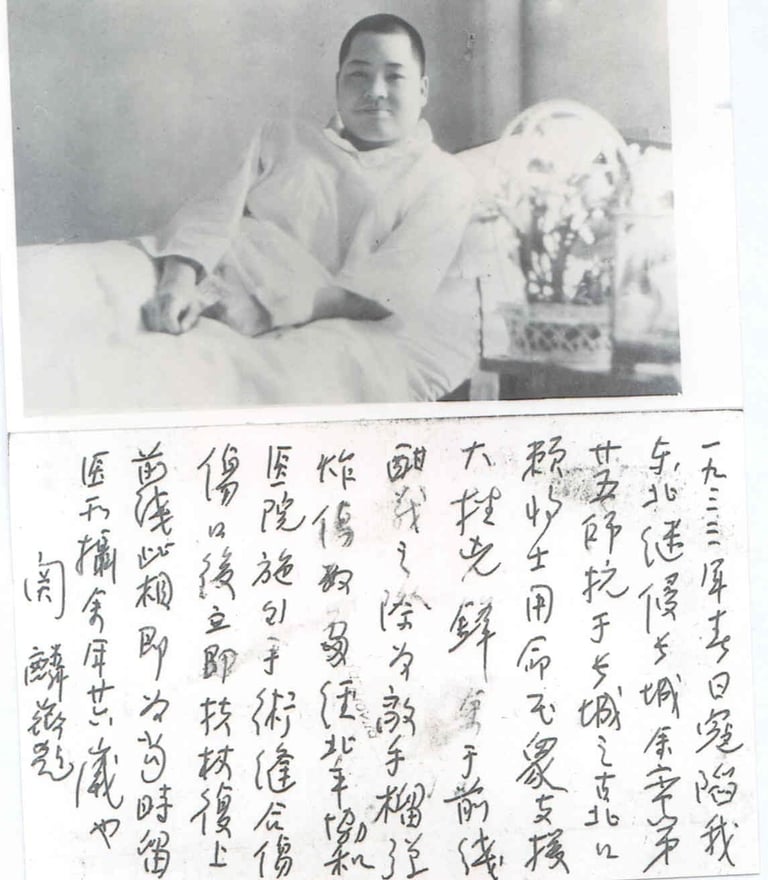
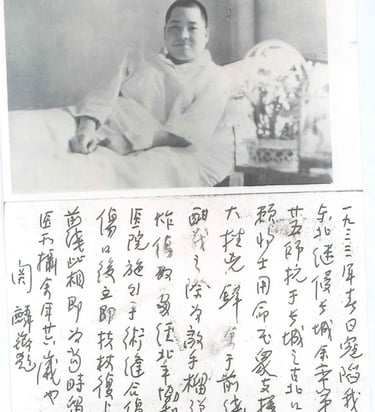
The Battle of Gubeikou: Huang Jie and Guan Linzheng
By Li Chengyi
From "Notes on Roosters and Hoofbeats," Part One
Wartime Records of General Guan: Researching Historical Newspapers in Xi'an
Source: Historical Archives of the Shaanxi Provincial Library
When researching General Guan Linzheng’s role in the War of Resistance against Japanese aggression, several challenges were noted in the archives:
· Incomplete Records: The Shaanxi Provincial Library’s collection of Ta Kung Pao (The Impartial) is missing several months and specific daily editions from that era.
· Military Censorship: Because the war was active, news reports often practiced strict operational security. While enemy units were named, Chinese forces were often referred to simply as "our army," frequently omitting specific unit designations and commanders' names.
The Battle of Gubeikou (The Great Wall)
Reports from the Ta Kung Pao (Tianjin Edition)
April 6, 1933: Tokens of Appreciation
Published on Page 3 (Short Report)
Telegram from Xuzhou: The Xuzhou Anti-Japanese Support Association dispatched Zhao Litao to deliver a large quantity of comfort goods to the front. Two ceremonial flags were presented to General Guan Linzheng and General Song Zheyuan. The delegation headed north on the 5th to honor the troops.
April 8, 1933: Statement Upon Hospital Discharge
General Guan Prepares to Rejoin His Division
Report by Guowen News Agency: General Guan Linzheng, commander of the 25th Division, who was treated at Peking Union Medical College Hospital for wounds sustained during the Battle of Gubeikou, was discharged last week. A reporter visited the 25th Division Headquarters yesterday afternoon to interview General Guan.
General Guan’s Statement:
"Since being hospitalized, my heart aches whenever I think of those who have perished under the fire of Japanese aircraft and artillery. My only wish was to recover quickly so I could return to the front, fight the aggressors to the end, and save our nation from this crisis.
Although my doctors repeatedly urged me not to leave the hospital so soon, I could no longer endure the wait. I am now actively retraining and replenishing my units. Once ready, we shall engage the enemy in a decisive battle.
Our officers and men do not fear the enemy's planes and cannons; we only detest their cruelty. The morale of my troops is at its peak. Every night at the front, groups of soldiers voluntarily launch raids, killing many Japanese troops. This is the true spirit of those who view death as a homecoming for their country."
On the morning of the interview, General Guan also visited wounded soldiers at the Guanghua Temple and Feng Yong University hospitals to offer his personal encouragement.
April 18, 1933: Inspection and Departure
General Guan Moves to Nantianmen
Report by Guowen News Agency: After recovering from his injuries and being discharged, General Guan Linzheng has been rigorously training his troops stationed in Beiping (Beijing).
Due to the escalating urgency of the conflict, and to bolster our military strength, General Guan inspected two regiments yesterday. He is scheduled to depart today for Nantianmen for further inspections. Upon completion, he will immediately lead his forces to the front lines to coordinate with allied units.
Historical Notes and Reflections
These three reports were extracted from the April 1933 editions of the Tianjin Ta Kung Pao. Unfortunately, the March editions are missing, meaning the famous editorials by Mr. Zhang Jiluan and the initial reports regarding General Guan’s hospitalization are unavailable.
However, these three news items clearly demonstrate the profound impact the Battle of Gubeikou had on the Chinese public. They also highlight General Guan’s unwavering character: despite his wounds not being fully healed, he ignored medical advice and resolutely returned to the front to lead his men in defense of the nation.
Excerpts from the book "The Great Victory in Northern Hunan"
Source Note: Taken from the historical volume The Great Victory in Northern Hunan (湘北大捷). Due to the age and wear of the book, the author’s name is no longer visible on the cover.
A Collective Account of History
The book’s preface clarifies its origin:
"To commemorate this extraordinary campaign and its victory, we have collectively written this account based on facts witnessed personally on the battlefield. We are confident that we have neither exaggerated the combat situation nor suppressed the truth."
(This passage confirms the book was a collaborative effort by those who fought in the campaign, preserving the raw reality of the front lines.)
An Extraordinary Confrontation
The first page sets the stage:
The Japanese leadership—Prime Minister Abe Nobuyuki and commanders Nishio Toshizuki and Itagaki Seishiro—had arrived in China, vowing to "resolve the China Incident" with full force. Their spearhead was the bold and resourceful Okamura Neji.
However, they met their match in the Chinese Supreme Command’s "Master of Annihilation," General Guan Linzheng. Backed by a skilled coalition of commanders and strategic masterminds, Guan’s forces didn't just defeat Okamura’s 11th Army; they delivered a staggering blow to the entire Japanese high command.
The Song of the Ninth Group Army
The opening of the book features the marching song of the Ninth Group Army, also cited in other historical biographies of General Guan:
"A crescent moon hangs above the horse's head,
The spirit of the three armies glows a fiery red!
In the midnight chill, we drink tea as wine,
While the stars descend into our cups to shine."
War as a Science: General Guan’s Philosophy
On page 13, General Guan is quoted during an inspection of a frontline military school and fortifications:
"War is a matter of scholarship. We must rigorously study strategy, tactics, and military history. One must achieve a comprehensive understanding to apply these skills with ease. We must learn while we fight, and fight while we learn."
The "Hindenburg of the East"
The book draws a striking parallel on page 17. Before World War I, the German Field Marshal von Hindenburg spent his retirement studying the terrain of Tannenberg. When war broke out, his intimate knowledge of that land led to a total victory over the Russian army.
General Guan Linzheng took a similar approach. Having commanded the Northern Hunan sector for over a year, he knew the terrain of Xinqiang, Jiuling, Miluo, Pingjiang, Changsha, and Xiangyin like the back of his hand. He knew exactly where to deploy troops and where to set an ambush.
The Strategic Master Plan: Luring the Enemy
Working with his Chief of Staff, Lt. Gen. Yao Guojun, General Guan identified that the enemy intended to attack with over four divisions. His plan was:
1. Active Defense: Lure the enemy deep into the interior.
2. Overextension: Force the enemy to stretch their lines until they were exhausted.
3. The Ambush: Strike the enemy’s flanks and rear when they were most vulnerable.
Unit Deployments:
· Zhao Gongwu (under Zhang Yaoming): Guarded the front lines at Leishishan, Xingwangju, and Xinqiang.
· Tan Yizhi: Defended Gengkou and Yanglin Street to block the main land advance.
· Zhang Hanchu: Guerilla forces acting as a mobile reserve.
· Luo Qi (under Chen Pei): Tasked with relentless counter-attacks to prevent the enemy from expanding their gains.
The Decisive Counter-Attack
General Guan ordered his troops to conduct a "phased retreat" after inflicting heavy damage at Xinqiang and Yingtian.
By setting ambushes at every turn, they lured the Japanese to the outskirts of Changsha. Once the enemy was depleted and their supply lines failed, Guan launched a massive counter-offensive across the entire front, surrounding and annihilating the exhausted Japanese forces.
Fear in the Enemy Ranks: A POW’s Confession
Page 32 records the testimony of a captured Japanese Sergeant, Ono Jiro, from the 6th Division (Inaba Division):
"Our division reached Yueyang months ago. We wanted to attack early, but our scouts discovered that we were facing the 2nd and 25th Chinese Divisions.
When we learned that Guan Linzheng—who commanded those divisions at Taierzhuang—had been promoted to Commander-in-Chief of this sector, we hesitated. We waited for the 13th, 3rd, and 33rd Divisions to arrive before daring to move.
Even then, the resistance was grueling. After crossing the Miluo River, we expected the Chinese to collapse, but we were struck by massive flank attacks at Fulinpu. We realized too late that the Chinese retreat was a trap. We are now surrounded, exhausted, and terrified."
(This testimony highlights how General Guan’s reputation alone caused the enemy to delay, losing their tactical advantage and leading to their ultimate defeat.)
In Memory of My Eldest Brother, General Guan Linzheng
By Guan Wuzhi
From My Earliest Memories
From the time I first became aware of the world,
your name was already inseparable
from the words “Resist Japan.”
It was deeply engraved in my mind.
A Youth Given to the Nation
During the war of Japanese aggression,
to save the nation from peril,
you gave your youth without hesitation.
With blood and sweat,
in the flames of war,
you forged your courage
and unwavering loyalty.
Memories of the Battlefield
Whenever I recall
those life-and-death battles
against the invaders—
where you fought with both courage and wisdom,
displaying extraordinary ability—
I am filled with emotion,
and a deep, heartfelt admiration.
A Life of Duty
For the nation,
for the people,
for the family—
you always bore the heaviest burdens.
With the vision and courage of a true commander,
you fulfilled your sacred mission
with remarkable success.
The Oath at Gubeikou
The gunfire at Gubeikou
pierced your heart.
You swore:
“Never will I kneel for false peace.
I stand tall—even if it costs my life.
For China’s dignity and peace,
the enemy shall never prevail.”
March to the Front
When allied forces at Gubeikou were in crisis,
an urgent call for reinforcements arrived.
Without hesitation,
you personally led the 25th Division
day and night toward the front.
Even when ordered to halt,
you chose to advance—
seizing initiative for the greater good.
Leading from the Front
To inspire your soldiers,
you braved enemy fire,
fighting side by side with them.
Though severely wounded,
you dismissed your pain,
refusing to retreat.
You remained in command
until the enemy’s assault was repelled.
What Sustained You?
What strength sustained you?
It was your burning patriotism—
flowing through every vein.
It was the trust
of the people of Beiping and Tianjin
reflected in their eyes.
Victory and Honor
Under your command and example,
the Gubeikou front held firm
along the Great Wall.
The enemy called it
“a battle among battles.”
The people praised you:
“General Guan of Gubeikou—
hero of extraordinary victories.”
Even in Injury
On a hospital bed,
even in unconsciousness,
you murmured:
“Attack! Charge!”
Only then did I understand—
your guiding belief was:
“Hold the line. Defend China.”
A Hero Loved by the People
Students in Beijing
lined the streets of Wangfujing
to honor you with flowers—
undaunted by wind or rain.
Before your wounds had healed,
you returned to the front.
Because in your heart
burned only one thing:
love for your country.
From Marco Polo Bridge to Taierzhuang
From the thunder of Marco Polo Bridge
to the fierce battles of Taierzhuang,
history will never forget:
your daring raid on Zhanghe Airfield,
your relentless fight alongside the 52nd Army,
and the victories that shook the enemy.
Brilliant Strategy and Sacrifice
At Ruichang,
your ingenious battlefield formations
sent countless invaders to defeat.
At Jinniu,
your command ensured the safe relocation
of the wartime capital to Chongqing.
With limited forces,
you deceived and contained the enemy—
winning through wisdom and courage.
The Great Victory in Northern Hunan
In the First Battle of Northern Hunan,
you commanded six armies.
Through tireless preparation
and brilliant strategy,
you defeated over 100,000 elite enemy troops.
You lured the enemy deep,
then struck with overwhelming force—
forcing even General Okamura
to order a full retreat.
Glory of the 15th Army Group
Your army’s bravery
became known across China and beyond.
Messages of praise poured in.
The people celebrated in joy.
Confidence in victory
spread everywhere.
Master of Defense
While stationed in southern Yunnan,
you developed innovative defenses:
“Layered Fire Networks,”
“Alphabet Fortresses,”
and “Integrated Positions.”
After facing your “iron fist,”
the enemy never dared return.
A Legendary Reputation
You earned many names:
“Iron Fist Guan”
“The Ever-Victorious General”
“China’s Patton”
The enemy feared you.
The people loved you.
As you once said:
“My life has been a life spent fighting the Japanese.”
A Life of Integrity
In 1948,
you resigned as Commander-in-Chief—
refusing to take part in civil conflict.
You lived in Hong Kong for 30 years,
reading, writing,
raising your children,
living simply, indifferent to fame.
Love for the Homeland
You always cared deeply
for your country’s future
and longed for reunification.
You never forgot your hometown—
its mountains, rivers, and familiar voices.
Final Days and Passing
Before your passing,
in Queen Elizabeth Hospital,
staff were deeply moved to learn
that the scarred patient before them
was the great General Guan Linzheng.
A Nation’s Farewell
Tributes came from across the nation.
Flowers and memorial banners filled your hall.
Hundreds came to bid you farewell.
A Life Remembered
You devoted your life
to your country and its people.
In death,
you received the honor you deserved.
This was your true life.
Reflection After Reading "The Biography of General Guan Linzheng"
By Dong Lixing (March 1969)
The Spirit of Shaanxi: Cradle of Heroes
In the spring of 1935, as Communist forces fled toward the Northwest, I followed the army in pursuit from Western Anhui through Henan and Shaanxi, eventually entering eastern Gansu. I lived in Xi'an and Baoji for over a decade. During that time, I befriended many local leaders and was struck by the people’s character: robust, honest, and deeply chivalrous. This region, the Wei River valley, is the cradle of Chinese culture—a land of spiritual mountains and elegant waters that has produced legendary generals throughout history.
General Guan: A Peerless Commander
General Guan Linzheng (styled Yudong) was a native of Hu County, Shaanxi. A man of extraordinary intellect and courage, he has had no equal among military men since the founding of the Republic. Favored by Generalissimo Chiang Kai-shek, he rose rapidly; by age 26, he commanded thousands. From the Eastern Expedition and Northern Expedition to the suppression of internal rebellions, he always led from the front. His fame reached its peak during the 1933 defense of the Great Wall at Gubeikou, where he shattered the enemy's momentum, and later through his legendary victories at Taierzhuang and Northern Hunan.
An Authentic Record of History
Biographies are often ghostwritten by later generations, resulting in accounts based on hearsay rather than fact. This work, however, is different. It is an oral history dictated by the General himself and recorded by Mr. Gan Ping. It provides a fair assessment of achievements and failures, making it far more authentic than official government records. I write these words to honor the General’s merit and to provide a truthful reference for future historians.
The Tragedy of National Collapse
The Fall from Victory to Exile
After the passing of Dr. Sun Yat-sen, President Chiang Kai-shek took up the mantle, leading the heroes of Whampoa to unify the nation and defeat the Japanese. After the victory, the nation rejoiced, hoping for an era of prosperity. Instead, the Communist catastrophe seized the land, leading to the deaths of millions and the destruction of our national spirit. Since the government retreated to Taiwan, our people have lived in misery. Those of us overseas look back at our homes with grief, unable to return or even hear news of our families. Who is truly responsible for this tragedy?
The Curse of Petty Officials
History shows that the collapse of dynasties is often caused by powerful officials who mislead the state. These men purge those who disagree with them; they appear loyal but are treacherous; they are mediocre yet narrow-minded. They rise through sycophancy and use their power to promote their own cronies while marginalizing men of true talent. They manipulate the leader’s will, feeding them slanders and prioritizing personal grudges over national security. By the time the disaster is clear and the enemy is at the gates, the people’s heart is lost. This was the path taken by the traitors Qin Hui and Yan Song, and it was the path that broke our nation’s foundation.
Strategic Blunders in the Northeast
A Command Denied
The war against the Communists hinged on the Northeast (Manchuria). General Guan possessed the wisdom to save the state and the courage to awe the military. Recognizing this, Chiang Kai-shek appointed him Commander-in-Chief of the Northeast Security Command. However, this order was blocked by those in power, and the position was given to another. When the nation heard this, a collective sigh went up: "The struggle for the Northeast is lost."
Turning Allies into Enemies
At that time, there were nearly a million trained soldiers from the former Manchukuo and local anti-Japanese volunteers ready to swear loyalty to the Central Government. But the narrow-minded authorities refused to incorporate them. Embittered, these troops turned to the Communists. The Communist leader Lin Biao seized the opportunity to recruit them, allowing his forces to swell. Soon after, they swept south, leading to the fall of Beijing, Tianjin, and eventually the entire Yangtze region.
The Self-Inflicted Defeat
During peace talks, while the Communists expanded their army, our government remained blind to the situation. Instead of strengthening our forces, the authorities disbanded elite units. These veteran soldiers, left with nothing, defected to the Communists in droves. By the time of the critical Huaihai Campaign, we had no soldiers left to fight. A more foolish course of action cannot be imagined.
Internal Strife and the Loss of the Mainland
A House Divided
The nation's fate was ruined by sycophants. Even within the same government, factions fought; even within the same command, there was sabotage. They cared nothing for the country, only for power. They forgot that if the boat capsizes, everyone drowns. This internal friction, combined with a "half-peace, half-war" policy toward the Communists, destroyed morale. We stood paralyzed before a Great Enemy, and before a decision could be reached, the enemy had already crossed the river. This is why the mainland was lost.
General Guan’s Stoic Retirement
I served as a subordinate officer my whole life, surviving countless battles, and I know the truth of what General Guan says. Though we served in different units, I have always admired his character. Today, despite his great past achievements, he lives a quiet life in anonymity. His detachment from fame and his inner cultivation are beyond the reach of ordinary men. As the History of Song says: "Never has a general succeeded abroad while treacherous officials ruled within." General Guan’s life proves this eternal truth.
Reflections on Exile and Loss
The Sorrow of the Displaced
We who have lived through these national upheavals are now in our twilight years, scattered to the corners of the earth. Some still harbor the ambition to reclaim the homeland; others maintain their integrity in quiet isolation. We grieve that there is no date for our return. As the poet Lu You wrote: "The man of ambition grows old in a lonely place, watching the fallen flowers in the rain." My heart shares this same bitterness with the General.
The Legacy of Chen Cheng (Chen Cixiu)
When General Chen Cheng passed away in Taiwan, a poet wrote a series of verses reflecting on his career. While critical, they contain profound truths:
1. On Disarmament: He disbanded a million troops after the war, causing bitter resentment. The "Rabbit" (the enemy) survived because the "Dog" (the army) was discarded. Veteran generals wept at the Sun Yat-sen Mausoleum in Nanjing, a protest known as the "Crying at the Tomb."
2. On Nepotism: He favored his own "Eight and Eight" (the 8th Class of Baoding Academy and the 18th Army). While loyal to friends, a commander must be impartial to lead an entire nation. Furthermore, he restricted promotions to those with academic diplomas, ignoring the traditional Chinese path of rising through merit on the battlefield.
3. On Guerilla Forces: He labeled local patriot groups "irregular/miscellaneous troops" and disbanded them. Had they been supported, they could have suppressed the Communists alone. Instead, by rejecting them and the former "Imperial Collaboration" troops, he handed a massive army to Lin Biao.
Final Assessment
Chen Cheng was not without merit—he was loyal to his leader, loved his subordinates, and was incorruptible regarding money and women. He had the ambition of great statesmen like Zeng Guofan but lacked their supreme talent. He excelled in local administration and defense in Taiwan, but when tasked with the leadership of the entire nation, his capacity was simply not enough. In the end, he was a man of modest talent burdened with heavy responsibility, and the nation suffered the consequences.
Written by Dong Lixing of Hefei, at the Hundred Flowers Garden, Kowloon, Hong Kong, March 1969.
Public Judgement
The Inside Story
Original Chinese text: 公論 (Public Judgement), by Zhang Ganping, with supplementary accounts by graduates of the Central Military Academy.
Foreword
The military achievements of General Guan Linzheng have now been recorded in full — from the Eastern Expedition and the Northern Expedition, through the campaigns against the Communists and the war against Japan. From this point forward, what follows is a different kind of account entirely: the private affairs of a man caught up in the fate of a nation, the personal crises of his leader, and the behind-the-scenes struggles that shaped — and ultimately damaged — his career. If the preceding chapters showed General Guan's talent as a soldier, the chapters that follow reveal the character of the man.
Time and again, when the Party or the nation faced its gravest moments, Guan Linzheng stepped forward without counting the cost to himself — regardless of how the world might judge him, regardless of the personal danger. His willingness to act on principle, to put the greater good above personal interest, to stand in the breach when others turned away — these are qualities that cannot be found in ordinary men.
And yet. "I reach with my whole heart toward the bright moon — but the moon shines only on the ditch." His selfless loyalty, his single-minded devotion to the Party and its leader, produced a bitter harvest. He was sidelined. Set aside. Left to gather dust. Today he asks for nothing, seeks no recognition, and has described his life with rueful self-deprecation as "a dream of yellow millet."
Those of us who know the full story cannot help but grieve — and reflect on how, in this world, the way of the petty man so often prevails while the way of the gentleman is pushed aside.
---
Part One: The Secret Meeting at Xikou — The Whampoa Men Sign Their Names in Shanghai
Chiang Kai-shek's First Resignation — The Hidden Story
In 1927, Chiang Kai-shek was Commander-in-Chief of the National Revolutionary Army. He had pacified Jiangnan and established the capital at Nanjing, but the Northern Expedition was not yet complete. The Communist Party seized the moment to cause internal division, producing the split between Nanjing and Wuhan. Although Wuhan eventually decided to expel the Communists, it continued its attacks on Chiang personally. With the Party divided, the Northern Expedition was in danger of stalling. Chiang decided to step down temporarily in the hope of forcing unity. On the night of 12th August he left Nanjing, returned to his hometown at Xikou in Fenghua, then went to Japan for over forty days. He returned to China in mid-November, came back to Nanjing to resume his post on 4th January 1918, rebuilt his force, turned the army north, completed the later stage of the Northern Expedition, and unified the country. This much is known history.
But what actually caused Chiang to resign contains an inside story that few outsiders have ever known. General Guan told the author this privately.
---
A Visit to Xikou
At the time, Guan Linzheng was commanding the 7th Supplementary Regiment, a unit directly under the Commander-in-Chief's headquarters, stationed at Wufu barracks in Zhejiang Province for training, alongside the 8th Regiment under Li.
When word suddenly came that Chiang had resigned and returned home, Guan Linzheng was consumed with anxiety. He and Deng Ruian — a fellow Whampoa graduate serving as a lieutenant colonel in the 8th Regiment — immediately set out for Xikou to pay their respects.
Chiang was preparing to leave for Japan. When he saw two of his students come to him in this hour of difficulty, he was visibly moved — and agitated. Then something unusual happened. Chiang Kai-shek — a man of deep learning and great self-discipline — began speaking of his resignation with fury, shaking his fist:
"Tell your fellow students — XXX has betrayed me. Those sons of bitches. You go be bandits, I'll be the bandit chief."
General Guan later told the author: "Write every one of those words down exactly as I have said them. If you don't, this biography you are writing for me will have no value. In all my decades of following Chiang, that was the first and only time I ever heard him use foul language in front of his students. The depth of his anger can only be imagined."
How had a man of such cultivated restraint been brought to this? The answer is this: the person he was referring to as "XXX" was a "closest comrade" whom Chiang had personally raised up, fully trusted, and regarded as his only true successor. And at the moment of crisis, that man had betrayed him.
---
What the Betrayal Was
According to what General Zhu Shaoliang later told Guan Linzheng: Chiang Kai-shek had convened a meeting of three army group commanders. Zhu attended in his capacity as acting Chief of Staff. Two of the commanders at the meeting pressed Chiang to resign temporarily, citing opposition to him within the Party. Zhu nudged under the table the third commander — the one Chiang had personally raised — hoping he would speak forcefully in Chiang's defence and argue against the resignation. Instead, this man whom Chiang considered his closest ally said nothing. He sat in silence, lips sealed, making not a single gesture of solidarity while Chiang faced the combined pressure from all sides. He simply watched.
That silence was what Chiang meant by "betrayal."
(Note: Chiang's first resignation was entirely a matter of military commanders manoeuvring against him; it had very little to do with the Party or government apparatus. After he resigned, the Party and government both urged him to stay. But he had made up his mind, and this episode was the origin of his lasting antagonism toward the Guangxi faction.)
---
The All-Night Meeting in Shanghai
Guan Linzheng and Deng Ruian, having heard Chiang's outburst, immediately declared: "Whatever the headmaster has in mind, his students will walk through fire for him." Seeing how troubled and preoccupied Chiang was, they took their leave the same day and hired sedan chairs back to their post. As they reached the halfway point, a messenger from Chiang caught up with them — he had sent ten silver dollars for each man.
Back at Wufu barracks, Guan Linzheng, Deng Ruian, and Yan Wu — another first-class Whampoa graduate — went to Shanghai to see General Zhu Shaoliang and declared their intention: to rally Whampoa graduates and secure Chiang's return to power.
Zhu Shaoliang told them: "The Commander-in-Chief has gone to Japan. He left eight hundred thousand silver dollars in my care, shared with General Wang Bailing, to manage this affair. Go see Wang — but don't mention that you've already been to see me."
After meeting Wang Bailing, the group came back together and worked out a plan. Guan Linzheng and Yan Wu would travel between Shanghai and Hangzhou to notify classmates in the Hangzhou alumni association and unemployed Whampoa graduates elsewhere. Zhu and Wang would write letters to be carried by the unemployed graduates to the units of the Central Army, summoning regimental commanders and above to a secret meeting in Shanghai.
Officers on active duty came without requesting leave. The meeting ran from eight or nine in the evening until dawn — a full night of discussion, with many voices and many opinions. When those present learned the full story of how Chiang had been forced from power and betrayed by a trusted subordinate, many were visibly outraged. Some called for killing the ringleaders outright. Others argued against it — such an act would throw the army into chaos, and the warlords were still watching from north of the Yangtze. Some wanted to take their troops to the hills and become bandits, as Chiang had said. Others objected: Chiang had said that in a moment of rage, and they were revolutionary soldiers, not outlaws.
After a night of heated argument, calmer heads prevailed. The meeting resolved to write a joint petition urging Chiang to return and resume his post.
---
A Suspicious Signature
As the papers went around for signatures, Guan Linzheng watched carefully. He noticed one first-class Whampoa graduate from Guizhou — referred to here only as "Wang" — writing his name in a deliberately distorted hand, using only two fingers on the brush. Guan immediately suspected that this man was trying to preserve deniability — either afraid of consequences or harbouring some ulterior motive.
He was right. Wang went straight back to his unit and reported everything to "XXX" the army group commander — with embellishments. The commander, hearing this, went white with shock. The middle and lower-ranking officers throughout his force were all Whampoa men. If these students who actually held the rifles decided to move against him, the consequences would be unthinkable. He ran to consult the other two commanders. All three quickly concluded: only Chiang's return could restore order. They sent a delegation to Japan to invite him back.
---
The Accidental Result
As Guan Linzheng reflected afterward: "The meeting itself actually accomplished nothing directly. A petition from junior officers would not have brought Chiang back on its own. But Wang's leak — unintentionally — produced exactly the shock effect needed. Chiang received the students' petition first, then the three commanders' envoys came to escort him home. He returned."
On 21st September a formal government telegram was issued urging Chiang's return. On 10th November he sailed home from Japan. On 1st December he married Song Meiling in Shanghai. On 4th January the following year he resumed his post in Nanjing. On the 18th the Central Political Council formally appointed him Commander-in-Chief of the Northern Expedition forces and telegraphed Yan Xishan, Feng Yuxiang, and other commanders to prepare to advance.
---
The Lesson Chiang Drew
After this episode, no one in the Party again dared to challenge Chiang's military authority. The guns were in Whampoa hands — and Chiang now knew it for certain.
But the same experience gave Chiang a lasting psychological wound. The man he had trusted most had failed him at the critical moment, choosing neutrality over loyalty. From that day forward, Chiang became cautious and suspicious in entrusting power. Private loyalties and factional networks followed as a consequence.
Guan Linzheng reflected: "My own later experiences, while not directly caused by this, were indirectly shaped by the atmosphere it created. The standard of choosing people on merit and virtue was gradually distorted by those around him. Tracing it to the root — the cause was that moment of 'close ally betraying him, others staying loyal.' I risked my life, counted nothing for myself, and acted purely out of loyalty. But whether what I did was ultimately good or bad for the Party and nation — whether it was a service or a mistake — I leave to historians to judge."
---
Part Two: A Frank Tongue Makes an Enemy of Chen Cheng — A Brotherhood Sworn With Ma Hongkui
The Poem at the Temple of Zhang Juzheng
Half a lifetime's worry for the nation, his brow still knit,
One imperial edict of posthumous honour, his bones already cold.
When grudges are all settled, history makes its judgment;
In the frontier's days of danger, talent proves hardest to find.
This is from a poem written at the shrine of Zhang Juzheng — the man Liang Qichao called the only great statesman of the Ming dynasty. Read in a time of suffering, it cuts to the bone.
Among the Republic's military and political figures, the man who most consciously held himself to Zhang Juzheng's standard — willing to bear toil, resentment, and slander — was Chen Cheng (courtesy name Cixiu). On the mainland, criticism of Chen far outweighed praise; in Taiwan it has been the reverse. To judge a man of his stature, living or dead, is beyond this author's ability. But General Guan Linzheng — a hundred-battle commander, a name synonymous with victory — found himself, after the victory over Japan, pushed aside and left to idle. Here is the story of how that happened, told in General Guan's own words.
---
The First Quarrel — "The Short One Is No Better Than Cao"
In 1927, after Chiang's resignation, General He Yingqin immediately dissolved all the directly attached supplementary regiments. Officers were scattered or discharged. Many Whampoa graduates found themselves unemployed and destitute. Guan Linzheng was one of them.
After being discharged, Guan Linzheng was eventually assigned as commander of the 61st Regiment in the 11th Division. The divisional commander was Cao Wanshun; Chen Cheng was deputy commander; Chen's ally Luo Zhuoying was the divisional chief of staff; the other regimental commanders were Li Mo'an and Xiao Gan.
One day Luo Zhuoying gathered the three regimental commanders and proposed that they jointly report to Chiang that Cao Wanshun was unfit to be divisional commander — with whatever charges could be manufactured — so that Chen Cheng could be promoted from deputy to full commander.
Guan Linzheng, young and direct, had no idea he was being drawn into a political manoeuvre. He spoke frankly: "If we're going to report anyone, let's report both of them. The short one [a reference to Chen Cheng's small stature] is no better than Cao Wanshun. He might even be worse."
Li Mo'an and Xiao Gan agreed. The scheme came to nothing. But Luo Zhuoying reported every word to Chen Cheng. From that day forward, Chen carried a grudge against Guan Linzheng that he never forgot.
Chen Cheng duly rose to divisional commander, with Cao Wanshun shuffled aside. Guan Linzheng was promoted to brigade commander — he was twenty-three years old. But Chen Cheng set about removing the three officers who had offended him. His first target was Guan Linzheng.
Chen went personally to Nanjing to report to Chiang that Guan Linzheng should be removed. Chiang reportedly replied: "I know Guan Linzheng well — he is excellent. If you say he is no good, that reflects your own failure to manage people."
(This was reported to Guan by Hu Jing'an, who was serving as Chiang's aide-de-camp at the time.)
Blocked from removing Guan outright, Chen Cheng used a different tactic: a "golden cage" promotion. He recommended Guan Linzheng for the post of deputy divisional commander of the newly organised 5th Division — a unit of Shaanxi troops under Deng Ying, far from Chen's own power base. Shortly after, Li Mo'an and Xiao Gan were also pushed out of the 11th Division. Chen Cheng's "Civil Engineering Faction" — built around the 11th Division and 18th Corps — was born from precisely this process of clearing out those who did not belong to him.
---
The Awkward Assignment
Arriving at the New 5th Division, Guan Linzheng found a force riven by internal intrigue and mutual suspicion. Not long after he took up his post, the divisional commander Deng Ying went to Nanjing for meetings, and two regiments simply took their rifles and went into the hills as bandits.
One regimental commander, Gong Bingfan, came to Guan Linzheng privately and proposed: "If you can secure my promotion to brigade commander, I will bring both regiments back down and support you as divisional commander."
Guan Linzheng refused him and despised the warlord thinking behind the offer. He did not detain Gong — he let him go. But the regimental and brigade commanders of the New 5th Division were all older men with deep local roots, and none of them had any intention of being commanded by a man in his mid-twenties. They obstructed him at every turn. He made clear to everyone that he had no desire to stay as divisional commander, went to Nanjing to see Chiang, and was reassigned as a regimental commander in the 2nd Division — a step down from deputy divisional commander.
General Guan reflected: "I have never been knocked down on a battlefield. But I was knocked down several times in front of Chen Cixiu. After that, whenever I served under his command — in Shanxi against the Communists, during the Wuhan withdrawal at Jinniu — both Chen and Luo Zhuoying found ways to obstruct and oppose me. The appointment as Northeast Security Commander after the war never happened either — Chen refused to give me unified command authority, so Du Yuming went instead.
Today Chen Cixiu is gone. History will judge his record. I will only state the facts and make no further comment. But when I read history and see how Li Guangbi and Guo Ziyi, though personal enemies, forgot their feud to save the Tang dynasty together — or how Zuo Zongtang, who despised Zeng Guofan, was nevertheless recommended by Zeng because Zeng recognised his talent — I cannot help but reflect. What I encountered was neither a Guo Ziyi nor a Zeng Guofan. The personal loss is small. The harm to the nation is large."
---
The Xi'an Incident — A Brotherhood Sworn on the Steppe
The Context
On 12th December 1936, the Xi'an Incident shook the world. Of the many accounts written about it, one episode has never been publicly recorded: how Guan Linzheng forged an alliance with Ma Hongkui and blocked Zhang Xueliang and Yang Hucheng from drawing Gansu into their rebellion.
The incident occurred shortly after Guan Linzheng had finished a sweeping campaign as Commander of the 11th Column in Gansu — with the 25th Division alone, he had crushed Communist forces, killing and capturing more than twenty thousand men. The Communists' remaining strength was barely thirty thousand broken soldiers, cowering in the Yan'an area in daily fear. (The figure of thirty thousand is the Chinese Communists' own admission, from their book Sparks Starting a Prairie Fire.)
Had Zhang Xueliang not acted foolishly and Yang Hucheng not acted rashly — both manipulated by Communist agitation — the "pacify within" policy would have been complete in three months at the fastest, six months at the latest. The Communist problem would have been eradicated at the root. China's history would have been written differently. Mao Zedong's rise would have been impossible.
---
The Day the News Came
On the day of the incident, Guan Linzheng was riding through the Helan Mountains toward the Alashan Banner region to cut off northward-fleeing Communist forces. Suddenly Hu Zongnan called by telephone with the news that Chiang had been kidnapped.
Guan Linzheng nearly collapsed. He could not continue speaking into the telephone. He wept. He thought: China is finished.
At that moment there was truly no one other than Chiang who could lead and hold China together.
---
The Alliance With Ma Hongkui
After the incident, Zhang Xueliang and Yang Hucheng sent representatives to Yinchuan to approach Gansu Governor Ma Hongkui — hoping to draw him into their coalition against the central government.
Guan Linzheng learned that Zhang and Yang's emissaries had arrived at the provincial capital. If Ma Hongkui joined them, not only would the central government's position become far more difficult, but Guan's own force in Gansu would find a friendly flank turned hostile overnight. But if he adopted a hostile posture toward Ma, he risked triggering yet another round of civil war and bloodshed.
Ma Hongkui and Guan Linzheng had always gotten along well. Guan thought carefully, and concluded that the only way was to go personally and appeal to Ma with both reason and self-interest. He went to see Ma and said:
"The situation is now urgent. Whether you side with Qin or Chu depends entirely on what you decide in this moment. If you intend to join Zhang and Yang in opposing the central government — then detain me here right now. If you are committed to following the centre and remaining loyal to Chiang — then you should detain Zhang and Yang's representatives. There is no middle ground. Trying to please both sides will please neither."
Ma Hongkui heard these words, and tears streamed down his face. He wept aloud and said: "Yudong! Do you not know that I serve the central government and am loyal to Chiang? I will have Zhang and Yang's representatives placed under house arrest immediately."
Ma Hongkui's uncle, who was present, spoke up: "Hongkui — at a moment like this, the two of you should swear brotherhood, to show your loyalty to the nation and stand together from this day forward."
Ma Hongkui knelt. Guan Linzheng knelt beside him. They swore an oath to heaven and became sworn brothers. Guan told Ma: "Until the Xi'an Incident is resolved, I will not leave Yinchuan. We stand together, whatever comes."
Ma was reassured. Gansu held firm, loyal to Chiang. The psychological blow to Zhang and Yang was considerable. In the months that followed, Hu Zongnan's and Guan Linzheng's Central Army forces received substantial grain and supply support from Ma Hongkui's forces in Gansu. This inside story has never been told before.
---
Part Three: Wenshan Holds — The Japanese Lose Heart; A Personnel Battle — Chen Cheng Acts From Private Interest
Foreword
General Guan Linzheng — a first-class Whampoa graduate, the man who fought more battles than any of his peers, won them better than any of his peers, and rose higher and faster than any of his peers — stood at the peak of his career after the First Northern Hunan Victory. He had returned to Chongqing in triumph, received at a gathering unlike any held before for a returning war hero. He was a national figure, a household name, a genuine symbol of the War of Resistance.
By every logic of merit and age — still in his mid-thirties, with a constitution of iron — he should have gone on from strength to strength, shouldering the burden of the nation's defence for decades to come.
Instead, a cloud blew in from nowhere. He was cast into the shadows and never fully emerged again.
---
Defending the Southern Door — Japan Never Came
After the First Northern Hunan Victory, central command — fearing a Japanese push through Vietnam into Yunnan and the strategic rear of China — decided to post Guan Linzheng to the Yunnan-Vietnam border. He was a commander whose name alone was said to make the Japanese lose heart.
His army group moved to the Tianbao and Jingxi areas along the Guangxi border, then was redesignated the 9th Army Group and redeployed to garrison the area east of the Yunnan-Vietnam Railway. Under his command were Zhang Yaoming's 52nd Corps, Huang Wei's 54th Corps, Dai Jian's division, and at times He Shaozhou's corps. He established his headquarters at Wenshan, divided the defence zones, mobilised local militia, organised the local population, and spent months constructing a network of fortifications that he was confident could defeat any Japanese attack — something he believed would be even more decisive than Tai'erzhuang or the Northern Hunan battles.
He waited one year. No Japanese came. He waited two years. Still no Japanese. The men sharpened their swords and trained daily, half-hoping someone would send the Japanese an invitation to test them. After Pearl Harbour, it became clear that Japan had overextended itself and could never risk opening another front in Yunnan.
People said: "The Japanese heard that Guan the Fierce was guarding the back door — and they were too afraid to come." Others made wordplay on his name: "Split the character 'Zheng' apart, and you get 'Wenshan' — the very place where the commander was stationed. And 'shuangli ren' — the double-man radical — means he brought a lot of men with him. No wonder the Japanese dared not challenge the tiger."
---
"A Famous Name Is a Dangerous Thing"
Yet this long period of vigilance without battle proved to be a trap as much as a triumph. While Guan Linzheng stood guard at the "back door" — untouched, unrecognised — others worked quietly against him.
He had too many "firsts." He had risen too fast, fought too well, become too famous. Those whose battle records were thinner but whose positions were higher became uneasy. In the shadows, they whispered into Chiang's ear — fabricating grievances, manufacturing incidents, engineering his slow and invisible decline.
"A man fears fame as a pig fears fat" — the Chinese saying proved prophetic. Guan Linzheng stood at ninety-nine miles of a hundred-mile road, one foot short of the summit — and was struck down by the politics he had never learned to play.
---
The 54th Corps Affair — A Report That Was Fabricated
One day Guan Linzheng received a telegram from Military Affairs Minister He Yingqin asking him to recommend someone to succeed Huang Wei as commander of the 54th Corps. Guan Linzheng was puzzled — the 54th was Chen Cheng's core formation, and He Yingqin and Chen Cheng had been in a covert rivalry for years. He was caught between two powerful superiors.
Being direct by nature, he went to see Chen Cheng and said plainly: "I have received a telegram from He Jingong asking me to recommend someone to command the 54th Corps. What are your thoughts?"
Chen Cheng asked: "Who do you have in mind?"
Guan Linzheng replied that the deputy corps commander Fu Zhengmo, though senior, was not a strong fighter; that divisional commander Que Hanjian was capable but had only just been promoted and could not be elevated again so soon. He proposed that his own deputy, Zhang Yaoming, serve as acting commander for a few months to smooth the transition, and then recommend Que Hanjian for the permanent appointment. Chen Cheng smiled and agreed it was a good solution.
The appointment was sent to the Military Affairs Ministry and approved. But the formal orders were held back by Chen Cheng's headquarters for days without being passed on. Guan Linzheng pressed and eventually the orders were released. He told Zhang Yaoming: "This is a transitional arrangement — don't touch a single person in that corps. Just hold it for a few months and then recommend Que Hanjian." Zhang agreed: "Chen Cixiu's people — I wouldn't dare touch them."
About two months later, a personal telegram arrived from Chiang Kai-shek: "I am informed that you have carried out large-scale personnel changes in the 54th Corps, causing alarm and unrest. Please take note."
Guan Linzheng immediately telephoned Zhang Yaoming and demanded an explanation. Zhang was bewildered: "In two months I haven't changed a single clerk. Please report to higher command for an investigation — if anything is found, I accept punishment."
Guan Linzheng investigated. The picture that emerged was extraordinary. Deputy Corps Commander Fu Zhengmo — furious at being passed over — had gone to Chen Cheng and stirred things up, claiming that Guan Linzheng was trying to absorb the 54th Corps. Chen Cheng, without a single inquiry, had immediately organised a petition — signed under pressure by all regimental commanders and above in the 54th Corps — attributing all the supposed "personnel changes" to Guan Linzheng personally. This petition, with Chen Cheng's own covering report, went straight to Chiang.
"When I investigated further," said Guan Linzheng, "I found that it was the same trick Luo Zhuoying had tried against me years before — the same scheme, just recycled against Zhang Yaoming and myself. Someone in the 54th Corps had even forged Zhang Yaoming's seal and submitted a fake resignation letter in his name to the Military Affairs Ministry, claiming he was resigning due to illness."
---
The Confrontation With Chen Cheng
Guan Linzheng reported to Chen Cheng's headquarters repeatedly and received no response. He requested that the trouble-maker Fu Zhengmo be disciplined — a modest demand. Still nothing. He offered, in the spirit of complete capitulation, to have Zhang Yaoming voluntarily step down and be replaced by Que Hanjian, asking only for a token demerit against Fu to preserve his own ability to command. Still nothing.
When Chen Cheng flew to Kunming from Hubei, Guan Linzheng went with Song Xilian and Du Yuming to the airport to receive him, then accompanied him back to his residence and raised the matter directly.
Chen Cheng ignored him and changed the subject.
That was the breaking point. Guan Linzheng — a man who had survived a hundred battles, who had been blown up, shot, and left for dead — was not prepared to be casually dismissed after being subjected to fabricated accusations.
He said everything that no one had ever dared say to Chen Cheng's face.
Chen Cheng went red. Song Xilian and Du Yuming stood there with expressions that had drained of colour.
When it was over, Guan Linzheng asked to be relieved of his command.
Chen Cheng, it was later reported, fell ill that day and vomited blood, and submitted his own resignation as War Zone Commander to Chiang.
The result: Chen Cheng was recalled to the centre and promoted. He Yingqin arrived in Kunming as Commander-in-Chief of the Chinese Army. Chen Cheng's trajectory continued upward — to Chief of the General Staff, then beyond.
Guan Linzheng's trajectory went in the other direction.
---
Part Four: The Northeast Post Lost — The Kunming Incident
A Cascade of Broken Promises
After his confrontation with Chen Cheng, Guan Linzheng's fortunes fell in a series of steps. His army group was dissolved in the name of "military reorganisation." He was ranked as deputy commander under Lu Han's 1st Area Army — a subordinate role in someone else's command, after a lifetime of commanding his own force.
At the victory ceremony in Zhijiang, where Japan's surrender was received, commanders of his rank and above were invited. But the man whose name had been printed in every middle-school textbook in China — whose victories stretched from Gubeikou on the Great Wall to Tai'erzhuang to Northern Hunan — was not present. He had not been told.
When Guan Linzheng later saw Chiang in Chongqing and mentioned in passing that he had not attended the surrender ceremony, Chiang's expression darkened. Neither said anything more about it.
---
The Kunming Gunshots — A Night of Errors
When the war ended, central command decided to reassign Yunnan Governor Long Yun to an advisory post in Chongqing. The task of effecting the transfer fell to Du Yuming.
Guan Linzheng, who had spent years in Yunnan and knew Long Yun and all his senior officials intimately, counselled Du Yuming beforehand: "Use encirclement, soft pressure, and persuasion. Long Yun has not disobeyed any order. There is no need to open fire. If shooting starts at night, we will cause panic and chaos — and if Long Yun is killed in the confusion, how do we explain that to the world?"
That night Guan Linzheng was staying at Wei Lihuang's residence. In the small hours, gunfire erupted across the city. He was appalled. He had not been listened to.
Long Yun, not yet having received any formal transfer order, heard the shooting from his home, slipped out the back door, and took shelter in the provincial government building — not knowing what was happening. Hours later Du Yuming informed him of his new appointment in Chongqing.
"Du Yuming wanted to give Long Yun a show of force first, transfer him second," Guan Linzheng said. "That recklessness alienated every Yunnanese person. When I later met Lu Han in Vietnam and Long Yun in Chongqing, they said nothing except that the central government had gone too far — and that the shooting was an insult to Yunnan. The later defections of Yunnan troops on the mainland, and Long Yun's eventual flight to Communist China, can be traced directly to that night."
---
Reward and Punishment Reversed
Chiang subsequently told Guan Linzheng that Du Yuming had "handled the matter poorly, in violation of military discipline," and that Guan should return to Yunnan to manage the aftermath — because the Yunnanese trusted him.
The outcome: Du Yuming, who had caused the problem, was appointed Commander of the Northeast Nine-Province Security Command — the post originally intended for Guan Linzheng. Guan Linzheng, who had spent years building goodwill in Yunnan and whose counsel had been correct, was sent back to Yunnan as Provincial Garrison Commander — a cold bench.
"Even a Buddha has a breaking point," said Guan Linzheng. But he swallowed the injustice, telling himself that if Chiang needed him to stabilise the southwest, he would do it. He went to Yunnan.
Shortly afterward, the Kunming student incident exploded — and Guan Linzheng became its scapegoat.
---
Part Five: The Student Uprising — Communist Manipulation, and a Scapegoat
The Root of the Trouble
After the war, Kunming was consumed by a major student movement — the first in a wave that would eventually sweep every major city in China. Its root causes were the manipulation of Communist student agitators and left-leaning professors, combined with genuine grievances: the collapse of the legal currency, soaring prices, miserable living conditions, and terrible food in the schools. The slogans were "Against Hunger, Against Oppression." Anti-government posters went up everywhere.
Guan Linzheng had only been in his post as Yunnan Garrison Commander for a month or two. He argued firmly for a peaceful approach: if students put up posters, officials should put up their own posters in response — cover their slogans with government slogans. If students marched, let them march until their feet gave out and their stomachs were empty. The situation was already subsiding.
Then a group of hardliners within the system overreacted.
---
The Violence
On the same day, two violent incidents occurred.
At Southwest Associated University, marching students clashed with members of the discharged Officers' Training Corps — men who had fought through the war only to be thrown aside in the postwar demobilisation. Embittered and itching for a fight, they waded into the student procession and beat it apart. One student was killed.
Almost simultaneously, a section of two hundred plainclothes operatives from the Yunnan Provincial Party headquarters — theoretically assigned to monitor the students — found themselves leaderless when their supervising officer slipped away claiming stomach pains. With no direction and their tension at breaking point, they surged into the Yunnan Normal College and clashed violently with students. In the chaos, someone threw two grenades. Several students were killed or wounded.
---
Guan Linzheng Goes to the Campus Alone
Guan Linzheng was taking his afternoon rest. When the reports arrived, he was furious.
He left with a single aide, got into a jeep, and drove first to the Normal College, then to Southwest Associated University. The campuses were surrounded by hundreds of grieving, enraged students. In that atmosphere, one shout of "Get him" and a handful of thrown objects could have killed a general and his aide amid the crowd. The danger was arguably greater than Guo Ziyi's solo ride into the Uighur camp. But Guan Linzheng had a clear conscience — and he did not think about the danger.
That evening he attended a faculty meeting at Southwest Associated University — calm, present, direct. He told the assembled academics that the atrocity had not been ordered or sanctioned by the government. It was the act of individuals. He would investigate and hold those responsible accountable. Then, with cold precision, he said: "There are people who use students as instruments of political agitation for purposes they dare not name openly. They feel no grief — because it is not their children who died."
Several people in the room went red and said nothing.
His personal appearance on both campuses that evening — and his words at the faculty meeting — were enough. The teachers and professors of Kunming concluded that the atrocity had nothing to do with the government and even less to do with Guan Linzheng. The crisis subsided.
(It was later established that the killings were carried out by a section chief named Yang from the provincial Party headquarters and a major from the 13th Military Police Regiment. Both were executed.)
---
The Scapegoat Volunteers
Despite having no personal responsibility for the deaths, Guan Linzheng went to Chongqing, reported the true facts to Chiang and to Chief of the General Staff Chen Cheng, and then proposed: in the current climate, the most effective way to defuse popular anger was for him to accept a formal public punishment — a finding of "dereliction of duty" — so that the government could be seen to have acted.
Chen Cheng told him: "The Kunming educational establishment speaks well of you."
Chiang knew the truth. But to calm the storm, he issued a written order: "Suspended from duty, pending investigation."
General Shang Zhen, then head of the Chiang's military secretariat, telephoned Guan Linzheng: "Yudong — this matter has nothing to do with you. How can we publish an order suspending you? It is deeply unjust."
Guan Linzheng replied: "As long as it brings the student unrest to an end sooner, I am willing to carry this cross."
---
The Misunderstanding That Followed
Once the suspension order was published, those outside the inner circle assumed Guan Linzheng had genuinely caused the student deaths. The sympathy of friends turned to pity for the wrong reason. Enemies seized the moment to add their fuel to the fire. Even fair-minded observers, not knowing the full story, concluded: "Guan Linzheng is brilliant as a soldier but clumsy in politics."
This verdict — that he was militarily gifted but politically inept — became the settled opinion in many quarters, repeated even in articles published in Taiwan years later, which praised his hundred victories in battle but described the Kunming affair as "losing Jingzhou through carelessness."
None of these commentators knew he was the willing scapegoat.
His old teacher Chen Jicheng — Garrison Commander of Beiping — met Guan Linzheng after the suspension and teased him in front of others: "Yudong! Fighting a battle calls for bayonets and grenades. But dealing with students requires a different approach entirely!"
Guan Linzheng replied: "Teacher, at Whampoa you only taught us to fight battles. You never told us how to handle students."
Everyone laughed. But it was telling that even this good-natured mentor believed the official version.
Not long afterward, Beiping had its own student uprising — and Chen Jicheng was himself removed as Garrison Commander. Several more garrison commanders across China were dismissed in the nationwide wave of student unrest that followed, including Huo Kuizhang — Chen Cheng's own trusted man who succeeded Guan Linzheng in Yunnan — dismissed after the murders of Wen Yiduo and Li Gongpu.
When Guan Linzheng next met Chen Jicheng, he said with deliberate innocence: "Teacher — you said there was a special way of handling students. How is it that you ended up just like me?"
Chen Jicheng stamped his foot in exasperation: "What terrible luck! I still don't know who was behind it."
Guan Linzheng replied: "The Kunming affair — to this day, I still don't know who was behind it either."
---
What the Communists Said
The Communist press accused Guan Linzheng of being a "killer" and claimed he had publicly declared: "You students have the freedom to march. I, as Garrison Commander, have the freedom to order gunfire and grenade-throwing."
When the author put this to Guan Linzheng directly, he laughed and explained what had actually happened. At a meeting of Kunming civic representatives convened to discuss the crisis, he learned that some students planned to carry coffins in a funeral procession, while the discharged officers were threatening to send their own "drill formations" into the streets. He said:
"The students claim the right to march. The officers claim the right to drill. If both sides exercise their 'rights' and collide — who do you think will come off worse? The students will be beaten again, and we will have another disaster."
The Communists deliberately distorted this warning into a threat.
---
Part Six: Rewards Reversed, Punishments Inverted — Private Interest Masquerading as Policy
A Meeting With Chiang — the Wrong Assignment
After the Kunming affair was settled, Chiang Kai-shek summoned Guan Linzheng to Chongqing. The author expected him to receive an important new post. Instead, Chiang said: "Why not take over as Hexi Garrison Commander?"
Hexi was a small town in Gansu, not far from Guan Linzheng's home county in Shaanxi. The Hexi Garrison commanded two infantry divisions — and reported to Hu Zongnan, a contemporary of Guan's from the same Whampoa class. For the man who had been the first first-class Whampoa graduate to command an army group — the nation's most-decorated active commander — this was not a question of rank. It was a question of dignity.
Guan Linzheng flatly refused and requested demobilisation. Chiang granted him a month's home leave.
He returned to his village in Shaanxi. His name had been in school textbooks for years. The welcome was overwhelming — crowds lining the road, villagers holding up their children to be touched by his hand for good luck, queues of people seeking calligraphy. But inside, his bitterness had reached its limit. His military career was effectively over. The nation's fate and his own were falling together.
---
"I Am Not Ignorant of Politics — I Simply Refuse to Play That Game"
Others told Guan Linzheng that men like Wang Yaowu — inferior to him in both ability and achievement — had risen by learning to play the political game. Why not do the same?
He refused. He said:
"What they call 'politics' is not politics. It is the art of manipulation — a degraded, contemptible means of advancing oneself at any cost. I am not ignorant of it. I simply will not do it. Mencius said: 'Only by choosing what not to do can a man achieve what is truly worth doing.' I would rather accept any criticism than act like a concubine trying to curry favour."
The author had seen enough examples of what "political" generals did: one who cried "Long live Madame Chiang!" and later had no difficulty crying "Long live Jiang Qing!"; generals who offered dawn parades of troops facing toward Chongqing to honour the leader and shout "Ten thousand years!"; officers who carried expensive Parker pens at all times, lending them to officials with key positions and then suggesting a swap. "This pen doesn't write well — and mine is out of ink. Let's exchange."
These men were called politically astute. They rose. The men who fought and won — the tigers who knew only how to lead from the front — were discarded.
"The mainland was lost in the hands of these 'military politicians,'" the author writes. "Among those who defected and surrendered, a great many were celebrated as just that."
---
The Military Academy — Guan Linzheng's Final Command
Shortly after his home leave, Chiang summoned Guan Linzheng to Chengdu to take over the Central Military Academy. He loved education, loved young people, and felt he had something genuine to offer the training of officers. And it would keep him clear of the factionalism that was consuming the rest of the military. He accepted with genuine enthusiasm.
He became the first person — after Chiang himself — ever to hold the post of Academy Commandant since the founding of Whampoa. Under his direction the Academy in Chengdu trained the 20th, 21st, and newly enrolled 22nd classes in infantry, cavalry, artillery, engineering, transport, and communications, spread across the North, South, and West parade grounds and the Imperial City. Nine branch schools in various provinces, training more than ten thousand officers in total, all reported to the Chengdu headquarters.
He set about a thorough review of the Academy's training methods and administration, inspected the branch schools, and preserved what was good while reforming what was not. He wanted to leave a mark here — not through battles, but through building something that would last.
---
The Four Reforms
First — Abolish Corporal Punishment, Cultivate Dignity and Shame.
For as long as anyone could remember, instructors had routinely punched, kicked, and slapped cadets — especially during the induction period. Guan Linzheng banned all physical punishment from the day he arrived. Any misconduct was to be addressed through education and alternative sanctions. A soldier who has no sense of shame will do anything — and fear nothing for the right reasons. That is the foundation of all other failure.
Second — Rewards Begin From Below; Punishments Begin From Above.
His experience had taught him that it is divisional commanders who ignore corps commanders' orders — never company or battalion commanders. For orders to be truly carried out, discipline must be applied from top to bottom, without exception and without favouritism. Several general officers were publicly disciplined during his tenure as Academy Commandant. When senior officers saw their peers standing at attention as a punishment in front of the assembled school, no further reminder was needed.
Third — Reform the Curriculum; Time Is the First Discipline.
Late by one minute to any assembly or class: stand at attention. The lesson: on a battlefield, a minute late completing an assignment is a minute too late. Operations succeed by being faster than the enemy, not by being merely adequate.
He found the curriculum stuck in the Northern Expedition era — outdated for the war against Japan, and even more outdated for the struggle against the Communists. He overhauled it from the ground up, based on his own hard-won combat experience. He completed two works: Lessons from Anti-Japanese Combat and Tactics Against Communist Forces. Both were widely circulated and praised for their practical value.
His watchword to students: "In personal conduct and study, be solid and plain. In manoeuvre and battle, be clever and resourceful."
Fourth — Fair Personnel, Open Finances.
He kept the Academy's accounts fully public. In an era when virtually every unit commander was padding pay-rolls and skimming supplies, the Academy under Guan Linzheng paid every officer and cadet on time, without deduction. The food was what the regulations prescribed. Not a dollar was diverted.
---
What Others Said
After an inspection visit, Army Commander-in-Chief Yu Hanmou told people: "Seeing the Academy felt like being back in the Northern Expedition — it restored my faith."
Tang Enbo, visiting privately, whispered to Guan Linzheng: "Yudong, you have a truly unique understanding of military affairs. What a pity that both of us are being held down. The strangest thing is that the leader only wants the short man — and not everyone else."
---
The Appointment That Kept Not Happening
After Guan Linzheng arrived in Nanjing as Army Deputy Commander-in-Chief — while continuing to serve as Academy Commandant and concurrently heading the 1st Army Training Command at Chalukou — the situation on the mainland deteriorated rapidly. Jinan fell. The Huai-Hai campaign began. The First Training Command was dissolved and its staff distributed to frontline units.
Rumours circulated in succession: Guan Linzheng was to be named Army Commander-in-Chief; then he was to command the Nanjing-Shanghai-Hangzhou Garrison; then he was to be named Chief of the General Staff; then he was to command the south bank of the Qiantang River. Each rumour died without result.
When Nanjing, Shanghai, and Hangzhou fell one after another, those of his former students still on the mainland listened to their radios in secret and felt the same grief: if only Guan Linzheng had been given command, things might have been different.
---
The White Paper — and a Defence of Du Yuming
When the American White Paper on China was published — stating that Chiang had sent "his incompetent general Du Yuming" to the Northeast — the author put this to Guan Linzheng directly.
He replied:
"That criticism is unfair. Du Yuming is my subordinate. In terms of ability, he is a capable officer — sharp, hard-working, worthy of the description. But he lacked combat experience against the Communists. Putting a man who can carry a hundred jin on a load of a thousand jin — of course he collapsed.
"As for the Huai-Hai defeat: to put all the blame on Du Yuming alone is also unjust. When we were in Shanxi in 1936, Du was my deputy divisional commander. When we first reached Lingshi, I argued for patience — wait until the Communist forces are dispersed, then strike. Du passionately argued for an immediate attack. If I had listened to him, we would have been lured out of the city and encircled. But I held to my judgment, as a commander must.
"As for why Du Yuming went to the Northeast instead of me — I was once told that the stated reason was that Du was also a first-class Whampoa graduate. If that logic held, then since Chen Cheng is a Baoding Academy graduate, any Baoding man should qualify as Chief of the General Staff. And since Chiang studied at the Japanese Military Academy, presumably any Japanese-trained officer can be President."
The author adds: the mainland was lost for many reasons, but among them was this — good men were set aside and lesser men advanced for private reasons. The principle was stolen from Chiang's own name to serve private ends. The principle of merit was abandoned. The result was what it was.
---
Part Seven: To Xuzhou, Then to the Military Academy
The Academy and What It Stood For
"Cadres decide everything" — this was the Nationalist government's own oft-repeated maxim. But in practice, cadres were decided by faction.
The military academy system — from Whampoa to the Central Military Academy — had always been a direct channel of loyalty between Chiang and the officers he trained. That relationship had carried the Eastern Expedition, the Northern Expedition, the suppression of the Communists, and the war against Japan. After 1945, the relationship began to break down — partly because Chiang no longer personally served as Academy Commandant, and partly because the factional networks of men like Chen Cheng had displaced the old Whampoa identity.
When Guan Linzheng became Academy Commandant — the first man after Chiang to hold the post — he was carrying the weight of that tradition. His students describe his tenure as the Academy's last genuine flowering.
---
The First Encounter — Point Roll Call
The 21st class, arriving from various branch schools across the country, assembled at the North Parade Ground in Chengdu. Their new Education Chief (later Academy Commandant) Guan Linzheng called roll personally.
A graduate of the 21st class recalls:
"The first time I saw General Guan Linzheng, I saw a broad-shouldered, powerfully built man — a typical man of the northwest, imposing and commanding. His presence inspired an instinctive respect. After calling roll he announced that we would be redesignated from the 20th to the 21st class, since our military education lagged two years behind the resident class — a decision we accepted without complaint."
Students came from the Hunan 2nd Branch School, the Xi'an 7th Branch School, the Xinjiang 9th Branch School, and elsewhere. Two students from Laos — Tang Suwen and Wenna — were also in the class. Both later rose to senior positions in the Laotian military.
---
The Inspection at Dawn
Every morning, Guan Linzheng was present for morning drill — riding the circuit of the parade ground three times on horseback before the day began.
One morning assembly was called sloppily by the duty officer — a senior general named Shi Jie. Ranks were uneven, voices too loud. When the assembly ended, Guan Linzheng called Shi Jie out in front of the entire school and announced he would be punished — then, out of respect for the general's age and his connection to Chiang, substituted a two-hour standing punishment at attention for the Education Department Chief Li Yongzhong instead.
From that day forward, every assembly was impeccable.
---
Refusing the Governorship
During his term as Academy Commandant, central command reportedly offered Guan Linzheng the post of Shaanxi Provincial Governor. He declined it without hesitation, recommending instead a general from Hu Zongnan's force, Huo Zhaozu, to succeed Shao Shaoshou. Almost no one outside the Academy knew. He told his students plainly: "I am a soldier. I do not understand politics, and I do not wish to be in politics. My only wish is to serve in a military capacity and repay the Party and nation through the one thing I know how to do."
His students believed him — and believed that if he had been given the post of Chief of the General Staff, things would have gone differently.
---
Chen Cheng Coveted the Academy
That the trust between the Academy's students and their Commandant was deep and genuine was itself a political fact. "Cadres decide everything" — and Chen Cheng knew it.
It is well established — and was widely known within the Academy at the time — that Chen Cheng directed Huang Wei to manoeuvre for control of the Academy. The attempt failed. But it confirms that the Academy under Guan Linzheng was considered a prize worth seizing.
---
Graduation — the Last Words
A graduate of the 21st class served as class representative and was deputed to visit Guan Linzheng's residence before departure to request additional travel funds and equipment. He was refused.
Guan Linzheng told him:
"Every graduating class is like a daughter leaving home — wanting as large a dowry as possible, not forgetting the chamber pot. But the state has its rules. If I, as Academy Commandant, were to be generous with state funds to win a moment of gratitude, I would not only be failing in my duty but contradicting everything I have told you about upholding the law. I would rather be thought stingy than spend the nation's resources to buy your goodwill."
---
Appendix One: The "Civil Engineering Faction" — A Letter From a Reader
[A reader named Liu, writing under the pen name "Liu Yang," himself a member of Chen Cheng's faction, writes:]
"The '土木工程' (Civil Engineering) faction gets its name from a piece of wordplay: '土' (earth) splits into '十一' (eleven) — the 11th Division; '木' (wood) looks like '十八' (eighteen) — the 18th Corps; '工程' (engineering) is homophonous with '攻城' (assault-city) — the assault brigade. The joke circulated everywhere in military circles.
"The 18th Corps made its name breaking the Communist siege of Ganzhou, using tunnel warfare to rout forces under Zhu De, Mao Zedong, Peng Dehuai, and Huang Gong. Thereafter anyone who had served in the 11th Division, the 18th Corps, or the Assault Brigade found their careers carried along by the rising tide. Generals such as Luo Zhuoying, Zhou Zhirou, Huang Wei, Fang Tian, Huo Kuizhang, Hu Lian, and Li Jilan all benefited.
"Political factions can consolidate power — but they can also destroy a state. After the war, the factional treatment of 'miscellaneous' units and surrendered puppet-army soldiers, combined with the mass demobilisation, created tens of thousands of embittered men who had nothing to lose. The slogan 'With enemies I exist; without enemies I am nothing' became the common lament. I myself carry both a 'yellow jacket' (Whampoa), a 'green hat' (Army War College), and a 'Civil Engineering' card — a turtle that has become an eel, serving nineteen years in exile overseas, unable to bear looking back."
---
Appendix Two: General Guan Linzheng's Letter to the Ministry of National Defence History Bureau
[In the following letter, Guan Linzheng formally requests corrections to the published history of the Communist suppression campaigns. The key points are:]
1. The attack table for the Northwest campaigns of 1936 is misdated by a full year. Guan Linzheng held his commission as Commander of the 11th Column from October 1936, commanding four divisions — the 25th, Li Jilan's, Wang Yaowu's, and Shen Jiucheng's — none of which appear in the published table.
2. Pages 997–1002 of the history attribute a series of actions — in which the 25th Division alone attacked and routed the northward-fleeing Communist forces three times consecutively, pursuing them through the night to the Yellow River crossing at Jingyi County in Gansu and capturing Dalachi — to Hu Zongnan's force. This is incorrect. Hu Zongnan refused to cooperate in a plan to trap the Communists against the southern bank of the Yellow River, and his force was positioned dozens of miles away to the northeast. The entire operation was conducted by the 25th Division alone.
3. The history's account of Communist troop strengths and unit designations contains multiple errors, which are detailed with reference to the Communist publication Sparks Starting a Prairie Fire.
4. The history's claim that Communist forces under Xiao and He were surrounded near Jingyi and broke out toward Ningxia is inaccurate. Under the 25th Division's continuous pressure, no encirclement was achieved and the Communist forces retreated into Shaanxi, not Ningxia.
5. The history misidentifies the commander killed in the Henan-Hubei-Anhui campaign of 1932 as "Cai Shenxi" — it should be "Cai Shengxi," who was the commander of the Communist 25th Corps and simultaneous front-line commander, killed in action and confirmed dead. This was later acknowledged to the author by Zhou Enlai personally in Xi'an after the Xi'an Incident.
6. Regarding Liu Zhidan: the history states he was secretly killed by Mao in March in Diaoshi County. The Communist publication Sparks Starting a Prairie Fire states he was killed in April at Sanjiaozheng on the Yellow River crossing as he was retreating into Shaanxi — which, if accurate, means it was the 25th Division's pursuit that caused his death, not a Maoist purge.
General Guan Linzheng requests that the History Bureau correct these inaccuracies and restore the combat record of the 25th Division to the historical account.
---
Part Eight: Our Commandant — General Guan Linzheng
[Written by a graduate of the 21st class of the Central Military Academy]
Introduction
"A long sword and a cup of wine,
a high tower and ten thousand miles of heart."
This was the couplet General Guan Linzheng wrote for a charity calligraphy auction held by the Hubei Compatriots' Association in Hong Kong. "An old warhorse — ambitions still spanning a thousand li." Reading it in a newspaper, those of us who were once his students and subordinates were overcome with feeling.
Having lately read the two articles by Zhang Ganping on General Guan — "Nemesis of the Red Army" and "Hero of the War of Resistance" — old memories of the North Parade Ground in Chengdu and the Chalukou barracks in Nanjing came flooding back. Youth is gone and hair is white — but the past is vivid as yesterday. I have things to say about General Guan's conduct as Academy Commandant, and about the national tragedy that followed the mainland's fall, that feel like a bone in the throat — impossible to keep down.
---
The Branch School Comes to Chengdu
I was studying at the 3rd Branch School of the Central Military Academy in Ruijin, Jiangxi, when the war ended. We were ordered to reach Hangzhou by 1st September to take part in the surrender ceremony. We arrived exactly on schedule at the West Lake — after eight years, restored. Our school's jurisdiction ran from Songjiang in Jiangsu to Shaoxing in Zhejiang, receiving the surrender of Japanese prisoners, civilians, financial institutions, and military stores throughout the region.
Supreme Commander Gu Zhutong personally warned us: not a single item was to be taken for private use. We were young and idealistic, and we meant it. Hangzhou's was later cited as the best-conducted surrender and reception in the country.
The following year, the branch schools were consolidated into the Chengdu headquarters. Passing through Wuhan, we learned that Education Chief Wan Yaohuang had been transferred to become Hubei Provincial Governor, and that our new Education Chief would be Guan Linzheng.
---
First Sight of the General — Awe
Arriving at the North Parade Ground in Chengdu, we were assembled to hear the new Education Chief call roll. The first sight of Guan Linzheng: broad-shouldered, powerful, every inch a northwest fighting man. The presence was commanding, the manner direct. He called each name himself.
He then announced that we were redesignated from the 20th to the 21st class. The gap in our education compared to the resident class was two full years. It was fair. No one complained.
---
The Morning Ride
Every morning Guan Linzheng rode his horse around the parade ground three times before the day began — present with the men, as he always had been.
At one monthly assembly, the duty officer — a senior general — called the formation poorly. When the meeting ended, Guan Linzheng publicly reprimanded him and ordered a standing punishment — then, respecting his age and his connection to Chiang, redirected the punishment to the Education Department Chief instead, who stood at attention in front of the Hall of Zhongzheng for two hours.
From that day, every formation was perfect.
---
Absent Before Departure
Before the 21st class graduated and dispersed to their posts, three students got into a fight at the Academy cooperative store on the evening before departure. Guan Linzheng heard of it the next morning and expelled all three. Three years of hard work — destroyed in a single night. That tells you everything about how he enforced discipline.
---
The Graduation Request — Refused
I was elected class representative and went to see the Academy Commandant to request additional travel funds and equipment.
He refused, and told me:
"Every graduating class wants to leave with as large a dowry as possible. But the state has its regulations. If I spend state money to make you happy, I am not only failing my duty — I am contradicting everything I have taught you about the law. I would rather be thought stingy."
Twenty-three years later, I still feel ashamed of that visit. And I still believe: if there had been more commanders like General Guan, the mainland would not have fallen as it did.
---
The Calligraphy
What is not widely known is that Guan Linzheng was also a master calligrapher. His cursive script was held by connoisseurs to rival that of Yu Youren — the great calligraphic master of Shaanxi — a remarkable achievement for a military man. He had spent decades working at it daily. His characters carry his nature: iron determination, righteous force, sweeping vitality.
Another graduate writes on this subject:
"General Guan studied the cursive script with depth and breadth — ranging across the steles and copybooks, ranging freely through the Jin and Tang dynasties. He was particularly devoted to the work of the Tang monk Huaisu of Changsha: the Shengmu, Shiyu, and Thousand Character Classic. He held the brush with the full tip engaged, using suspended elbow technique for all but the very largest characters. Every stroke through the centre of the tip — this requires years of sustained effort. The paper he used in daily practice over his lifetime, if laid sheet by sheet, would be enough to wrap the whole of Hong Kong Island. Wang Xizhi, who practised until the pond water turned black with ink, would not have been ashamed of him.
"His couplet for the Hubei auction — 'A long sword and a cup of wine, a high tower and ten thousand miles of heart' — seven feet of xuan paper, characters as large as a peck measure — was, in my view, the representative work of his mature style. I was told it commanded the highest price in the auction and sold out fastest. Men who know calligraphy have sharp eyes."
---
The Final Word
Guan Linzheng never sought political office. When the central government offered him the Shaanxi governorship during his time as Academy Commandant, he declined and recommended someone else. He said to the whole school: "I am only a soldier. I do not understand politics, and I do not wish to practise it."
He was a true soldier. He remained one to the end.
His students — scattered across the world in the decades since — remember two sentences he told them: "In personal conduct and study, be solid and plain. In manoeuvre and battle, be clever and resourceful."
They have lived by those words.
---
Original Chinese text: 公論 (Public Verdict), by Zhang Ganping, with supplementary accounts by graduates of the Central Military Academy.
© Guanlin Zheng Memorial – Family Managed
Contact
This website is the official platform managed by the family.
For all inquiries, please contact:
generalguanlinzheng@gmail.com