The following articles were written by the renowned military journalist Mr. Zhang Ganping, who personally interviewed General Guan Linzheng in the 1970s. As a first-hand oral history, this material is of exceptional historical value.
Military Campaigns
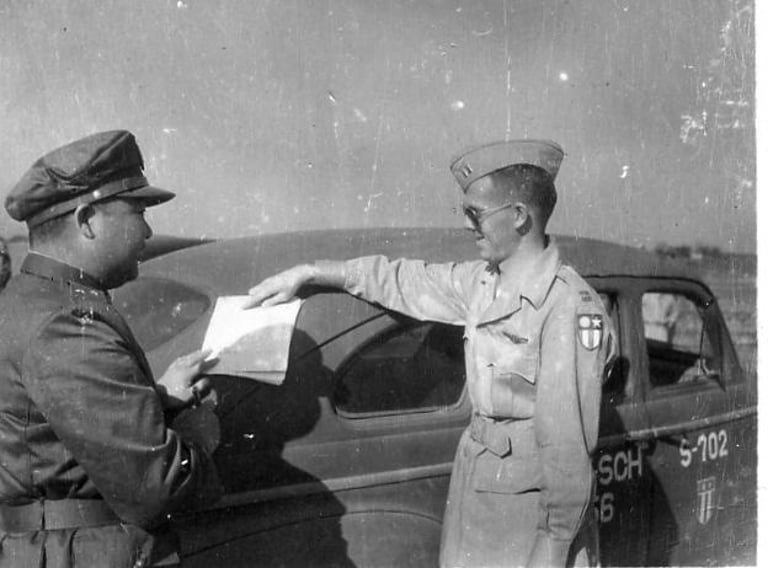
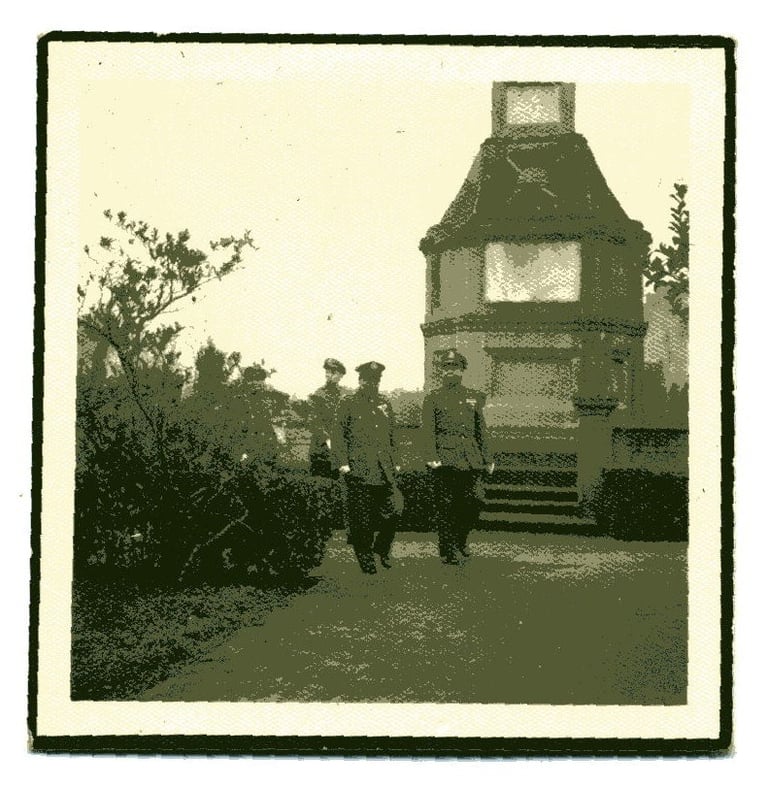
The Northern Expedition
Ordered to Hold a Thin Front
When the forces of Yan Xishan and Feng Yuxiang launched a massive counteroffensive, Guan Linzheng's brigade was ordered to defend the railway frontage and its right flank — a stretch of positions roughly twenty Chinese miles from Liuhe.
The defensive front was wide and the troops were stretched thin. A battalion under Liu Ziqing was temporarily placed under Guan Linzheng's command to help cover part of the line. Chiang Kai-shek himself was at Liuhe, personally directing the battle.
The Enemy Attacks in Full Force
When the battle opened, the fighting was ferocious from the first moment. The enemy came with everything they had — overwhelming firepower, overwhelming numbers. The thunder of guns was deafening; the battle cries shook the sky.
One by one, positions across Guan Linzheng's defensive line sent up distress signals. He fed his brigade reserve into the front line in successive waves to plug each gap — until there was nothing left in reserve.
Then came the worst news: the position held by Liu Ziqing's battalion had been broken through. Liu Ziqing himself had fought until he was wounded, and the entire battalion had fallen back in disorder.
Nothing Left — But Guan Linzheng Himself
Guan Linzheng received this devastating report with no reserves remaining and the entire brigade frontline still locked in desperate fighting.
He gave two orders simultaneously.
To his brigade: every soldier on every position was to hold to the last man and fight to the death — no retreat, no surrender. Officers such as Zhang Yaoming — then a lieutenant colonel serving as regimental deputy under Du Yuming's regiment, later to become Commander of the Taipei Garrison — was wounded in this very battle, yet bound his wounds and fought on.
To higher command: he reported the crisis and called for reinforcements.
Then he personally led the brigade staff officers and his close-protection platoon — barely thirty men in total — and rode hard toward the gap left by Liu Ziqing's broken battalion.
The Empty City Stratagem — In a Cornfield
Fortune offered one advantage: it was autumn in Henan, the season of the qingshaqzhang — the "green gauze curtain." The sorghum and maize had grown to a height of fifteen to twenty feet. You could not see more than a few dozen paces in any direction.
Guan Linzheng used this to his advantage. He spread his thirty-odd men as widely as possible through the tall crops, stretching their presence across the entire width of the gap. The appearance of a defended line was restored.
He then ordered every man to fire continuously and at random — whether they saw an enemy or not — so that the sound of gunfire never stopped, and the enemy would have no way of knowing that the defending battalion had withdrawn.
The Enemy Hesitates
The enemy was just as blind in the tall crops. They had not seen Liu Ziqing's battalion retreat, and they could not see that barely thirty men now stood between them and Chiang Kai-shek's headquarters.
Hearing that the guns on this section of the line had not gone silent, they assumed the position was still held in strength.
Like Zhuge Liang's "Empty City Stratagem" — where Sima Yi, suspecting a trap, dared not advance — the enemy continued to bombard with artillery but did not mount a major infantry assault.
Thirty Men Holding a Battalion's Front
To plug an infantry battalion's position with thirty men from a brigade headquarters was, in terms of firepower and numbers, almost nothing.
But in that razor-edge moment of crisis, if the commander had not thrown himself forward with gambling-style boldness — leading from the front, using every ounce of his ingenuity — the entire line would have collapsed and the army would have been destroyed.
This was no small matter: Chiang Kai-shek's forward command post at Liuhe railway station was only twenty Chinese miles away. Had Guan Linzheng not plugged the gap the moment Liu Ziqing's battalion broke, the enemy could have driven straight through to Chiang's headquarters.
People said afterward: "The leader's danger at Liuhe was greater even than Zhuge Liang's danger at the Empty City."
Reinforcements Arrive — and a Famous Question
Guan Linzheng held the deception until midday, when headquarters finally dispatched reinforcements led by Hu Zongnan — then deputy commander of the 1st Division — to fill the gap properly.
When Hu Zongnan reached the front line and saw the brigade commander himself crouching in the dirt with a rifle, holding the position like a common soldier, he could not hide his astonishment.
He said: "How is it that the troops have run — but the brigade commander has not?"
The story spread through the entire army. From that battle forward, Guan Linzheng's reputation for courage, resourcefulness, and fighting ability was firmly established — admired by his superiors and respected by his peers.
He was twenty-four years old.
A Night Raid on Nangong County — An Entire Brigade Annihilated
In the autumn of 1931, following the rebellion of Han Fuqu and Shi Yousan, and with Liu Guitang secretly colluding with the enemy, Guan Linzheng was reassigned as commander of the 11th Brigade of the 4th Division. He was ordered to attack Xia Ziming's brigade of Liu Guitang's forces, which was occupying and fortifying the county town of Nangong in Hebei Province.
Reconnaissance made clear that Xia Ziming's men had shut the city gates and set up strong defences throughout. A frontal assault would mean severe casualties. Brute force was not the answer.
Guan Linzheng decided on a stratagem.
Lulling the Enemy to Sleep
He ordered his troops to make camp in villages no closer than ten Chinese miles from the city walls — close enough to be seen, but far enough to suggest he was in no hurry. The purpose was to lull the defenders into lowering their guard.
Then he personally led a small party — including the bold and capable regimental commander Zhang Yaoming and battalion commander Qin Yizhi — moving through the cover of the autumn crops, pressing up close to the city walls to personally observe the terrain and probe for weaknesses.
The Plan: Sun Tzu's "Swift as the Wind"
Returning from his personal reconnaissance, Guan Linzheng briefed his battalion and regimental commanders face to face.
The plan followed Sun Tzu's principle: "Move like a startled hare — swift as the wind."
Qin Yizhi's battalion would use the cover of darkness to move silently to within striking distance of the city gate. Every man would have live rounds chambered and bayonets fixed. But no one was to fire a single shot before entering the gate — on pain of military law.
Guan Linzheng's reasoning: once the enemy knew the troops had settled into camp in the surrounding villages, they would relax. Sooner or later, the city gate would be opened — if only a crack — to send someone out to scout. That was the moment to strike.
All other battalions and regiments would be positioned nearby, ready to follow through the gate or intercept any breakout.
The Gate Opens — Strike
The plan unfolded exactly as Guan Linzheng had predicted.
Qin Yizhi's battalion had barely finished moving into position outside the walls — concealed, bayonets fixed, not a sound — when the defenders, seeing no movement outside for some time, opened the city gate a fraction and sent a few soldiers out to have a look.
The hidden troops erupted. They seized the gate before it could be slammed shut and poured through in a flood. The main force followed immediately.
Three columns drove simultaneously into the city: along the top of the walls from both sides, and straight down the central street toward the heart of the town.
Total Victory in Hours
The effect was like two arms wrapping around a body while a blade drove straight into the chest.
Only then did the shooting begin.
The enemy commander Xia Ziming — known for his ferocity — was caught completely off guard. He dropped his pistol in fright, fled with his hands over his head, and escaped the city by rope over the far wall.
Within a few hours, Nangong was fully retaken. Guan Linzheng's brigade suffered only about thirty casualties. Xia Ziming's entire brigade was annihilated. The captured horses and mules alone numbered over eight hundred. Weapons were stacked in mountains.
Why This Victory Matters
The capture of Nangong was one of the most complete victories in the entire Northern Expedition — and the battle Guan Linzheng himself considered his finest achievement in those early years.
Sun Tzu wrote: "If you outnumber the enemy ten to one, surround him; if two to one, attack him."
Yet here was Guan Linzheng — one brigade against one brigade, equal numbers — the enemy rested and fortified behind thick walls, he the attacker. And in a few hours, with minimal casualties, he took the city entirely.
This was not the work of brute courage. It was the product of sharp judgment, calculated timing, and total command of his own men.
Three Reasons This Battle Could Not Fail
Guan Linzheng identified three reasons afterward:
First: He did not attack the moment he arrived. Had he struck immediately and been repulsed, the enemy would have been alerted and the opportunity for a surprise strike would have been lost forever.
Second: He personally went forward to scout the walls himself. Had he not done so, he would not have caught the precise moment when enemy uncertainty caused the gate to open.
Third: His men were disciplined enough to hold their fire. Had even one soldier in Qin Yizhi's battalion fired a single shot prematurely, the entire plan would have collapsed.
All three conditions had to hold simultaneously. Remove any one of them, and the battle would have become a costly, prolonged siege.
A Historical Error on the Monument
The monument to the restoration of Nangong, hanging today in the National History Artefacts Hall in Taipei — with an inscription attributed to "Chiang Chung-cheng of Fenghua" — states that the city was retaken by "the 11th Brigade of the 4th Division, together with the Independent Brigade of the 1st Division."
This is historically inaccurate.
According to Guan Linzheng himself, when his 11th Brigade attacked Nangong, Division Commander Xu Tingyao had not yet arrived at the front. No friendly units participated. The so-called "Independent Brigade of the 1st Division" simply did not appear in this battle.
Regimental commander Zhang Yaoming and many other officers who took part in the battle were still alive in Taiwan and could confirm this. Guan Linzheng wrote formally to request a correction — the details of which appear at the end of this document.
The Attack on Daming City — Victory, but at a Cost
From platoon leader to brigade commander, what stands out across all of Guan Linzheng's early battles is this: beyond his courage and resourcefulness, virtually everything he knew came from the battlefield itself, not the classroom.
His military academy training gave him a foundation. But his real knowledge — his tactical instincts, his command judgment — was built entirely through combat: thinking hard under fire, learning on the spot, and absorbing the lessons of each engagement.
It was precisely this gap in experience that led to his one genuine regret from this period: the attack on Daming City.
Riding High After Nangong
Fresh from the annihilation of Xia Ziming's brigade at Nangong, Guan Linzheng turned his force toward the main base of the rebel general Liu Guitang in Daming City.
By this time, Division Commander Xu Tingyao had arrived at the front. The brigade was riding high — the eight hundred captured horses and mules from Nangong had been incorporated into the force, increasing its mobility considerably. Guan Linzheng kept all the animals for his men and surrendered all captured weapons upward to the division, as regulations required. The troops' confidence in their commander was absolute. Morale was at its peak.
A Heavily Defended City
Liu Guitang had watched the fall of Nangong and had no intention of repeating Xia Ziming's mistakes. He sealed Daming City's gates, reinforced every position, and prepared for a fight to the death. He was determined not to be taken by surprise.
Xu Tingyao directed Guan Linzheng's 11th Brigade to surround the northern, eastern, and western faces of the city. The New 35th Division under Cui Zhentang was assigned the southern face. Once encirclement was complete, Guan Linzheng's brigade would lead the assault.
The Breach — and the Trap
The walls were high and thick. Artillery was brought up and concentrated on the northwest section, where the terrain was most complex. After half a day of bombardment, a breach was opened in the northwest wall.
Guan Linzheng ordered the assault. At his command, the attacking troops rushed the breach with everything they had — like a dam breaking, surging forward, fighting to be first through the gap.
What no one had anticipated: the newly collapsed section of wall was nothing but loose, unpacked rubble and soft earth. No wooden planks or ladders had been prepared for crossing unstable ground. Hundreds of men reached the breach and found their feet sinking helplessly into the debris — unable to advance, unable to retreat, trapped in place.
A Costly Lesson
The defenders had been waiting for exactly this.
Machine guns opened fire directly into the breach. Hand grenades rained down. The men of Guan Linzheng's brigade, stuck in the rubble, could neither go forward nor pull back. More than two hundred were killed or wounded in front of that single breach. The assault stalled.
When Guan Linzheng recounted this battle to the author decades later, sorrow still showed clearly on his face.
He blamed himself. He had never been taught siege tactics at the Academy. He had no experience of attacking fortified walls. He had relied on courage alone — and men had died needlessly as a result.
He said: "A soldier must be prepared to die at any moment. But a commander must do everything in his power to avoid unnecessary sacrifice. This loss was avoidable. Xu Tingyao did not think it through carefully enough, and I commanded poorly — too eager for a quick victory, too short on experience. That is why I still carry this with me, even thirty years later."
His moral standard of command is plain in those words.
Recovery — and a Night Surprise
After halting the assault, Guan Linzheng immediately gathered his commanders for an all-night meeting. He worked out a new plan, requisitioned proper equipment for scaling walls, and reassigned each battalion and regiment its specific assault tasks. This time, preparation would be thorough.
But before the new assault could be launched, an unexpected incident tested him again.
Liu Guitang's rearguard cavalry — the last troops out of the city — slipped out under cover of darkness, lost their bearings, and stumbled directly into the vicinity of Guan Linzheng's brigade headquarters.
Gunfire suddenly erupted in the dark right outside his command post.
Composure in the Dark
With no warning, no clear picture of the situation, and the night pitch black, Guan Linzheng could easily have lost control. But he was calm.
He personally led his headquarters protection platoon and staff officers out to meet the threat, directing the counter-action himself — until the panicking, fleeing enemy cavalry was driven off.
By the time dawn came, the crisis had passed. When the brigade mounted its assault on Daming City, Liu Guitang's main force had already fled during the night. There was little resistance. The city fell.
Over a thousand remnants of Liu's force were captured. Liu Guitang's own chief secretary, unable to escape in time, was taken prisoner.
A Victory That Left a Scar
Daming City was retaken. But in Guan Linzheng's own judgment, the victory was incomplete.
The two hundred men lost in the failed first assault never left him. He never stopped believing those deaths could have been avoided.
That sense of personal responsibility — the refusal to excuse himself because the men had died bravely, or because the walls were formidable, or because these things happen in war — was the measure of the man.
Promoted at Twenty-Six — A Division Commander
In the autumn of 1932, Guan Linzheng was promoted to commander of the 25th Division at the age of just twenty-six. His deputy was Du Yuming. The division comprised the 73rd and 75th Brigades, commanded by Liang Kai and Zhang Yaoming respectively, with regimental commanders Qin Yizhi, Zhang Hanchu, Wang Runbo, and Dai Anlan.
Japan Moves South — The Wall Must Be Held
In the spring of the following year, Japanese forces swept into North China, their spearhead aimed at Beijing. Guan Linzheng's 25th Division and Huang Jie's 2nd Division were ordered north, advancing toward Gubeikou on the Great Wall.
Guan Linzheng's division arrived five days ahead of Huang Jie's. The Northeastern Army units under Wang Yizhe had already fallen back from beyond the Wall, leaving the natural fortress of the Great Wall entirely undefended. If the Wall were lost, Beijing and Tianjin would be exposed.
Patriotic feeling across the country was at a fever pitch. To fail to fight would invite the condemnation of the entire nation — a charge that the central government was refusing to resist Japan.
One Division Against a Japanese Army — The Decision to Fight
Guan Linzheng assessed the situation with clear eyes. The enemy was a crack force. With only one division, the odds of victory were slim. But not to fight would shake the very foundations of national morale.
He made his decision alone: to lead the entire division forward to die for the nation if necessary, and in doing so, to steady the hearts of the people. He moved his force north to Gubeikou and began deploying for battle.
The defensive positions had barely been divided up and the fortifications had not yet been built when the Japanese struck. They opened with air bombardment, then artillery, then sent tanks forward to cover an infantry assault.
Hand-to-Hand on the Wall
Every man of Guan Linzheng's division fought with everything he had. The battle became hand-to-hand combat. Casualties mounted terribly. Regimental commander Wang Runbo fell to a Japanese sword — his head cut from his body. The regiment under Dai Anlan, defending the tower known as the Jianglou, also called for urgent reinforcement.
Guan Linzheng went forward personally to direct the defence, moving up to the front-line company positions. Company commander Yan Shouting had been gravely wounded, blood streaming down his face, yet he bound his wounds and kept fighting.
The position was on the verge of collapse. The enemy surged forward in waves.
Wounded Five Times — Would Not Leave the Line
Guan Linzheng directed the defence from the front line itself. Japanese grenades exploded around him and he was wounded in five separate places. He was covered in blood. He did not step back.
Every one of the ten-odd staff officers and orderlies who had accompanied him to the front was killed.
But the line held. The Japanese assault was broken and the enemy withdrew without achieving their objective.
The attacking force was part of the Japanese 8th Division under Nishigi Yoshikazu.
Carried Off the Field — The Division Holds On
After the battle, Guan Linzheng was transported to Peking Union Medical College Hospital in Beijing for treatment. Command of the division passed temporarily to Du Yuming, who continued to hold Gubeikou together with the reinforcing units that arrived — Huang Jie's 2nd Division, Wang Jingjiu's 87th Division, and Liu Kan's 88th Division — all under the unified command of Xu Tingyao, holding the Great Wall against further Japanese attack.
A Nation Celebrates — A City Goes Flower-Mad
When news of the victory spread, the whole country erupted in celebration. The world took notice.
In Beijing, female students from every school and university lined up each day to bring flowers to the hospital — the queues stretched all the way down Wangfujing Street. So many flowers arrived that each evening a motor car was needed to cart away what had accumulated during the day.
Zhang Jiluan of the Ta Kung Pao wrote an editorial headed: "Patriotic Sons, Blood Spilled on the Field of Honour." Luo Jialun composed a poem in tribute. Messages of congratulation and comfort came flooding in like snowfall.
Back to the Front — Wounded, on a Walking Stick
Guan Linzheng did not wait to recover fully. With his wounds still bandaged and leaning on a walking stick, he returned to the front line and held the Great Wall for more than two months. Throughout that time, the Japanese did not dare advance a single step further.
Eventually both sides negotiated a ceasefire and signed the Tanggu Truce. Only then did the 25th Division withdraw to Beijing for rest and reorganisation.
Respected Even by the Enemy
After the battle, the Japanese army — in a mark of respect for the courage of the 25th Division — erected a grave and stele at Gubeikou for the division's fallen soldiers. The inscription read: "Tomb of the Brave Warriors of China."
Huang Jie, who had witnessed his comrade Guan Linzheng's bravery firsthand, composed a poem in tribute. Among its lines were the words: "All say you are without equal — throwing down my whip, I know I cannot match you."
Guan Linzheng was subsequently awarded the Order of Blue Sky and White Sun. His name for courage became known to every man, woman, and child.
An Eyewitness Account — From a Contemporary Record
The following passage is drawn from a contemporary account titled "The Fall of Rehe in the Early Period of the War of Resistance," written by a witness who was in Beijing and Tianjin at the time. It describes what he personally saw and heard regarding the 25th Division's seizure of the Wall and its fierce fighting, and the stir caused by Guan Linzheng's wounding at Gubeikou:
"...The commander of our army's 25th Division, General Guan Linzheng, was ordered to lead his force eastward from Beijing through Miyun and Shixia, with the mission of holding Gubeikou. The division marched in good order, unhurried and untroubled. Local villagers were astonished to see soldiers carrying their own cooking equipment — something unheard of under warlord armies, which would have commandeered vehicles and labourers even on a combat march.
When word came that Chengde had fallen and the Japanese were advancing, General Guan ordered the division forward at forced-march pace — mirroring Zhang Zizhong's 20th Army racing to reinforce Xifengkou. At this moment, the Northeastern Army units under Wang Yizhe were retreating back through Gubeikou from beyond the Wall in complete disorder, streaming southward toward Beijing along the very road the 25th Division was advancing on, without stopping, without firing a single shot.
When the 25th Division reached Gubeikou, it immediately deployed to occupy the Great Wall positions. The men had barely caught their breath when the Japanese arrived.
The terrain at Gubeikou is not particularly precipitous. The Wall has numerous gaps and stretches for dozens of miles east and west across gentle, rolling hills with occasional small basins — terrain that offered little tactical value and gave no room for General Guan's preferred formation, his celebrated "plum-blossom mother-and-child defence array," which worked equally well in attack or defence. The ground simply would not allow it.
So when the two armies made contact, the fighting immediately became hand-to-hand. Our soldiers swung cold steel at the stubborn enemy, spilled their blood on yellow sand, and fought a desperate battle on the open ground before the Great Wall — a battle that shook heaven and moved ghosts to weep. General Guan directed the fighting from the front line, in the midst of smoke and shellfire.
This battle marked the first engagement between central government forces and the Japanese army in the early period of the War of Resistance. It gave the Japanese a sharp lesson, and it changed their contemptuous attitude toward "Chinese troops" that they had carried until then.
Sadly, General Guan was struck by enemy grenade fragments in five places and was taken to Peking Union Medical College Hospital in Beijing. Command at the front passed to Deputy Division Commander Du Yuming, whose men followed the path their commander had set — fighting with skill and determination. As reinforcements arrived, that ground, before it was declared a demilitarised zone, was never yielded to the Japanese even by a single step.
While Guan Linzheng lay recovering in Beijing, the entire city seemed to go slightly mad. Female students from every secondary school and university skipped morning classes to bring flowers to the hospital, forming queues that stretched all the way up Wangfujing Street. Flowers piled up in mountains; each evening a motor car carried away the day's accumulation.
Every newspaper, large and small, was filled with praise. The Ta Kung Pao and Wen Hui Pao in particular ran the eight characters 好男儿热血洒疆 — "Good sons of China, hot blood spilled on the frontier" — in half-page banner headlines. Such honour, such esteem — it filled one with boundless admiration.
After surgery at the Union Hospital to remove shell fragments, General Guan once again bound his wounds, took up his walking stick, and went back to the front to join the allied forces in the Battle of Nantianmen. The results were brilliant, the world rejoiced, and the invaders were shaken.
This created one of the most celebrated passages in the history of the Republic: "Zhang Zizhong wins glory at Xifengkou; Guan Linzheng destroys the enemy at Gubeikou."
The Battle of Gubeikou — A Firsthand Account
By Qin Yizhi and Yao Guojun
Background: Japan's Advance Into North China
In 1932, Guan Linzheng had just been promoted from brigade commander of the Independent Brigade of the 4th Army to commander of the 25th Division when the Japanese invasion army, already in occupation of China's three northeastern provinces, began active preparations to attack North China.
In January 1933 they seized Shanhaiguan. In late February they attacked Rehe. By early March they had occupied the entire province of Rehe and launched attacks against the Great Wall defence line — against Song Zheyuan's force at Xifengkou, Shang Zhen's force at Lengkou, and the Northeastern Army holding Gubeikou.
Public feeling in Beijing, Tianjin, and across Hebei was running at fever pitch, with urgent calls for resistance against Japan.
The Order to Move North
Under pressure from civic groups across North China and from Zhang Xueliang — who demanded that troops be sent north to reinforce the resistance — the Nationalist central government ordered Guan Linzheng's 25th Division to travel by rail from Xuzhou to concentrate near Tongzhou outside Beijing, with Huang Jie's 2nd Division to follow and concentrate near Baoding. Both would be under the command of He Yingqin.
In early March 1933, while the 25th Division was concentrating near Tongzhou, an urgent message arrived from Zhang Xueliang — then acting chairman of the Beijing branch of the Military Affairs Commission — reporting that fighting at Gubeikou had become extremely fierce and requesting that Guan Linzheng bring the entire 25th Division forward as reinforcement immediately.
Pressing Forward Against Orders
Guan Linzheng, thinking always of the broader situation, assembled the whole division and spoke to the men himself — raising spirits and strengthening their resolve to fight. The division set off for Gubeikou through the night.
While on the march, orders arrived from He Yingqin, reinforced by a senior staff officer sent in person, instructing the division to halt and stand by near Shixia township, north of Miyun County.
Guan Linzheng weighed the order carefully. If the division stopped mid-march, the Japanese could well seize Gubeikou and the critical Nantianmen defensive line south of it — threatening not only the other units fighting along the Wall but Beijing itself. The consequences for North China would be severe.
He decided to continue the advance.
Arriving at the Wall — Taking Over From a Broken Army
When the 73rd Brigade commander Du Yuming led the vanguard into Gubeikou, the Northeastern Army division under Zhang Tingzhu — its men exhausted and its casualties severe — was barely holding on and repeatedly requesting relief. When Guan Linzheng himself arrived, Zhang Xueliang sent the Northeastern Army's corps commander Wang Yizhe personally to Gubeikou to arrange the handover, formally requesting that the 25th Division take over the entire defensive line from Zhang Tingzhu's force.
To stop the Japanese advance, Guan Linzheng committed the bulk of the 25th Division to holding the Gubeikou line, with a portion occupying key points near Nantianmen as a reserve position. After personal reconnaissance and assignment of sectors to each unit, he executed the relief of the entire Gubeikou line at dusk in a single movement, then spent the night strengthening the fortifications.
The Terrain — and Its Challenges
The 25th Division occupied the high ground and Wall on both sides of Gubeikou, with the emphasis on the high ground to the right. Much of the Wall on the heights was held by Chinese forces, creating an interlocking, mutually supporting line. The high ground directly in front of Gubeikou was comparatively steep and difficult to assault, so the Japanese concentrated their main effort against the high ground to the right of Gubeikou.
The division's weapons were rifles, light and heavy machine guns, mortars, and grenades. The enemy facing Gubeikou was the Japanese 8th Division, with superior weapons and equipment. What the Chinese had was fierce morale and a terrain that favoured close-quarters fighting.
Three Days of Hell
The Japanese method was consistent: first a barrage from field and mountain artillery, with aircraft conducting reconnaissance and bombing runs to cover the infantry advance. Wherever the enemy's artillery concentrated its fire, that was where their infantry would push.
Under artillery cover, the Japanese infantry launched repeated assaults against the Chinese positions. Every one was beaten back. Casualties on both sides were severe.
Guan Linzheng sent a full situation report to Chiang Kai-shek and He Yingqin. What was deeply moving was the response of Beijing's civic organisations, who loaded motor cars with flatbread and winter clothing and drove them continuously to the front — a gesture that stirred the fighting men enormously. Division commander and brigade and regimental commanders alike directed the fighting from the front.
Through each night, the Chinese troops used the pause in enemy artillery to continue strengthening their positions.
On the second day, the Japanese artillery resumed its heavy bombardment fore and aft of the Chinese line, covering more infantry assaults. All were repulsed.
On the morning of the third day, the enemy increased its artillery against the right flank — hammering the positions of the 149th and 145th Regiments from front and rear — and sent the infantry in again and again. Close-quarters fighting broke out repeatedly. The fighting was at its most savage.
Regimental commander Wang Runbo of the 149th Regiment was severely wounded and died at his post. The 145th Regiment, its casualties mounting beyond endurance, also called for reinforcement.
Guan Linzheng Goes to the Front — and Falls
Guan Linzheng personally led a reserve infantry battalion forward to reinforce. As they approached the 149th Regiment's position, they found Japanese infantry already overrunning it. Guan Linzheng immediately directed the reserve battalion in a counter-attack. The fighting was at its most desperate. Casualties on both sides were enormous.
Guan Linzheng himself was struck by grenade fragments in five places. But the enemy was driven back and the line was sealed.
He was carried by stretcher to the division command post, which had been established in the Guan Di Temple near Gubeikou. Even as his wounds were being dressed, he issued orders: Du Yuming, the 73rd Brigade commander, was to be appointed deputy division commander and to assume acting command immediately. He also sent a telegram to Chiang Kai-shek and He Yingqin reporting the situation.
By this point the division had suffered over a thousand killed and wounded. Guan Linzheng instructed Du Yuming that if the situation required it, the force could fall back to the prepared positions near Nantianmen.
Du Yuming adjusted the defensive deployment that same night — shortening the front line, strengthening the fortifications, and sending a regimental commander to reinforce the reserve position at Nantianmen.
The Fourth Day — Withdrawal to Nantianmen
On the morning of the fourth day, Japanese artillery continued its barrage, but the enemy infantry — having suffered heavily over the previous three days — no longer pressed with the same ferocity. Taking advantage of this, the Chinese forces conducted a phased withdrawal from the front line to the Nantianmen reserve positions during the afternoon. Throughout the withdrawal, the Japanese artillery and aircraft remained active, but their infantry did not follow up.
Relief Arrives — Too Late for Gubeikou
The 25th Division had fought the Japanese 8th Division at Gubeikou for three full days and nights. On the morning of the day after withdrawing to the Nantianmen line, the vanguard of Huang Jie's 2nd Division finally arrived near the 25th Division headquarters and made contact with Deputy Commander Du Yuming. Simultaneously, orders arrived for the 2nd Division to take over the Nantianmen line, while the 25th Division withdrew to the rear to rest and replenish.
The battle of Gubeikou had profound significance for the entire Great Wall campaign. After Guan Linzheng was wounded, civic organisations and newspapers across Beijing rallied to express their warmth, admiration, and praise. The Nationalist central government awarded him the Order of Blue Sky and White Sun.
Back to the Front — Again
After a brief period of rest and reinforcement, the 25th Division returned to the front to fight alongside the 2nd Division. Guan Linzheng's wounds had not yet healed, but he rejoined his division to direct the fighting. The division remained on the line until late April, when it was finally ordered to pull back and occupy positions north of Miyun County in preparation for further fighting.
By then, however, the Japanese — having taken the Nantianmen to Shixia area — did not advance further.
Tears at Miyun — The Tanggu Truce
In late May 1933, the 25th Division was ordered to concentrate and rest near the northern outskirts of Beijing.
When Guan Linzheng left Miyun County, he saw the terror on the faces of the local people — their dread of what the Japanese might do when the army departed. He could not hold back his tears.
"The government has disregarded the safety of the people and ordered the troops to withdraw," he said. "We have truly let the common people down."
Only later did he learn the full reason: China had signed the Tanggu Truce with Japan, requiring Chinese forces to withdraw from the Luandong area east of the Luan River.
Forced Out of Beijing — The He-Umezu Agreement
After the Tanggu Truce, Huang Jie's 2nd Division was stationed between Beijing's Nanyuan airfield and Baoding for training. Guan Linzheng's division concentrated in the Beiyuan area north of Beijing for reorganisation and training.
In early June 1935, the Beijing branch of the Military Affairs Commission was forced to sign what became known as the He-Umezu Agreement with the commander of Japan's China Garrison Army, General Umezu. Among its terms: all Nationalist central government forces, the 3rd Military Police Regiment, and the Northeastern Army's 51st Corps were to withdraw from Beijing and Hebei Province.
Guan Linzheng Objects — and Loses
Guan Linzheng went personally to He Yingqin and argued with passion: withdrawing from Beijing and Hebei without a fight would lose the trust of the people and damage the credibility of the central government. He urged that preparations be made for battle against Japan. He also sent a telegram directly to Chiang Kai-shek, warning in plain terms that a withdrawal without resistance would gravely damage Chiang's own standing and authority.
At the same time, he ordered the 25th Division to begin immediately constructing defensive positions around the outskirts of Beijing, in preparation for fighting the Japanese.
None of these representations were approved. The 25th Division was ordered to concentrate near Changxindian and travel by rail to Luoyang in Henan Province for training. Huang Jie's 2nd Division was ordered to Xuzhou in Jiangsu.
A Farewell at Changxindian
As the 25th Division gathered near Changxindian preparing to move south, teachers from Beijing schools who had befriended Guan Linzheng made the journey out to see him off.
He spoke with raw feeling. This departure under orders, he said, had left him unable to fulfil his duty of resisting the Japanese invaders. He felt he had failed the expectations of every fellow citizen in Beijing. But he expressed his belief that the patience of the government and the people of China had its limits — that in the end, they would unite and fight Japan together.
Then, with evident reluctance, he said his farewells and left.
A Meeting With Chiang — and a Private Word
In June 1935, as Guan Linzheng led the 25th Division to Luoyang, passing through Zhengzhou, a telegram arrived from Chiang Kai-shek — then in Sichuan — summoning him: "Come to Sichuan to see me at once."
This was during the period when Chiang was at Mount Emei in Sichuan directing Nationalist operations against the northward-marching Red Army. Guan Linzheng met with Chiang, then returned to Luoyang.
He spoke privately to those close to him afterward: "The Generalissimo still insists on the policy of 'pacify within before resisting without' — meaning he is set on eliminating the Communist Party first. But there is nothing to be done about it, because the Communist Party has a base among the people and international connections. It cannot be eliminated."
Kang Ze Comes to Luoyang
Not long after the 25th Division arrived in Luoyang from Beijing, Chiang Kai-shek sent Kang Ze to Luoyang to call on Guan Linzheng and to address the troops of the 25th Division. Kang Ze offered a few words of praise for the division's resistance at Gubeikou, then proceeded to deliver the standard line: "Pacify within before resisting without."
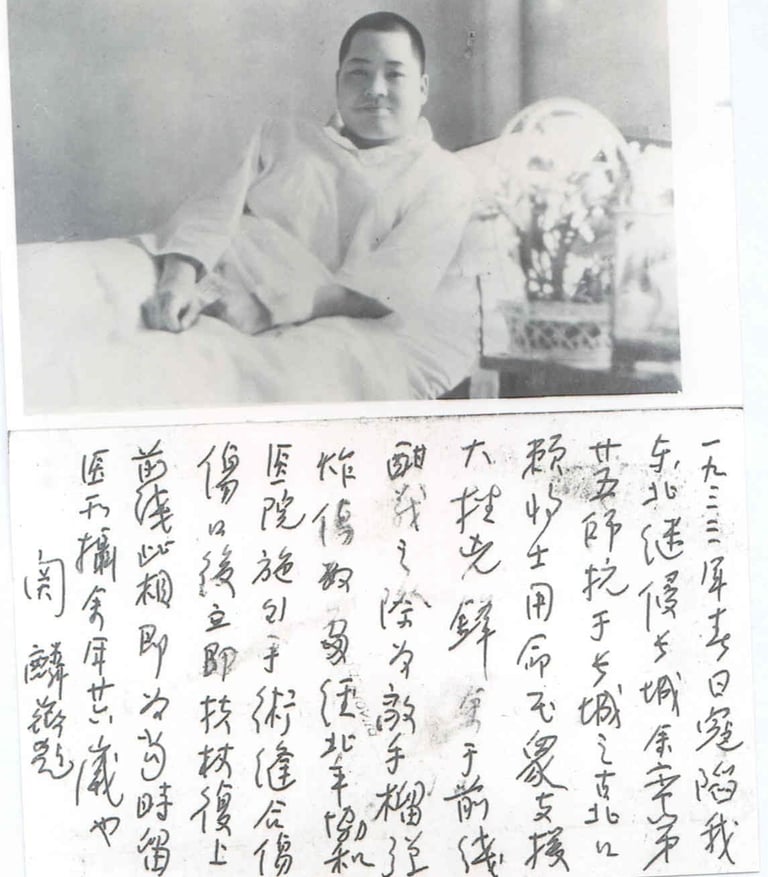
The Battle of Gubeikou — Fighting Japan at the Great Wall
A Poem by Guan Linzheng
Half the rivers and mountains lost beneath rising smoke,
Beacon fires glow red on the frozen northern land,
Beyond the Wall the invaders water their horses,
Iron hooves at our doorstep,
the ancient city at risk,
A great house collapsing into fire and ruin,
The fate of China hangs in a single breath,
How could I bend my knee and beg for hollow peace?
Standing tall, offering my head,
I smile without fear,
The sons of Yan and Huang carry pride in their bones,
I volunteer three times to take up arms against Japan.
The Battle of Tai'erzhuang
A Poem in Tribute — Yu Dafu
Written to Honour General Guan's Victory in the Pizhou-Tancheng Area After the Battle of Tai'erzhuang
Blood flows thick at the head of Shuijing Gou,
The setting sun hangs beyond Tai'erzhuang,
Standing in the saddle on the open plain, gazing into the distance,
Word arrives suddenly — the brilliant force has taken Pizhou and Tancheng.
The Greatest Victory of the War
The Battle of Tai'erzhuang, fought from the 24th of March to early April 1938 — also known as the Great Victory of Tai'erzhuang — was the largest single engagement of China's full-scale War of Resistance against Japan. It was a battle of sheer brutal force on both sides, and the first great victory in which a numerically superior Japanese force was smashed into complete rout. Of the more than fifty thousand Japanese troops committed, over thirty thousand were killed on the battlefield. Barely ten thousand escaped with their lives. The victory sent the entire nation into celebration and shocked the world.
Many commanders of the National Army contributed to this extraordinary achievement. But across all accounts — official histories and private records alike, Chinese and Japanese sources both — there is unanimous agreement: the commander who killed the most enemy troops and contributed the most to the victory was General Guan Linzheng, whose forces bore the main burden of the attack. His conduct of this battle stands out in three respects above all others: his courage and composure in the face of crisis; his almost supernatural ability to read the enemy and seize the decisive moment in the final five minutes; and his brilliant strategic thinking, which inflicted maximum destruction on the retreating enemy and produced the greatest results of the entire campaign. As a direct consequence of this battle, Guan Linzheng was promoted from corps commander to army group commander.
Tai'erzhuang — The Place and the Battle
A Town on the Canal
Tai'erzhuang was a railway station on the Tianjin-Pukou line, on the northern bank of the Grand Canal in Shandong Province — and also a large village, a key junction on the route to Xuzhou. It had some three thousand four hundred households, enclosed within earthen walls, with more than seventy blockhouses inside. The town ran roughly one kilometre north to south and two kilometres east to west. Thirty-four kilometres to the northwest lay Yi County. The surrounding terrain was mostly flat, with villages scattered across it and occasional low hills of no great height. It was a prosperous, settled countryside.
But after the savage fighting that followed, eight or nine out of every ten buildings in the town were destroyed. Tai'erzhuang became a ruin — and a ruin that shines with a glory shared by the entire Chinese nation.
The Japanese Assault
The battle for Tai'erzhuang opened with Japanese General Itagaki Seishiro's division attacking two divisions of General Sun Lianzhong's force. The fiercest and most steadfast defence was put up by General Chi Fengcheng's 31st Division.
The Japanese subsequently committed Itagaki Seishiro's division as well, together with dozens of aircraft, nearly a hundred field and mountain guns, and approximately forty tanks — a combined force of over fifty thousand men. Their aim was to destroy Sun Lianzhong's force in a single blow and seize Tai'erzhuang.
Despite repeated close-quarters fighting, constant bombing and shelling, and appalling casualties, the Chinese defenders at Tai'erzhuang adopted a method of holding by day and counter-attacking by night, and held their ground waiting for relief. By the end, three-quarters of the defensive positions inside and around Tai'erzhuang had been lost. Still the Chinese did not withdraw. They waited for the relieving force.
This defence was a feat that shook the heavens and moved the spirits of the earth. As it is not the main subject of this account, the full story of those courageous defenders is noted only briefly here.
The Relief Force — Guan Linzheng Leads the Main Attack
After the battle for Tai'erzhuang began, theatre commander Li Zongren ordered Army Group Commander Tang Enbo to lead Guan Linzheng's 52nd Corps and Wang Zhonglian's corps in an attack on the Japanese forces surrounding Tai'erzhuang from the outside.
The first objective was the Zaozhuang area near Yi County. Here the main attack was assigned to Guan Linzheng's 52nd Corps — specifically, elements of the 25th Division under Zhang Yaoming and the 2nd Division under Zheng Dongguo — pushing into the villages in the Zaozhuang area and clearing them one by one.
The Japanese refused to yield. Guan Linzheng ordered the use of fire. Men climbed ladders onto rooftops and set the buildings alight, forcing the Japanese out of each village or destroying them inside. The fighting was every bit as savage as the earlier battles at East and West Baozhang.
The Plan Changes — Race to Tai'erzhuang
Just as Guan Linzheng's force was methodically destroying the ten-thousand-plus Japanese troops between Yi County and Zaozhuang, the situation at Tai'erzhuang became critical. Sun Lianzhong's defending force was in dire straits. Higher command ordered Tang Enbo's army group to drive immediately to the northeast of Tai'erzhuang and strike the Japanese attacking force in its flank and rear.
By this point the Japanese had committed not only Itagaki's division but Itagaki Seishiro's division as well — the latter tasked with blocking Chinese relief efforts — and Tang Enbo's army group was now locked in fierce fighting in the northeast Tai'erzhuang area against this blocking force.
Attacking Against the Odds — Fire as a Weapon
Tang Enbo Gives Guan Linzheng Free Rein
When the army group's mission changed to relieving Tai'erzhuang, Tang Enbo knew full well that Guan Linzheng excelled at offensive operations and that the 52nd Corps had an exceptional attacking spirit. He kept Guan Linzheng's force as the main attacking element.
Tang Enbo and Guan Linzheng were not merely commander and subordinate — they were close friends. In normal times the two argued constantly, but arguments were forgotten the moment they ended, and there was nothing they could not say to each other.
On the day he received his orders, Guan Linzheng made one condition: in everything concerning the conduct of the battle at the front — how to attack, how to defend — Tang Enbo was to give him complete authority and not interfere. Everything in the rear — supplies, ammunition, coordination with neighbouring units — Tang Enbo would handle. Tang Enbo, who was frank and open by nature and had the admirable quality of never holding grudges, and who knew how to identify talented subordinates and trust them fully, agreed immediately. He also transferred a portion of Wang Zhonglian's corps to reinforce Guan Linzheng's attacking strength. With responsibilities clearly divided and cooperation close, Guan Linzheng drove his force forward and launched a fierce assault on the Japanese left flank and rear.
Fighting Across Open Ground
The area northeast of Tai'erzhuang was almost entirely flat, with only a scattering of small hills — a broad plain dotted with villages. The attacking force had almost no cover from terrain or natural features. Fighting with inferior firepower, completely exposed, the 52nd Corps faced an extremely difficult task.
Fortunately, the Japanese were active during daylight but retreated inside the villages at night and dared not move. Guan Linzheng seized on this weakness. He adopted what he called the "fan the wind and start the fire" method: hiding by day, moving by night. Under cover of darkness his men crept close to the enemy positions, reducing casualties, and then when a village was taken, they climbed onto rooftops to start fires, using the direction of the wind to spread the flames.
With fire driven by wind and wind feeding fire, his force pushed through the Japanese-held villages one by one — attacking, burning, and bombarding. The Japanese "Akashiba Regiment" was completely annihilated by precisely this method. Progress, on the whole, was steady.
The Crisis of 31st March
A Sudden Reversal
Then, on the 31st of March, everything changed in an instant.
At around two o'clock in the afternoon, a group of senior officers from the theatre command, together with Army Group Commander Tang Enbo, arrived at Guan Linzheng's command post to observe the battle.
At that moment the 25th Division under Zhang Yaoming, attacking on the front line, was sending back one piece of good news after another. Guan Linzheng was in the middle of a buoyant battle briefing, his listeners sharing in the mood of excitement, when a report arrived: a Japanese force estimated at two to three thousand men, with field guns and tanks, was striking at the flank and rear of the Chinese position. Almost simultaneously, a deafening roar of gunfire broke out — the enemy had closed to within three or four Chinese miles of Guan Linzheng's command post.
It was later confirmed that this was the Yizhou Detachment of the Japanese brigade, attempting to raid Guan Linzheng's headquarters in a "capture the king" operation — to cause his attacking units to panic and collapse between two fires. The situation was desperate. Shells were already falling in the vicinity of the command post.
Seeing Off the Visitors With a Smile
The sudden change of situation — the shellfire erupting without warning — turned the faces of almost everyone who had come to observe white with shock. All except Tang Enbo himself were thrown into confusion. These were men who spent their days behind desks in rear headquarters, writing plans and reports, men who had never seen a battlefield. Now they were being told that the enemy had come up behind the command post — small wonder they had no idea what to do.
Guan Linzheng was worried that this crowd of panicked visitors would get in the way and undermine the morale of his men. He turned to Tang Enbo and said calmly: "There is nothing useful for the commander to do here. Please take everyone back to the rear, call up reinforcements, and send them forward. I have this situation in hand."
Then he turned to the others with a grin: "The Japanese are firing a salute in your honour. Time for you gentlemen to be on your way."
These men, who had gone pale at the sound of Japanese guns, found themselves looking at their host — calm, smiling, utterly untroubled in the middle of a crisis. When they got back to the rear, they could not stop talking about it: "Guan's reputation is entirely deserved. We saw it with our own eyes today — not a flicker of alarm."
Keeping the Front Line in the Dark
The moment his guests had gone, the Japanese raiding force pressed even closer to the command post.
At that moment, Zhang Yaoming — commanding the 25th Division on the front line — telephoned to ask why there was gunfire coming from the rear.
This put Guan Linzheng in an acutely difficult position. To tell the truth would be to shake the morale of the entire front line. If the attacking force learned that the enemy had swept around behind them, they might instinctively think of retreat — and caught between two fires, the result would be total annihilation.
To steady the men, Guan Linzheng borrowed a trick from the ancient general Tian Dan, who had deceived his own troops at the siege of Jimo to keep them fighting. He told Zhang Yaoming on the telephone: "A small enemy reconnaissance party in plain clothes has been spotted in the rear. We are sending men to drive them off. The gunfire you can hear is our own. Carry on with the attack as normal — this small group will be dealt with shortly."
Three Hundred Men Against a Reinforced Detachment
He had sent the rear-area visitors away. He had steadied the front line. And the enemy gunfire was drawing closer and heavier by the minute.
The force available to him at his command post was, in name, a full battalion. But the battalion had been fighting continuously and taking casualties, and now numbered barely three hundred men. Against the Japanese reinforced raiding detachment bearing down on him, this was — as the saying goes — an egg thrown against a rock.
But Guan Linzheng had always fought by seizing the initiative, leading the battlefield, making the enemy respond to his intentions rather than the other way around. Dangerous as his situation was, outnumbered as he was, his decision was: attack. Not a straightforward attack — a calculated, opportunistic feint. But attack nonetheless.
Audacity Against Audacity — The Second Empty City
Sun Tzu and Clausewitz
Sun Tzu wrote: "All warfare is based on deception." Clausewitz said: "The principle of war is founded on the duel between two men."
In the situation Guan Linzheng now faced, retreat meant certain destruction. Standing still and holding meant the same. But a direct fight was beyond his means.
It was like facing a vicious dog. Show fear and it will bite you. Step back and it will come after you. The only answer is to stand your ground, make a show of reaching for something on the ground — a stone, a stick — and force it to hesitate. Then find the stick and drive it off.
He had used this method once before, as a regimental commander during a rearguard action in the campaign against Yan Xishan and Feng Yuxiang. This would be the second time.
The Order to Battalion Commander Xu Wenliong
His mind made up, Guan Linzheng stood on a piece of high ground and summoned the only battalion commander he had with him — Xu Wenliang, a fifth-class graduate of the military academy, a Jiangxi man — and gave him his orders directly:
"I know you have always been brave and capable in battle. But I have never had the chance to see you fight with my own eyes. Now is your chance. There is an enemy force of unknown strength in the villages over there [pointing]. Take the whole battalion, fix bayonets, load your weapons, and advance toward the enemy at the double. Do not fire a single shot. When you reach approximately one thousand metres from the enemy and are facing them, halt. Deploy in position on the spot. Do not advance further. If the enemy attacks, hold your ground and do not give way. I will handle the rest."
Xu Wenliang, hearing the corps commander give the order personally and knowing he would be watching, was filled with excitement. He came to attention, turned about, ordered the whole battalion to fix bayonets and load, and led them forward at a run through enemy shellfire in full assault posture.
Only when Guan Linzheng raised his binoculars and saw the battalion halt and deploy at the right position did he allow himself to breathe.
The Trick Works — Reinforcements Arrive
If this moment were filmed, it could not be played by an ordinary actor. It required composure, quick thinking, courage, and iron determination all at once. That is what makes a true hero.
Shortly afterward, the 4th Division under Chen Daqing — who later became commander-in-chief of the army on Taiwan — arrived in response to Guan Linzheng's telephone call for reinforcements. A situation on the edge of disaster turned once again toward safety.
Why It Worked
To throw his entire available strength of three hundred guards into a feigned attack looked, on the surface, like a mantis trying to stop a cart. In truth it was the only correct course of action available.
Had the corps headquarters pulled back, the front line would have collapsed. Had he pulled men from the front line to plug the gap in the rear, it would have shaken morale, weakened the attack, and there was no time for it anyway.
Between the moment he ordered Chen Daqing's division forward and the moment that division arrived, if the Japanese had simply kept coming, three hundred men standing in place could not have stopped them. The only way to buy that time was to make the enemy hesitate — and the only way to make the enemy hesitate was to meet boldness with boldness, and play the Empty City stratagem once more.
He threw his three hundred men forward in a feigned assault — not holding, but attacking — pressing to within the range where the enemy could see them but could not yet shoot accurately. This left the Japanese uncertain and unable to decide. It froze them.
Reading the Enemy
There was also an element of precise enemy knowledge in this calculation.
Japanese tactical doctrine was methodical and cautious. Before any attack, they would first bombard with artillery to destroy the defending force's will to resist; then advance tanks to cover an infantry assault, minimising their own casualties.
When they suddenly saw the Chinese not defending but attacking, they assumed they had walked into a trap. The momentum of their advance was checked by the unexpected development directly in front of them. The Japanese commander, who had every opportunity to smash the 52nd Corps headquarters in a single thrust, now saw the headquarters launching its own counter-attack — and was thrown into confusion by the feigned assault of barely three hundred men. Unable to make up his mind, he halted the infantry and resorted to artillery bombardment.
By the time Chen Daqing's division came racing up, the Japanese dared not move forward at all.
And so the Empty City — as precarious as a pile of eggs — held. Crisis turned once again to safety.
Defending Baoding — Battle on the Zhanghe River
The Most Frustrating Battle of His Career
The Marco Polo Bridge Incident of the 7th of July 1937 opened the full-scale War of Resistance against Japan. By this time Guan Linzheng had already been promoted to commander of the 52nd Corps. But in the "Battle of Baoding" that followed — fought under the command of General Liu Zhi — Guan Linzheng would later admit that his 52nd Corps fought what he considered the most infuriating and humiliating battle in its entire history. That battle gave him a stomach ailment from sheer frustration that did not leave him until the great victory at Tai'erzhuang finally set things right.
Outnumbered Three to One — Outgunned Ten to One
The situation at the time was as follows. After the Japanese seized our positions at Nankou, Liangxiang, Fangshan, and surrounding heights, General Itagaki Seishiro led three divisions — some sixty thousand men — supported by aircraft and tanks, in an assault on Baoding. Guan Linzheng's 52nd Corps had only three divisions. The enemy outnumbered him three to one in men, and outmatched him ten to one in weapons and equipment. In this wildly unequal contest, Guan Linzheng shouldered the task of defending Baoding.
The Problem Was Not the Enemy
But the problem that emerged had nothing to do with the Japanese attack. It came from within — from a unit temporarily placed under Guan Linzheng's command that chose to shirk its duty rather than fight.
And the unit in question was the 17th Division under Zhao Shouzhan — a division belonging to Yang Hucheng's force, the very army that had kidnapped Chiang Kai-shek at Xi'an and demanded that China resist Japan. Now that there was real fighting to be done against the real Japanese enemy, their commander ran away.
"I've Lost My Courage"
After the 17th Division was placed under Guan Linzheng's command, Zhao Shouzhan began bargaining over his assigned defensive sector — this position would not do, that position would not do either. Guan Linzheng was beside himself with fury. But Zhao Shouzhan was a guest commander from a friendly unit, and some measure of courtesy had to be observed — he could not simply apply military law. So Guan Linzheng swallowed his anger, and in the midst of a rapidly deteriorating situation personally visited the 17th Division headquarters to negotiate with Zhao Shouzhan, letting him choose his own defensive line.
What did this division commander — a man past forty, fed by the state for decades, a Northwest Army general who had been shouting for years that China must resist Japan — say when the Japanese actually came?
He said: "I'm too old. I've lost my courage."
That such a shameless, contemptible thing could be said openly, in front of a superior officer and his own divisional staff, was an insult to every fighting man from the three Qin provinces who had ever served under the Northwest Army's banner.
By every instinct in him, Guan Linzheng wanted to have the man shot on the spot. But there was nothing he could do. After considerable persuasion, Zhao Shouzhan eventually agreed to take responsibility for part of the right flank, keeping a portion of his force as reserve. The entire north-Baoding front along the Caohe River line fell to the 2nd Division and the 25th Division alone.
A Front of One Hundred Kilometres — Two Divisions
The front to be defended stretched over a hundred kilometres. A single division can normally hold roughly ten kilometres. The result was a line with no depth at all — spread so thin it amounted to little more than a picket line. And the Caohe River itself was only about two zhang (around 20 feet) wide. Under air and artillery cover, the Japanese could cross it easily.
Higher command recognised that the 52nd Corps was dangerously understrength. Zeng Wanzhong's 3rd Corps was ordered to defend Mancheng, west of Baoding, to anchor the left flank of the 52nd Corps and free up troops to strengthen the main front.
"Tomorrow I Will Go"
But when Guan Linzheng prepared to shift forces from his left flank in anticipation, Zeng Wanzhong's 3rd Corps was still sitting ten kilometres south of Baoding, behind the 52nd Corps, watching and waiting. Guan Linzheng urged them forward repeatedly, asking them to advance to Mancheng and fight together. Zeng Wanzhong's answer each time was: "I'll go tomorrow."
Tomorrow became the day after tomorrow. The Japanese bombed and shelled the 52nd Corps for a full week. On the 21st of September the main assault was launched. The 3rd Corps still had not moved.
Guan Linzheng was left to fight with whatever he had. He reported the situation upward and directed the 2nd Division and the 25th Division to resist with everything they could muster, leaving the left flank exposed. His thinking at that point was simple: do your duty, and if necessary die for the country. That was all there was to it.
Abandoned on All Sides
But even as the fighting raged and Guan Linzheng steeled himself for a fight to the finish, the 17th Division on the right flank — under the general who had been calling for resistance against Japan for years — simply left. Zhao Shouzhan mounted his mule, turned north, and rode away, taking the entire 17th Division with him.
So the left flank had Zeng Wanzhong's 3rd Corps, which never came. The right flank had Zhao Shouzhan's 17th Division, which abandoned its position in the middle of battle. Only the two divisions of the 52nd Corps remained, holding an enormous front north of Baoding.
And then, without a word, the overall commander General Liu Zhi quietly withdrew from Baoding to Shijiazhuang — leaving the 52nd Corps, still fighting at the front, entirely without support or direction. Guan Linzheng cried out to heaven and received no answer, called to the earth and was not heard. Alone, unsupported on either flank, with nothing behind him, he was left to hold a vast exposed line north of Baoding and fight on.
The Verdict — From Both Sides
This was the most miserable, most infuriating battle of Guan Linzheng's entire career, from the day he was a platoon commander to the day he became a theatre commander. He himself called it the battle he fought most "stuffed in a bag."
General Liu Zhi, the officer responsible for the overall conduct of the campaign, wrote in his memoir My Recollections — on page 149 — that it was a case of "the Baoding resistance ending in military reversal," attributing it to friendly units having already withdrawn, an excessively wide front, and an enemy too numerous to hold. He also noted that enemy bombing had destroyed the railway bridge, preventing follow-on forces from reaching Baoding as planned.
General He Yingqin, in his book Eight Years of the War of Resistance, also recorded that Guan Linzheng's force was required to defend a front of over seventy kilometres with a strength far too thin for the task.
What was not adequately recorded was this: Guan Linzheng's two divisions were left to sacrifice themselves in that wretched situation, and the casualties they suffered numbered in the tens of thousands.
October — Striking Back on the Zhanghe
The Order to Attack
After that bitter battle, in October of the same year the 52nd Corps was placed under General Tang Enbo's command. The Japanese 6th Division was advancing along the Beiping-Hankou railway line, while the main force of the 14th Division pushed against the Chinese right flank from Feixiang, Cheng'an, and Linzhang. Japanese agents also infiltrated the refugee columns to slip across the Zhanghe River in civilian clothes, seizing the high ground around East and West Baozhang.
On the 21st of October, Tang Enbo ordered Guan Linzheng's 52nd Corps to attack the enemy in the East and South Baozhang area.
Fury Unleashed
The entire 52nd Corps had been simmering since Baoding — officers and men alike burning with frustration and grief. When the order to attack came, every man went forward without hesitation. No one held back. For every man who fell, another stepped forward. Guan Linzheng went personally to the front line to direct the battle.
Equipped with inferior weapons, attacking strongly held enemy positions, the men of the 52nd Corps advanced through Japanese shellfire without flinching. They engaged Doihara Kenji's 14th Division in a titanic struggle along the south bank of the Zhanghe River.
Fighting for Every Hilltop
Hand-to-hand fighting broke out on multiple occasions. Zhang Yaoming's 25th Division drove the Japanese off the high ground at East and South Baozhang and pushed the enemy back to the south bank of the Zhanghe River. The 2nd Division under Zheng Dongguo and elements of the 89th Division under Wang Zhonglian attacked in coordination with equal ferocity.
The Japanese counter-attacked. A see-saw battle developed across the heights at East and South Baozhang — ground lost and retaken, positions abandoned and recovered — time and again. Both sides suffered terrible casualties. Bodies lay across the fields. Blood ran in channels.
The Japanese advance was broken. On the 23rd they retreated in disorder, pulling back northward toward Shexian and Wu'an. The 52nd Corps, exhausted beyond measure, received orders to halt the pursuit.
The Price of Victory
This was the first time since the Japanese invasion began that the 52nd Corps had succeeded in defeating the enemy and forcing them to retreat.
But the 25th Division, which bore the main burden of the assault, paid a heavy price. Regimental commander Zeng Qian — a Hunanese, fourth class of the Whampoa Military Academy — died in hand-to-hand combat at Dujiagang, cut down by a Japanese sword. Another regimental commander, Zheng Mingxin — third class of Whampoa, a Cantonese — was severely wounded in the same battle.
That the attacking 25th Division lost one regimental commander killed in a bayonet fight with the enemy face to face, and another regimental commander gravely wounded, speaks without further words to the ferocity of the fighting and the weight of the casualties.
The 52nd Corps — built around the 25th Division as its core — had maintained its reputation as an elite force that fought and won on every battlefield since the Great Wall. That reputation was built, and maintained, by officers and men who upheld the fighting spirit established at Gubeikou.
Military commentator Huang Zhenhia, pen name Dongfang He, later read the memoirs of two regimental commanders from Doihara's division, who acknowledged in their own words that in this engagement the Japanese attack had been checked and the force compelled to withdraw northward.
A Daring Raid — Burning Japanese Aircraft at Handan
Choosing the Raiding Force
After the Japanese withdrew, Guan Linzheng looked at his men — exhausted after three consecutive days and nights of savage fighting, casualties heavy throughout the corps — and knew he could not order a general pursuit. But he was not willing to simply watch the enemy walk away from the battlefield.
From the 25th Division under Zhang Yaoming he selected his sharpest troops and sent them, under Battalion Commander Liang Zhiwei — a Yunnanese — on a surprise raid against the Japanese airfield at Handan.
The Raid
The Japanese had not imagined that a Chinese force, after such a battle, would still have the energy and the will to strike at Handan. They were completely unprepared. By the time they realised Liang Zhiwei's raiders were already upon them, it was too late to mount a proper defence.
The raiding force drove into the airfield. Most of the Japanese garrison was killed. Japanese air crew had no time to get their aircraft airborne. More than ten Japanese aircraft were set on fire and destroyed where they stood. Large quantities of weapons, equipment, and ammunition were seized. The raiders withdrew loaded with captured materiel, having achieved a total victory. The action was reported upward and celebrated up and down the chain of command.
Praise From On High
The theatre commander Liu Zhi had by then been transferred. The new commander of the 1st War Zone, Cheng Qian, sent a telegram of commendation — and added the caution: "Do not press your luck by going further."
With that, the Battle of the Beiping-Hankou Railway line came to a close. The 52nd Corps was subsequently transferred to take part in the Battle of Tai'erzhuang, where it would add another chapter to the most extraordinary victory in the history of the War of Resistance.
Lessons Written in Blood
General Guan Linzheng told the author:
"Most of what I know about fighting I learned from the enemy's shellfire and bayonets. At Gubeikou I was hit by Japanese grenades, so when I went back to Beiping to regroup and retrain, I had the entire division concentrate on rifle marksmanship and grenade throwing — and after that, we repaid the Japanese in their own coin. A good many Japanese soldiers died from our grenades.
In the East and South Baozhang fighting I also received two lessons written in blood. The first was terrain reconnaissance. In one attack, the map showed nothing unfavourable about the ground ahead. But when the men reached the enemy position, they found a sheer cliff face directly in front of them — the attacking troops were trapped, exposed to enemy fire, and took heavy casualties. After that I made it a standing requirement that the lead elements of any attacking unit continuously report the ground ahead.
The second lesson: on one occasion the enemy quietly evacuated a village overnight and concealed their full strength in ambush positions all around it. Our men attacked, entered the village, found it empty — and were then struck from all sides. We suffered serious losses. Later, at Tai'erzhuang, I turned this method against them. When the Japanese counter-attacked Aishan twice, I deliberately withdrew our men from the village, let the Japanese enter, and then closed the trap around them. All of it was experience bought with blood."
Defending Ruichang — Shielding Wuhan
The Plum-Blossom Formation — Twenty Days, Not One Hilltop Lost
In January 1938, during the Battle of Wuhan, Guan Linzheng led his force to defend the Ruichang and Yangxin area on the south bank of the Yangtze River. Yangxin lay north of the Fu River, backed by the natural barrier of the Mufu Mountains, its terrain a complex mix of hills and marshland — a major stronghold in the Jiangnan region.
The Japanese Terauchi Yoshiryo 9th Regiment came to attack, and a fierce battle of attack and defence unfolded along the roads between Ruichang and Yangxin. The Japanese assaulted Guan Linzheng's hilltop positions repeatedly for more than twenty consecutive days without taking a single one. Japanese radio broadcasts acknowledged that they had encountered a formidable enemy at Yangxin. Central command relayed these broadcasts to all units — both to commend Guan Linzheng's force and to encourage the fighting spirit of the wider army.
The Method Behind the Defence
What made this battle worth recording in particular was Guan Linzheng's defensive method. He deployed his force in the meihua zhen — the "plum-blossom formation" — arranged in interlocking circular positions. The Japanese attacked by day but never by night, so Guan Linzheng ordered each hilltop position to be held by one infantry battalion as its tactical unit, with standing orders to hold for one full day.
After enduring a full day of attack, that battalion was relieved at nightfall by a fresh battalion, which took over the fight. First and second line forces rotated in this way continuously, each battalion fighting one day at a time, knowing that no matter how ferocious the assault, they only had to hold until dark when relief would come.
The result was this: the Japanese would attack all day, taking heavy casualties, assuming that by the next morning the defenders would be shattered and the hilltop theirs for the taking. Instead, the next morning they were met by a completely fresh battalion at full fighting strength.
Furthermore, the interlocking plum-blossom positions could support one another mutually, creating a web of crossing fields of fire. Any Japanese assault on one hilltop was immediately struck from the flanks by the fire of the adjacent Chinese positions. The Japanese were beaten back with heavy losses, and their own broadcasts admitted they had met "a formidable enemy."
August 1938 — Japan's Thrust Toward Wuhan
In late August 1938, the Japanese 9th Division under Yoshizumi Yoshisuke landed at Jiujiang — the key Yangtze city — and attacked Guan Linzheng's positions at Mingshan near Ruichang, aiming to sweep around the Chinese left flank and cut the road south from Wuhan into Hunan, severing the line of retreat.
The Japanese calculation was straightforward: capture Wuhan, and China would no longer have the strength to continue the war. Combined with diplomatic pressure, this would force the Chinese government to its knees and bring the "China Incident" to a rapid end.
A Force Half Destroyed — Asked to Fight Again
The troops defending Ruichang and Yangxin along the south bank of the Yangtze were from the army group of the famous Guangxi general Zhang Fakui, but they had been fighting under extreme pressure and were calling repeatedly for relief. Of Zhang Fakui's force, only Li Xianzhou's corps remained holding its original line; the rest had fallen back in disorder.
Chiang Kai-shek himself was at Wuhan directing operations in what had become the battle for Greater Wuhan.
It was at this moment that Guan Linzheng's force, having fought across Shandong and Henan for months and marched a thousand li on foot, arrived at Wuhan with casualties exceeding half its strength. They had been expecting rest and replenishment. Instead, they were given the task of defending Wuhan.
"Can Your Men Fight Again?"
The moment Guan Linzheng arrived at Wuchang, he was summoned by Chiang Kai-shek in person. Chiang came straight to the point: "The situation near Ruichang is critical. Zhang Fakui's army group may not be able to hold. Without reinforcement, Wuhan cannot be saved. But vital supplies and equipment have not yet been evacuated — there is not enough time to move them. Can your force fight again?"
Guan Linzheng had always made it his personal duty to share Chiang's burdens. This was a moment of national crisis — precisely the time for a man to serve his country. He answered without hesitation:
"Sir, you know well that my men have been fighting hard for months and have marched a thousand li. By the standards of an ordinary army, perhaps they could not fight again. But my army can."
Chiang asked: "Why?"
Guan Linzheng replied: "Despite the heavy casualties over these months, my officer corps is excellent. We need only to be given new recruits, and we can go straight back to the front."
Five Regiments of Recruits — Back to the Line
Chiang Kai-shek, seeing the iron spirit in the man before him and knowing the officers and men of the 52nd Corps to be fighters of extraordinary individual courage, was visibly heartened. He immediately instructed General Lin Weiwen to transfer five newly trained infantry regiments — the men prepared under Wang Xijun's supervision — entirely to Guan Linzheng's command the following day.
By this time Guan Linzheng had been promoted to army group commander, with Zhang Yaoming elevated to command the 52nd Corps in his place.
Guan Linzheng set off for the front line by motor vehicle ahead of his troops, ordering Zhang Yaoming's corps to march to Yangxin through the night.
General Zhang Fakui met him at his headquarters. The moment they met, Zhang said: "Yudong! You have come just in time. Look — Sun Tongxuan's army group has lost its fighting strength, most of them have already pulled back. Li Xianzhou's corps is screaming that he has to retreat too. These Whampoa classmates of yours — I can do nothing with them. Here is the telephone. Li Xianzhou's corps is now under your command. The front is your responsibility."
Guan Linzheng received this wreckage of a situation with complete composure — he had already made his calculations. He said to Zhang Fakui: "Please don't worry, sir. Leave the front to me. I will not disappoint you. Li Xianzhou's corps — I will handle them."
Military Law and Old Friendship — Both Honoured
The Phone Call to Li Xianzhou
Li Xianzhou was a Shandong man and a fellow first-class graduate of the Whampoa Military Academy — the same class as Guan Linzheng. He was now a corps commander. Guan Linzheng called him on the telephone.
Li Xianzhou's voice on the line was immediately that of a man in distress: "Army group commander, I have nothing on either flank. The enemy is concentrating everything on Hou Jingru's division — the casualties are terrible. Not a single reinforcement has come from the rear. With this many enemy troops attacking, two divisions of a single corps cannot hold. We must retreat, or the whole thing will collapse."
Guan Linzheng listened to his old classmate's complaints and knew that every word was the truth. But Zhang Yaoming's 52nd Corps was still on the road — it would take one more day to reach the front line. Everything depended on that one day. Whether Wuhan could be held came down to those twenty-four hours.
He had received his orders directly from Chiang Kai-shek. National survival was at stake. There was no room for old friendships now. He spoke into the telephone with quiet formality:
"Xianzhou — can you hear me clearly?"
Li answered: "Clearly."
"The 52nd Corps is coming to relieve your position. They will not reach the front until tomorrow. If you withdraw before they arrive, Wuhan falls immediately. The Generalissimo is still in Wuhan. A great quantity of vital supplies has not yet been moved. If Wuhan falls suddenly, the loss to the nation will be immense. Your difficulty is heavy casualties and overwhelming enemy numbers — correct?"
He waited for Li Xianzhou to say yes.
Then his tone changed:
"Now receive your orders. Before the 52nd Corps arrives — if Hou Jingru's division retreats, the divisional commander will die at his post, and I will answer for it. If the divisional commander has not died — but his division retreats anyway — you will bring me his head. Do you understand?"
Li answered: "Understood."
"Good. I am coming to the front now to face whatever comes with you."
In Person at the Front
He put down the telephone, discussed the enemy situation, terrain, supply lines, and general operational picture with Zhang Fakui, then went forward to Li Xianzhou's corps headquarters in person. There, with a hand on the shoulder and the tone of a brother, he explained himself — making sure his old classmate understood this was not a new commander showing off his authority by burning old friends.
Li Xianzhou — a true man of Yan and Zhao, bold and straightforward — struck his own chest and said: "Even if it comes to a fight to the death, I will hold one more day. The reason I was complaining to you is because the men at the front kept saying they couldn't hold. Now that things are as they are — don't worry. Tomorrow we will give everything we have."
One More Day — Held
With Li Xianzhou settled, Guan Linzheng returned to the second line to organise the relief arrangements.
The next day the Japanese launched a ferocious assault on Li Xianzhou's corps, concentrating again on Hou Jingru's division — aircraft, artillery, and tanks all committed together. The front-line defenders clenched their teeth and held on. The commanders behind them watched with hearts in their mouths. The savage battle lasted all day. By some miracle they got through it.
On the third day, Zhang Yaoming arrived at the front with the newly reinforced 52nd Corps. Everyone breathed again.
A New Defensive System — The Chessboard Formation
Guan Linzheng reorganised the entire front. The surrounding terrain was almost entirely hilly — an unbroken succession of peaks and ridges. He deployed along the line of Tingzishan, Jianshanpo, Moshan, and Hamadong on the outskirts of Ruichang County, arranging his force in what he called a qipan xing — a "chessboard formation."
Li Xianzhou's corps was given a shortened sector on the secondary right flank. Zhang Yaoming's corps was placed on the main front — the sector the Japanese were certain to attack — and to its left.
The Japanese attacked for over twenty consecutive days. They gained nothing.
Understanding the Enemy — and Turning His Tactics Against Him
Guan Linzheng had studied the Japanese tactical system carefully and identified its consistent pattern: concentrate all firepower and manpower on a single point, first bomb from the air, then bombard with artillery, suppress the defenders' return fire, destroy the fortifications, reduce the garrison to near nothing — then send in tanks to cover an infantry assault, with aircraft and artillery shifting their fire to the Chinese rear to block reinforcement. The infantry then attacked in depth, wave after wave, in what amounted to a relay assault. This method never varied. And the Japanese only attacked by day, never by night, confident it would be enough to break any Chinese force.
The Answer — Allocate by Hill, Rotate by Day
Guan Linzheng deployed Zhang Yaoming's 52nd Corps across the Ruichang hill terrain in a chessboard pattern. Each hilltop was assigned forces proportionate to its size. Every position was capable of fighting independently on three sides, with men concealed inside well-constructed fieldworks, sheltered in dead ground.
Behind each main position, he kept a reserve force equal in size to the garrison. Further back, the general reserve was divided and positioned at suitable points across the rear.
When Japanese aircraft began bombing a particular hilltop, that was the enemy's announcement of their next objective. The garrison of that hill and the garrisons of all adjacent hills prepared for battle simultaneously.
"Hold for One Day" — Not "Fight to the Last Man"
Many commanders issue the order: "Hold your ground — fight to the last man." It sounds bold. In practice, it is a serious mistake that violates the fundamental principle of knowing your own men.
Men fear death. To make them not fear death, you must inspire them — not sentence them. When soldiers hear "fight to the last man," the thought that follows is: I will die today or die tomorrow — since I am going to die here anyway, I might as well survive by throwing down my rifle and slipping away tonight. The result: the men are not killed by the enemy. They have already run away.
Guan Linzheng was famous for fearless, aggressive command. But he never gave the order "fight to the last man." In the Ruichang-Yangxin defence, his standing order was: hold this position for one day. Since the Japanese always broke off the assault at dusk and refused to fight at night, one day was a defined, survivable task. His exact words: "Any position under attack is to be held for one full day. Any man who retreats during that day will be shot on the spot."
When soldiers heard they only had to hold for one day, even the weakest units gritted their teeth and endured. When night fell, the fresh reserve battalion moved up and relieved the exhausted garrison. The relieved men rested for a day. The fresh battalion spent the night reinforcing the fortifications, ready to meet the Japanese again when dawn came.
In this way he rotated more than thirty battalions of the 52nd Corps through the defence — always a fresh force facing the Japanese each morning.
Drawing the Enemy Into the Trap
When a Japanese assault succeeded in pushing the defenders back into a position that formed a concave shape — like a 凹 character — with the enemy inside the hollow, exposed and off-balance, Guan Linzheng concentrated his army group artillery and opened fire, while infantry closed in from three sides and destroyed them in place.
The result was that his men fought with growing confidence, the Japanese met a fresh force every single day, and after more than ten days of attacks the Japanese had gained not one metre of ground. Their casualties were severe and their morale was falling.
Central command received a Japanese radio broadcast: "The Imperial Army at Ruichang has encountered its most formidable enemy." This broadcast was relayed to all Chinese units as a commendation of Guan Linzheng's force and an encouragement to all.
Ill With Malaria — Still at the Front
When the Japanese brought in reinforcements and resumed their assault, Guan Linzheng contracted severe malaria and collapsed on the battlefield. Every day he was carried on a stretcher to the front line to direct the fighting. Zhang Yaoming, Liang Kai, Zhao Gongwu, and Zhang Hanchu — his corps and divisional commanders — none of them rested, none of them removed their armour. They stayed at the front around the clock.
Outstanding above all were two battalion commanders — Li Zhengyi and He Shixiong — whose positions absorbed the most ferocious attacks and who fought with extraordinary courage. For close to a month the Japanese could not take a single hilltop. As people said of the force: it is easier to move a mountain than to move Guan's army.
Zhou You, who was responsible for supply at the time and witnessed everything personally, could not stop telling everyone he met how extraordinary it had been.
The Japanese 9th Division was shattered. Bodies piled up across the hills.
Ordered to Hunan — But Not Yet
Eventually, with casualties in Guan Linzheng's force mounting to a point where urgent rest and replenishment were essential, orders came to hand over the position and move to northern Hunan to regroup. But on the march, a new task found them — covering the great Wuhan withdrawal. That battle, though fought with limited resources and improvised methods, left the Japanese thoroughly confused and achieved results of surprising brilliance.
Halt at Jinniu — An Order From Chiang Himself
From Shandong to Wuhan — No Rest
By this time Guan Linzheng had been promoted to commander of the 32nd Army Group. He had fought from Shandong all the way to Henan, campaigning for months, marching a thousand li, never a warm night's sleep. Arriving at Wuhan he received Chiang Kai-shek's personal instruction: with five regiments of new recruits, take on the defence of Wuhan alongside Wang Zhonglian's corps under Tang Enbo and Li Xianzhou's corps under Zhang Fakui's army group, to resist the Japanese advance together.
After holding the Ruichang hill terrain for close to a month — solid as a fortress, steady as a rock — and completing the mission of covering the Wuhan withdrawal, his casualties were severe and he himself had contracted malaria. Orders came from above to lead Zhang Yaoming's 52nd Corps to northern Hunan for rest and replenishment.
This was a genuine act of consideration from the highest level — intended to give the force time to replace its losses and recover its strength, in preparation for the defence of Hunan and another round of fighting against the Japanese.
The Phone Call From Lin Weiwen
But as Guan Linzheng led the battered and exhausted 52nd Corps along the Hunan-Hubei highway toward northern Hunan, a telephone call came from General Lin Weiwen of the Military Affairs Commission secretariat. The exchange that followed is recorded here word for word:
Lin said: "Yudong — the Generalissimo has asked me to inquire: can your men fight one more battle north of Jinniu?" (Jinniu lay southeast of Wuhan, between the Yue-Han Railway and the Daye Railway, in an area of lakes and waterways as dense as a spider's web.)
Guan Linzheng asked: "What does this mean?"
Lin said: "The withdrawal has moved a little too fast. There are still many vital supplies in Wuhan that have not been evacuated. The Generalissimo hopes you can stop at Jinniu and fight one more battle to cover the evacuation of those supplies."
Guan Linzheng replied: "Last time, coming down from Tai'erzhuang, I agreed on the spot to fight again. This time the men have just fought a full month of hard fighting at Ruichang, with even greater losses, and with no new soldiers to replace them. If you want me to fight again, I will have nothing left but officers and mules. That said — if we truly must fight, we can. But after this performance, there will be no more performances left in me."
There was a pause on the line.
Then Guan Linzheng added: "This is a long war of resistance, is it not? The troops absolutely must be rested and replenished. If you truly need a battle fought, I personally can stay and command other units. The men go on to Hunan."
Another pause. Then Lin said: "Very well. The troops continue to northern Hunan. Your army group headquarters stops in place and awaits orders."
Lin added one final remark: "Yudong — only you can hold this situation. The Japanese are afraid of you the moment they hear your name."
It later became known that when Lin Weiwen made that call, Chiang Kai-shek was sitting beside him. The idea of keeping Guan Linzheng behind to command other units in battle was Chiang's own. A soldier's duty is to obey. He stopped his army group headquarters near Jinniu and ordered Zhang Yaoming's 52nd Corps to continue south into Hunan.
Too Few Men, Too Wide a Front — Improvising Again
The Forces Assigned
Orders soon arrived. He was to command Gan Lichu's corps, Fang Tian's division, Du Yuming's 200th Division with one battery of 155mm howitzers, and a number of guerrilla units. These forces were either severely depleted from prolonged fighting, or raw units going into battle for the first time.
The front he was ordered to hold stretched over a hundred kilometres — enough only to place sentries. Spread across such a vast area, this tiny force was like a paper wall — one push and it would fall through.
The defensive methods he had developed and refined against the Japanese were entirely useless here. Worse still, a few dozen kilometres behind his line lay the Yangtze River and a labyrinth of lakes and waterways. He had a serious headache.
War Is Never the Same Twice
War is a thing of infinite variation. Every battle has its own character. The enemy is never the same, the ground is never the same, the weather and the season are never the same. There are doctoral degrees in every field of knowledge — there is no doctoral degree in the art of war. Western doctrine cannot be applied wholesale in China. Ancient methods cannot be applied wholesale to the modern battlefield. Tactics must change with every time, every place, every set of circumstances.
Guan Linzheng found this situation genuinely difficult, but he was too proud a soldier to say so. The orders had arrived. There was no room for bargaining.
He made one telephone call to Lin Weiwen: "May I ask what the central purpose is in having me fight near Jinniu?"
Lin answered: "Hold for one week. Do not let the enemy cut our line of withdrawal. Give the government time to move Wuhan's vital supplies out. That is all."
The Plan — Turn Everything Upside Down
Once he understood the objective, he devised a solution in the spirit of the old saying: when desperate, change; when you change, find a way through.
To deploy his pitiful, battered forces across the entire front in a static line and fight head-on was impossible. To accomplish the mission, he would have to overturn the orders and act on his own judgment for the third time in his career — and produce a battle plan that was almost without precedent in the military histories.
He reversed the entire orientation. The original north-facing defensive line was turned to face west — covering the line of withdrawal to the south. The north-facing front was given depth instead of width, extended forward by more than ten kilometres. Every significant hilltop was assigned a garrison — but the smallest possible garrison: groups of eight to ten men, led by experienced veterans, capable of independent action.
The key instruction to these small groups: no fire discipline required. The moment you see Japanese troops approaching, open fire from long range — as far as possible — to slow their movement. Hold your fire, hold your position, until the Japanese have climbed halfway up the hill. Only then fall back to the next hilltop to the flank or rear, and repeat the process. In short: engage the enemy the moment you see him. But do not run the moment you see him. Any man who runs will be shot.
All details of ammunition allocation, force groupings, and the military regulations to enforce the plan were left to each individual unit to organise for itself.
Old Friends Uneasy — The Commander Takes Responsibility
The first commander to receive this plan was Corps Commander Gan Lichu — first-class Whampoa graduate, a Guangxi man, honest and straightforward by nature. When he heard that Guan Linzheng intended to reverse the entire defensive orientation and fight the Japanese with this bizarre arrangement, his face changed colour. He said: "Army group commander — how can this work? What happens when higher command investigates?"
Guan Linzheng could understand his old classmate's anxiety. He had seen too many unprincipled commanders who would tell you to do things their way, claim the credit if it worked, and disown you entirely if it failed — leaving the man who carried out the orders to face a prison sentence or worse.
Guan Linzheng was not that kind of man. He would have liked to report the plan upward, but the military situation was pressing, everyone was in the midst of withdrawal, and it was not the kind of thing that could be explained in a few words. The telephone lines were unreliable at the best of times — one shouted into the receiver for an age without being heard clearly. A telegram would lose all the nuance. A written report was out of the question — there was no time. A decision had to be made on the spot.
He had always been a man who, as the old saying goes, "advances without seeking fame, retreats without fearing blame." He was accustomed to bearing the weight of difficult decisions on his own shoulders. He said to Gan Lichu: "Do not worry. I will issue written orders. Every ounce of responsibility rests with me alone. No one else is implicated."
The Plan in Action
Once Gan Lichu and his divisional commanders understood they were to pull back from the front and take up lateral positions — and that no one was asking them to slug it out in a set-piece battle — they accepted the orders with relief and threw themselves into executing the plan.
When the Japanese attacked, they followed their standard script exactly: the moment gunfire was heard on a hilltop, aircraft bombed, artillery bombarded, then infantry went in. But all they were bombing and shelling were empty hillsides. The eight- or ten-man groups were perfectly easy to conceal. They waited. When the Japanese infantry came on, they fired a volley, then slipped back to the next hilltop and played the same game of taiji all over again.
At this point the 155mm howitzers opened fire on the advancing Japanese, who dared not press forward, and shifted to attack a different hilltop — where the same performance was repeated.
He played this trick across the entire front, leaving the Japanese bewildered and disoriented, unable to find a point of leverage. All the while the Chinese force was conducting a deliberate, fighting withdrawal, yielding ground step by step. When the covering mission was complete, Guan Linzheng gave the word, ordered every unit to pack up, and withdrew the entire force southward into northern Hunan.
The Result
It was a peculiar battle — fought with "flowery fists and embroidered kicks," as the Chinese saying goes — more performance than brute force. But it left the Japanese thoroughly confused, achieved everything it set out to achieve, and did so with a brilliance that was remarkable in its own right. Casualties were light. Every item of vital supplies and equipment that the government needed to evacuate was moved out. Not a single vehicle was lost, not a single artillery piece. Compared to the chaos of the withdrawals from Nanjing and Shanghai, this was incomparably better managed.
This was the third time in his career that Guan Linzheng had acted on his own judgment against explicit orders from above. The first had been at Gubeikou in 1933. The second had been in Shanxi in 1936 during operations against the Red Army.
Promoted Again
At this period the central government still maintained a system of clear rewards and punishments to encourage the fighting spirit of its commanders. For his achievements in the battles at Ruichang, Yangxin, and Jinniu, Guan Linzheng was promoted once more — from army group commander to deputy commander-in-chief of the 15th Army Group, and shortly after acting commander-in-chief. The commander-in-chief position was concurrently held by Xue Yue, commander of the 9th War Zone.
The First Battle of Changsha — Northern Hunan
A Calligraphy Inscription From Yu Youren, Presented to General Guan After the Victory in Northern Hunan
He rises for the sake of the people — He is the hero of this age.
Taking Command in Northern Hunan
After completing the mission of covering the Wuhan withdrawal at Jinniu, Guan Linzheng took up his position in northern Hunan as acting commander-in-chief of the 15th Army Group. He commanded three corps under Zhang Yaoming, Chen Pei, and Xia Chuzhong. Before long the enemy advanced along the railway lines — one force pushing from Tongcheng toward Maishi and Changshoujie, threatening the Chinese right flank, where Xia Chuzhong's corps moved to meet it; the main force came from Miluo direction and was engaged by Zhang Yaoming's and Chen Pei's corps. After several days of fierce fighting, the attacking enemy was stopped north of the Xinqiang River. The Tongcheng force also dared not advance further.
Once the Japanese offensive had been blocked north of the Xinqiang River, they did not attempt another major push. A front-line standoff between the two sides then lasted for more than ten months, with only minor skirmishes and no large engagements.
Building the Defences — Ten Months of Preparation
During this period Guan Linzheng threw himself into the work with characteristic energy. Every day he was planning, reconnoitring terrain, visiting officers and men, convening meetings, and designing fortifications. He implemented his "chessboard deployment" across all corps and divisions, constructing positions suited to hill and village fighting.
In every previous engagement against the Japanese, he had gone straight into battle the moment he arrived — fighting while building fortifications at the same time, never with the opportunity to fully develop his system of layered fields of fire, mutually supporting strongpoints, flanking emplacements, concealed cave positions, and the combined "two-in-one" and "three-in-one" defensive arrangements he had worked out through hard experience.
This time he had ample time and ample materials. He left nothing undone. Infantry and artillery positions were all properly constructed. Along the Miluo River he also built a complete second-line reserve position.
September 1939 — One Hundred Thousand Japanese, Three Columns
In September 1939, a Japanese force of one hundred thousand men — army, navy, and air force together — advanced on northern Hunan in three columns. From the moment the battle opened, the fighting was savage beyond description.
The Japanese main force drove south from Yueyang, attacking Zhang Yaoming's corps frontally across the Xinqiang River and hammering the 2nd Division's positions. From Tongcheng the enemy pushed toward Changshoujie against Xia Chuzhong's corps, attempting to sweep around the Chinese right flank. A strong third force used Dongting Lake and the Xiang River — covered by aircraft and warships — to land at Lujiao and Yingtian on the eastern bank of the Xiang River, striking at the Chinese left flank and assaulting the division of Luo Qi under Chen Pei's corps. General Luo Qi later served as deputy commander-in-chief of the army on Taiwan. The Japanese coordinated army, navy, and air power in a fierce and powerful offensive.
Holding the Flanks — One Critical Moment
On the main front and the right flank, the Chinese forces used their prepared fortifications to repel the attackers, and the main positions were never broken through. But on the left flank, heavily outnumbered, part of the Yingtian position was lost. The situation was serious.
To respond, the front-line positions along the Xinqiang River had to be pulled back to the reserve line along the Miluo River — to prevent the enemy from sweeping around the left flank and cutting off the Chinese line of withdrawal.
But withdrawing Zhang Yaoming's corps from the Xinqiang River to the second-line Miluo River position required Chen Pei's Luo Qi division on the left flank to hold its current position without retreating. And Luo Qi's division could not be withdrawn until Zhang Yaoming's corps had reached the Miluo River line. Any other sequence would produce chaos with consequences too terrible to contemplate.
At precisely this moment, Luo Qi called by telephone to report: the situation was desperate, company and battalion commanders were among the casualties, the rank and file were dying in large numbers, the enemy had overwhelming numbers and firepower, and it was impossible to hold.
The Order That Could Not Be Refused
Guan Linzheng outlined the overall plan to Luo Qi on the telephone, then said:
"I don't care how many are wounded, I don't care how many are killed. If your division is down to one battalion, you command the battalion. If it is down to one company, you command the company. If it is down to just you — you pick up a machine gun and keep firing. Tell every soldier in your division: until my new deployment is complete, this division may only die in place. No one may retreat. Anyone who retreats will be dealt with by military law."
Luo Qi answered without hesitation: "Understood. I know the commander's mind. Luo Qi does not fear death. Whoever retreats, I will kill personally — and I ask the commander-in-chief to take responsibility for any man I kill."
With that resolve fixed between commander and subordinate, Luo Qi passed the order to all his units and went forward to the front line himself. Standing immovable in the smoke and shellfire, he directed the front-line defenders through repeated rounds of close-quarters fighting — attacking, falling back, attacking again.
The battle was one that made ghosts weep and heaven itself go dark. But the left flank held. Zhang Yaoming's corps completed its move to the Miluo River line in good order. On the right flank, Xia Chuzhong's corps held the attacking enemy in place. For all the ferocity of the Japanese offensive, they had gained nothing.
By this time Li Jue, Peng Weiren, and Ou Zhen had arrived in northern Hunan with their corps and placed themselves under Guan Linzheng's command. He now had six corps.
The Order to Withdraw — And How It Was Done
An Order From the Centre
While Guan Linzheng was directing six corps in fierce combat against one hundred thousand Japanese troops, a telegram arrived via War Zone Commander Xue Yue from central command. Its substance: for the purpose of long-term sustained resistance, all forces were to withdraw immediately to Zhuzhou, south of Changsha.
Guan Linzheng received this order knowing that his men had not been defeated — this was a strategic withdrawal carried out with morale intact. But he had several serious concerns.
Two Dangers in a Withdrawal
His first concern was timing. He feared that a small number of irresponsible unit commanders, the moment they heard the order, would simply run — abandoning their assigned withdrawal timetables and creating chaos the enemy could exploit.
His second concern was control during the march. He feared that certain commanders, once on the road, would sprint all the way to Zhuzhou without stopping — and if higher command assigned a new mission mid-withdrawal, they would be unreachable by telephone or telegraph.
He worked out the withdrawal plan carefully, assigned each of the six corps its route and its daily billeting area, and set the entire main force to move at night simultaneously, leaving only a small covering force behind.
But controlling two hundred thousand men reliably on the march was genuinely difficult. Against his two concerns, he devised two measures.
The Two Rules
First: When the withdrawal began, each corps headquarters was the last element of that corps to move. No corps headquarters could depart until its commander had personally spoken with Guan Linzheng by telephone. No excuse was acceptable — if the telephone line was cut, the corps had to wait until it was repaired and the call made. Violation meant military law. What he required of his corps commanders, each corps commander required of his division commanders, and each division commander required of his regimental commanders.
Second: During the withdrawal, each corps headquarters was assigned a specific location by the army group headquarters and could not change it without permission. Upon arrival, each corps immediately established contact with army group headquarters. Each division and regiment's location was assigned by its respective corps commander, and the same contact procedures applied. Any commander who moved his unit to an unauthorised location or led his men in an unauthorised retreat was subject to military law.
Two Hundred Thousand Men — Moving Like One
With these two simple, clear rules applied at every level, Guan Linzheng only needed to keep his hands on six corps commanders. Each corps commander applied the same system to his division commanders, each division commander to his regimental commanders. The result was that every commander stayed close behind his troops — keeping them tight, controlled, and directed — rather than a herd of horses bolting for the rear.
Two hundred thousand men withdrew as smoothly as a unit on a training march — orderly throughout, advancing and halting as one, without a single incident of confusion or crowding from start to finish. Every war correspondent present called it the most composed and methodical withdrawal they had seen in the entire war. The Japanese did not even realise the main Chinese force had gone until it was already clear of the battlefield.
The Other Kind of Commander
A careless commander, having received the order to withdraw to Zhuzhou, might well have assigned the covering force, given the order for everyone to concentrate at Zhuzhou, jumped into his motor car, and driven there ahead of his troops — waiting at Zhuzhou for the force to trickle in behind him. Or he might have kept firm control of his own trusted units while losing track entirely of the various corps assigned temporarily to his command, leaving them to wander.
To control six corps as reliably as a man controls his own hands and fingers — that was what Guan Linzheng achieved. He was not afraid of enemy pursuit, and he was not afraid of receiving a new mission mid-march.
As it turned out, a new mission arrived exactly as he had anticipated.
Halt — Turn Around — Counter-Attack
On the 2nd of October, as Guan Linzheng's army group headquarters was withdrawing through Laodaohe north of Changsha — traditionally said to be the place where Guan Yu retrieved his sword during the battle for Changsha — near Yong'an Market, a telephone call arrived from War Zone Commander Xue Yue. Central command had issued new orders: the withdrawing forces were to stop in place immediately and turn around to counter-attack the Japanese.
Getting the Order to Six Corps Simultaneously
Guan Linzheng had his six corps headquarters within a few dozen kilometres of one another at their assigned locations. But an order requiring a force that was withdrawing to the rear to reverse direction and move to the front in an attacking role had to reach every corps on the same day, without fail. If even one corps headquarters had a radio problem, one-sixth of his striking force would end up a hundred and fifty kilometres in the wrong direction — how could that be prevented?
His answer was to act on two channels simultaneously. The order went out by radio telegraph, and at the same time staff officers were given handwritten copies of the order, mounted on fast horses, and dispatched individually to each corps headquarters location. Their instructions: do not say you are delivering an order — that might give a commander the excuse to say the general had just stepped out, or cite some other reason not to receive it. Instead, say only that the commander-in-chief has sent you with a confidential matter to deliver in person. The moment the corps commander appeared, hand over the order and have him sign the receipt to bring back to army group headquarters. In this way all six corps received the order on the same day.
A Lesson From the Past
This precaution might look excessive. But in war, the ten-thousand-to-one chance is what kills you. When Guan Linzheng was still a regimental commander, one of his battalion commanders had led his entire battalion away in a retreat, nearly costing Guan Linzheng his life. That lesson had never left him. On all matters of advance and withdrawal, he was meticulous.
The Counter-Attack — Total Victory
With all six corps halted, Guan Linzheng wheeled his force around, swept both flanks, and drove north. By early October the entire attacking Japanese force had been routed and every captured position recovered. Japanese bodies lay thick across the ground. Large quantities of Japanese weapons and equipment were seized. The War Zone command reported Japanese casualties in excess of forty thousand.
This was the First Great Victory in Northern Hunan — one of the most celebrated battles in the entire history of the War of Resistance. For his accumulated achievements, Guan Linzheng was confirmed as commander-in-chief of the 15th Army Group.
A Note on the Historical Record
Official and unofficial accounts of this battle are plentiful and generally detailed. Some, however, contain errors so serious they demand mention. One publication — The Course of Eight Years of the War of Resistance, by He Yingqin, published in Taiwan — actually lists Guan Linzheng's position during this battle as "commander of the 37th Corps," rather than commander-in-chief of the 15th Army Group. See page 209 of that work.
Both the writer and the subject of this biography are still alive, and many of the participants of those days are still alive as well. Without that fact, someone might accept He Yingqin's book as authoritative history and accuse this author of fabrication. That such a fundamental error could appear in print is a matter of astonishment. The book contains numerous other errors as well — Zhang Fakui's name is absent from the Battle of Songhu altogether; the entire fighting on the south bank of the Yangtze during the Battle of Wuhan is dismissed in one or two hundred words. Word has it that many of He Yingqin's own officers have written to point out errors, and some critics have called in the press for the book to be rewritten. In good conscience, it should be rewritten. An account so incomplete and so inaccurate — how does one answer to one's comrades, and how does one answer to history?
Three Keys to the Victory
Reflecting on the reasons for the First Northern Hunan Victory, the author identifies three decisive factors:
The first was Guan Linzheng's prior construction of the first and second line fortifications, combined with General Luo Qi's execution of orders in holding the Yingtian left-flank position to the last.
The second was Guan Linzheng's reliable control of his forces during the withdrawal, maintaining fighting morale throughout.
The third was the timely conversion from withdrawal to counter-attack — six corps turning on the same day and striking together.
Remove any one of these three and the sequence of defend, withdraw, and counter-attack that destroyed forty thousand Japanese soldiers could not have happened. A victory achieved through pursuit after an attack is relatively easy. A counter-attack launched from a defensive position is not too difficult either. But to defend, then withdraw, and then counter-attack successfully from mid-withdrawal — that is a genuinely difficult thing to accomplish.
This is the defining characteristic of the First Northern Hunan Victory — and a characteristic worthy of study and emulation by every soldier who comes after.
The Measure of the Men
Rather than describe once more the scenes of carnage and heroism already recorded by others, the author offers one example that has never been told, as testimony to the spirit with which the officers and men answered their orders and fought the enemy.
While this battle was being fought, the author was undergoing officer training at the 2nd Branch of the Central Military Academy in Wugang, Hunan, as part of the 17th class. The 16th class was holding its graduation ceremony. The school authorities announced a piece of news — solemn, and deeply moving to all of us who heard it.
They said that in the aftermath of the battle, families of fallen officers had gathered from the battlefields the graduation badges of 2nd Branch graduates killed in action — and had delivered them to the school in a small basket. The graduation badges gathered by a single family alone numbered nearly a hundred.
The 14th and 15th class graduates were at that time all serving as junior officers. In that great battle — the transformation from defence to attack — they had led from the front, falling one after another in an unbroken chain. They gave their lives in the sacred war of resistance to defend the nation and the people. The spirit with which the officers and men answered their orders is plain in that one detail.
The news fired all of us who came after with a shared and burning resolve.
A battle is won or lost through both high command and the men who carry out the orders. A brilliant commander without brave and capable officers at every level will always find his intentions outrun by reality. Brave and capable officers without a brilliant commander will always find their heroism wasted without a stage on which to act.
This is why General Guan, whenever he discussed a battle with the author, would always say: "The spirit with which the officers and men answered their orders is the main reason for victory."
The Jinjing Conference — Rewards and Punishments in Public
After the battle, Guan Linzheng convened a conference at Jinjing in northern Hunan for all officers of regimental commander rank and above. Each gave a report on the fighting in their sector — experience gained, lessons learned, personal observations — to serve as the basis for future improvement. Awards and censures were announced openly, with complete impartiality.
Division commanders Luo Qi and Zhao Gongwu, and corps commanders Zhang Yaoming and Chen Pei — who had fought hardest and performed best — were publicly commended and recommended for decorations. For all other officers and men deserving reward or punishment, each unit was ordered to conduct a thorough and impartial investigation and report back.
One Public Dressing-Down
One corps commander — a man with powerful connections behind him — was publicly reprimanded at this conference and given a formal demerit, in spite of the fact that the battle had been won. This commander had committed precisely the error described earlier: when ordered to attack, he sent only one regiment in a perfunctory half-measure, failing to execute the order fully and nearly causing a critical delay. The punishment was given regardless of his connections.
On Rewards and Punishments
Guan Linzheng offered an analogy: "Commanding troops is like training a monkey to perform tricks. You must stay close to the monkey, understand its nature, let it understand your intentions. Train well in ordinary times. Then when it comes to the real performance, hold sugar in one hand and a whip in the other — reward and punishment applied without the slightest bias or personal feeling. Only then will the monkey obey and give its full effort.
But many of our commanders — especially senior ones — keep themselves apart from their men in ordinary times, and when it comes to combat, they allow personal feeling and bias to cloud their judgment of merit and fault. How can they expect their subordinates to fight well?"
This is a simple and obvious truth. Many people understand it. Far fewer act on it. The loss of the Nationalist government's position on the mainland had many causes — the failure to distinguish right from wrong, the failure to reward and punish with consistency, the disconnection between those above and those below — these were among them.
After the Victory — To Chongqing and Yunnan
After the Northern Hunan battle, Guan Linzheng was summoned by Chiang Kai-shek to Chongqing. He was received with great warmth — attending meetings at the official residence, and appearing at several receptions hosted by cultural and press circles, where he reported on the conduct of the battle.
Dong Xianguang, who accompanied him to these events, said: "Yudong — among all the commanders I have known, you are the youngest and the clearest-headed."
Chiang Kai-shek expressed his personal appreciation and encouragement, and transferred Guan Linzheng from northern Hunan to garrison the southern part of Yunnan Province.
The Final Years of the War — Defending Southern Yunnan
Notes on the 9th Army Group's Defensive Battle Plan for Southern Yunnan
A Posthumous Account by Duan Peide
The Situation — One Corps to Hold a Country
In the early summer of 1944, the Chinese Expeditionary Force stationed in southern Yunnan transferred the 54th Corps — which had been garrisoning the south under the 9th Army Group — to strengthen the western Yunnan defences and prepare for the recovery of Burma. This left only the 52nd Corps to hold the entire southern Yunnan border region: the southern section of the Yunnan-Vietnam Railway, and the vast frontier areas stretching east through Maguan, Malipo, and Xichou. Command remained with General Guan Linzheng as commander-in-chief of the 9th Army Group.
With a wide area to defend and forces reduced to dangerously thin levels — leaving the Japanese a potential opening to attack — Guan Linzheng turned his mind to the problem. Drawing on the complex mountain terrain of southern Yunnan, and particularly the intricate ridgelines surrounding Wenshan where army group headquarters was located, he developed what he called the "Three-Combination Position" — a battle plan designed to draw the enemy in and destroy them completely.
The Open Challenge — Ten Thousand Yuan and a Thoroughbred
Once the plan was drafted, Guan Linzheng made an announcement to every officer and man at army group headquarters and in the 52nd Corps — American military advisers and training personnel included. The terms were these: anyone who could devise a method of breaking through the Three-Combination Position, using Japanese military technology and equipment as currently known, would receive a reward of one hundred thousand yuan, a Western-style house in a major city of the winner's own choosing, and a thoroughbred horse — to be selected by the winner personally from Guan Linzheng's own two horses.
After this challenge was announced, a small number of American personnel and individual officers of the 52nd Corps took Guan Linzheng on in sand-table attack-and-defence exercises. In every case, the attacker was annihilated. No one broke the plan. No one claimed the reward.
The exercises only deepened Guan Linzheng's confidence in his system. He began training all officers of platoon commander rank and above in the 52nd Corps in batches, with each course devoted entirely to the combat methods of the Three-Combination Position. Each training cycle lasted ten days before the next batch rotated in. The purpose was to establish an unshakeable belief throughout the entire force that they could fight a decisive defensive battle and defeat the enemy. Officers who went through the training were, without exception, full of admiration for Guan Linzheng's military genius.
When Guan Linzheng himself was asked about the unusual nature of the reward he had offered, he said: this was a concrete expression of his approach to independent command — unconventional, undistracted by formality, everything directed toward defeating the enemy and taking responsibility for the nation.
What the Three-Combination Position Was
Guan Linzheng was proud of this invention. A brief explanation of its main components is given here.
The Three-Combination Position works as follows. The first line of defence is deliberately abandoned as the enemy advances. When the enemy continues to push against the second line, three separate fire systems are brought to bear simultaneously against them.
The first is the frontal fire network of the second line itself — interlocking angled firing positions, arranged so that the enemy looking straight ahead cannot see the emplacements at all.
The second is the lateral fire network — flanking positions, equally concealed and strongly constructed.
The third — and the defining element — is the reverse-fire network: a set of specially constructed, exceptionally well-concealed firing positions built into the cliffs and sheer rock faces on the reverse slope of the ground the enemy has just advanced across. These positions fire backward, from height, directly into the rear of the enemy who has pressed forward to attack the second line.
Together, these three networks surround the enemy who has entered the second line position with plunging fire from close range on three sides simultaneously — front, flank, and rear — leaving not one man an avenue of escape.
Why It Was So Difficult to Counter
The reverse-fire emplacements were nearly impossible for the enemy to detect until it was too late. As the battle developed, the enemy would advance without realising they were entering a prepared killing ground. Even if they noticed the cliff positions in time, those emplacements were built into sheer rock faces — impossible to approach quickly. And at the moment of noticing, the enemy would already be under simultaneous fire from the frontal and lateral networks, caught between multiple fires, unable to advance or retreat, unable to concentrate on any single threat.
All three fire networks suppressed and constrained the enemy simultaneously, while each protected and supported the others. In combat they operated as a single indivisible whole, turning the enemy into what the Chinese saying describes as a turtle in a jar.
How the Reverse Emplacements Were Built and Manned
The soldiers assigned to the reverse-fire emplacements entered by rope ladder before the battle. Once they were inside, the ladder was removed and the entrance to each emplacement was locked and camouflaged by the men who had brought the ladder away. Every soldier selected for these positions was a marksman of exceptional determination, hand-picked in advance. All were armed with automatic weapons. Each emplacement was stocked with abundant food and ammunition, as well as other supporting equipment. Enemy artillery had no angle to engage these positions effectively. And because of the complex layering of the surrounding mountains, enemy aircraft could not fly low enough to destroy them.
Training the Force — Ten Days Per Batch
After the ten-day rotation training had given every officer in the 52nd Corps a clear understanding of the structure and combat methods of the Three-Combination Position, Guan Linzheng began construction of the decisive defensive complex. Using Wenshan — the army group headquarters town — as its core, and drawing on the surrounding mountain terrain in every direction, the main position was generally constructed in three lines, with the Three-Combination arrangement incorporated into the second and third lines. Construction was carried out over six months by the entire force.
At the same time, three forward independent strongpoints were constructed along the southern section of the Yunnan-Vietnam Railway at Zangun village, and at Maguan and Malipo — each sized for one regiment. Guan Linzheng called these positions the three powerful antennae of the core position. Each was self-sufficient and prepared for independent combat, while simultaneously serving as the eyes and ears of the core position, supplying reliable intelligence.
The Seven Missions of the Forward Strongpoints
The tasks and methods assigned to the three forward positions were explicitly defined:
First: Strike hard at enemy forces approaching from any direction. Inflict unexpected damage. Deny the enemy a quick capture. Create concern and difficulty for any advance on the Wenshan core position.
Second: If the enemy reinforces and the forward position can no longer hold, bury surplus food and ammunition for later retrieval. Convert to guerrilla operations — continuously harassing the enemy's supply lines and rear communications, leaving any force advancing on Wenshan unable to move freely in any direction.
Third: Deploy scouts and civilian intelligence contacts widely. Actively gather enemy information. Strike the enemy's weaknesses and avoid its strengths. Report enemy and guerrilla situation to Wenshan headquarters by radio at least once or twice daily.
Fourth: All guerrilla units to maintain radio contact with one another, sharing intelligence and providing mutual support. When conditions allow, converge on a Japanese force from multiple directions to increase pressure.
Fifth: Keep losses low while maximising damage to the enemy. Always seek the right moment to strike. Never sit idle waiting for safety — do not allow time to be wasted or the overall situation to be harmed by self-preservation.
Sixth: When the enemy retreats after a failed assault on the Wenshan core position, aggressively intercept the retreating force and coordinate with pursuing units to encircle and destroy them.
Seventh: As required by the situation, the forward positions could be recalled by radio order immediately before a decisive battle at the core position, returning to their parent units to add strength to the main position's destruction of the enemy.
The Wenshan Main Position — Construction and Flexibility
The construction and mobile arrangements for the main position at Wenshan are summarised as follows:
On position layout: The main position used Wenshan town as its centre, drawing on the surrounding mountain terrain to create generally three defensive lines. The Three-Combination arrangement was incorporated into the second and third lines. To draw the enemy deep and destroy them on the second line, the first line fortifications were deliberately kept simple and lightly manned — every measure was taken to minimise Chinese casualties at the first line while maximising the luring of the enemy forward.
On concealment of the second line: Taking advantage of the complex mountain shapes, all frontal fire positions on the second line were built as angled emplacements, woven together so that an attacker approaching from the front could not see any of the firing positions. Lateral fire positions were similarly concealed and strongly built. Together with the reverse-fire network, these formed the complete Three-Combination Position. Except for the independent reverse-fire emplacements, all frontal and lateral positions were connected by tunnels running to every level of command post and every shelter, including kitchens, latrines, and gas protection facilities. The third line was constructed on the same pattern as the second.
On artillery: Mountain gun positions were established on all sides of Wenshan. At that time the 52nd Corps had only one mountain artillery battalion — twelve guns in total. To compensate for their limited range, simple motor roads were built between each gun position. Any of the guns deployed across the surrounding area could be towed by motor vehicle and concentrated in a single direction within approximately fifteen minutes for effective massed fire. Forward artillery positions capable of handling motor vehicles were also built along the forward edge of the second line, so that surprise fire could be brought down on attacking or retreating enemy forces at the critical moment — keeping the Japanese in a state of bewilderment about the location and disposition of the Chinese artillery.
On rear-area troops: Every soldier in the army group transport regiment, the corps supply regiment, each division's transport battalion, and each regiment's transport company was required to qualify in basic and combat marksmanship — to be ready to enter the fight if necessary.
On ammunition stocks: The supply section was ordered to stockpile food and ammunition in large quantities. At the time of completion, Wenshan held more than twelve thousand rounds of mountain artillery ammunition, more than sixty thousand 82mm mortar rounds, and a very large quantity of small-arms and machine-gun ammunition.
The Combat Inspection — Five Hundred Targets
After the Wenshan core position was complete, Guan Linzheng ordered all six defending regiments to prepare five hundred targets representing various types of enemy — and assigned to each regiment one infantry company with two machine guns, two mortars, and one dual-purpose anti-aircraft and ground cannon, standing by for a combat readiness inspection that would also test the quality of the fortifications.
On the day of inspection, Guan Linzheng arrived personally with a small staff at each regimental position in turn. The sequence was the same at each: first, inspect the fortifications. Then check every target for bullet marks. Then send soldiers forward to place the targets at points in front of the second line where the enemy might be expected to appear. Then order fire — three minutes allowed, after which the exercise was declared over. The targets were then collected and examined one by one.
That day, six positions were inspected — representing the six regiments. All results were good. The best performance came from the 74th Regiment: of five hundred targets, only three had no bullet marks, and the majority of targets had been hit multiple times.
The author of this account was at that time the commander of the 74th Regiment, and received as a personal commendation a piece of calligraphy inscribed in Guan Linzheng's own hand.
Through this inspection, the confidence of every officer and man in their ability to destroy the enemy was made stronger still.
© Guanlin Zheng Memorial – Family Managed
Contact
This website is the official platform managed by the family.
For all inquiries, please contact:
generalguanlinzheng@gmail.com